

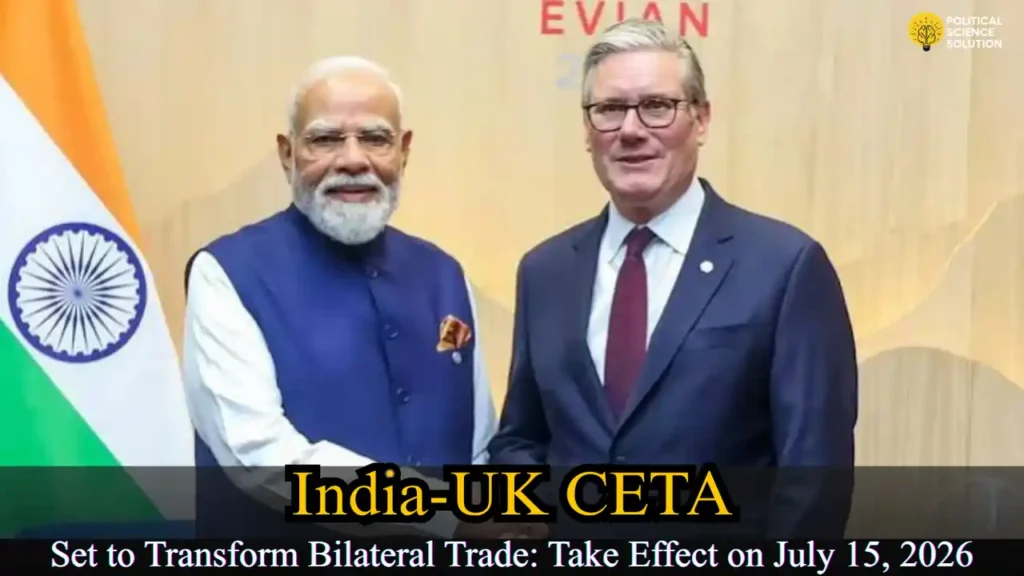
New Delhi: In a significant boost to India’s global economic outreach, the Comprehensive Economic and Trade Agreement (CETA) between India and the United Kingdom is scheduled to enter into force on July 15, 2026. This development coincides with the implementation of the Agreement on Social Security, commonly known as the Double Contribution Convention (DCC). The simultaneous rollout of these pacts represents a major milestone in India-UK relations, promising enhanced market access, streamlined mobility for professionals, and stronger economic ties aligned with India’s long-term vision of Viksit Bharat 2047.
The Ministry of Commerce and Industry confirmed the enforcement date following the completion of necessary internal procedures and ratifications by both nations. Union Minister Piyush Goyal described the move as a triumph of economic statecraft, highlighting how it dismantled barriers for Indian exporters while safeguarding domestic interests. This agreement builds on years of negotiations and strategic diplomacy, positioning both countries to navigate evolving global trade dynamics more effectively.
Background and Journey to Implementation
The foundation for deeper economic collaboration was established in 2021 with the adoption of the India-UK Roadmap 2030. This roadmap aimed to elevate bilateral ties to a Comprehensive Strategic Partnership and double trade volumes to USD 100 billion by 2030. After 14 intensive rounds of negotiations, the CETA was concluded on May 6, 2025, and formally signed on July 24, 2025, in London by Commerce Minister Piyush Goyal and his UK counterpart Jonathan Reynolds, in the presence of Prime Minister Narendra Modi and British Prime Minister Keir Starmer.
The companion Double Contribution Convention was signed later on February 10, 2026. Initial plans targeted implementation around April or early May 2026, but a last-minute hurdle emerged due to new UK regulations on steel imports announced in May 2026. These measures, effective from July 1, 2026, reduced duty-free quotas and increased tariffs on excess imports. Through intensive diplomatic engagements, including on-ground discussions by Indian officials in the UK, both sides resolved these differences, paving the way for the July 15 rollout.
Prime Minister Narendra Modi welcomed the announcement on social media, noting that the agreement would significantly boost bilateral trade and investment flows between the two nations.
Comprehensive Market Access and Tariff Eliminations
At the heart of the India-UK CETA lies substantial tariff liberalization. Indian exporters will gain immediate duty-free access for approximately 99% of tariff lines, covering nearly the entire value of current trade. This includes the complete removal of UK tariffs on several critical sectors:
- Processed food products (tariffs up to 70%)
- Marine products (up to 21.5%)
- Engineering goods and auto components (up to 18%)
- Leather and footwear (up to 16%)
- Textiles and clothing (up to 12%)
- Chemicals and pharmaceuticals (up to 8%)
These concessions are expected to inject significant pricing competitiveness into Indian manufacturing and agriculture-linked exports. Sectors such as textiles, leather, marine products, engineering, and processed foods stand to benefit immensely, enabling suppliers to reach UK consumers without tariff disadvantages.
The agreement is carefully balanced with stringent exclusion lists to protect India’s sensitive agricultural and rural economies. Products like dairy, cereals, millets, edible oils, oilseeds, apples, and certain vegetables remain safeguarded from potential import surges, ensuring stability for domestic producers.
Landmark Services Commitments and Mobility Pathways
Beyond goods, the CETA delivers one of the UK’s most expansive services packages ever extended to a partner country. It encompasses all major services sectors and 137 sub-sectors of particular interest to India, including IT and IT-enabled services (ITES), financial services, professional services, healthcare, education, engineering, telecommunications, and consultancy.
This framework provides greater regulatory certainty and market access for Indian service providers. Additionally, the agreement introduces predictable pathways for temporary mobility of professionals through categories such as Business Visitors, Intra-Corporate Transferees, Contractual Service Suppliers, Independent Professionals, and Investors.
A unique provision facilitates annual mobility opportunities for around 1,800 Indian chefs, yoga instructors, and classical musicians — a first-of-its-kind arrangement that celebrates cultural and creative exchanges alongside economic gains.
Double Contribution Convention: Relief for Indian Professionals
Parallel to the CETA, the Double Contribution Convention addresses long-standing concerns regarding social security contributions. Indian workers and employers on temporary assignments in the UK will be exempt from making dual payments. Importantly, the exemption period has been extended from the earlier three years to five years — a key win for India.
This measure is projected to benefit over 75,000 Indian professionals and more than 900 companies. It ensures continued social security coverage in India while reducing financial burdens during overseas stints, thereby enhancing the competitiveness of Indian talent in the UK market and strengthening service sector partnerships.
Resolving the Steel Trade Challenge
The resolution of steel-related issues demonstrates the collaborative spirit underpinning the agreement. The UK’s new steel measures had threatened disruptions, but both nations reached a consensus to protect commercial interests. Approximately 85% of India’s steel exports to the UK will remain outside the impact of these measures through a combination of country-specific quotas (CSQ), residual quotas, and access under the Authorised Use Scheme (AUS). This arrangement aims to minimize market volatility and maintain a stable trading environment for steel exporters.
A People-Centric Approach to Trade
Officials have emphasized the India-UK CETA as a people-centric pact designed to deliver broad-based benefits. Farmers will access premium UK markets for their produce, while fisherfolk gain from expanded seafood exports. Workers in labour-intensive industries stand to secure new employment opportunities. Women entrepreneurs, youth, startups, and Micro, Small, and Medium Enterprises (MSMEs) will enjoy better integration into global value chains.
The agreement also incorporates forward-looking elements across 30 chapters, extending beyond conventional tariff reductions. These include provisions on digital trade, telecommunications, financial services, intellectual property, government procurement, innovation, sustainability, SMEs, and transparency. Such disciplines are intended to secure critical supply chains, foster technological collaboration, and establish a modern rules-based framework for future engagements.
Broader Context of India’s Economic Diplomacy
The India-UK CETA forms part of India’s proactive strategy to forge strategic trade partnerships. Recent agreements include frameworks with the United States, the European Union, New Zealand, Oman, and others. These pacts serve as tools for advancing national interests while aligning with shared geopolitical and economic priorities.
Commerce Minister Piyush Goyal highlighted how the CETA not only expands export opportunities but also embeds protections for sensitive sectors. He stressed the importance of this “dual breakthrough” in enhancing India’s global commercial presence without compromising domestic priorities.
The Ministry of Commerce described the agreements as a structural transformation in India’s trade architecture, leveraging manufacturing strengths, service excellence, and grassroots production to tap into one of the world’s leading consumer markets.
Implications for Viksit Bharat 2047
This historic economic architecture aligns closely with India’s ambition of becoming a developed nation by 2047. By operationalizing sophisticated trade disciplines and mobility provisions, the CETA and DCC prepare both economies for the complexities of 21st-century commerce. The pacts are expected to accelerate inclusive growth, promote sustainability, and build resilience in supply chains.
Experts anticipate positive spillovers across multiple domains — from job creation in export-oriented industries to enhanced skills exchange and cultural ties. The focus on SMEs, innovation, and digital trade further positions India to capitalize on emerging opportunities in a rapidly evolving global landscape.
Looking Ahead
As the July 15, 2026, implementation date approaches, businesses on both sides are gearing up to explore new avenues. The full text of the India-UK Comprehensive Economic and Trade Agreement is available on the official Ministry of Commerce website for stakeholders seeking detailed provisions.
This agreement not only marks the culmination of sustained diplomatic efforts but also signals a new era of deeper integration between the world’s largest democracy and a key global financial hub. With tariff walls lowered, services liberalized, and mobility enhanced, the India-UK partnership is poised to deliver tangible prosperity for citizens, enterprises, and economies alike.
The successful navigation of the steel hurdle at the final stage underscores the maturity and pragmatism that have come to define bilateral negotiations. As both nations embark on this next phase, the CETA and DCC stand as testaments to the potential of collaborative economic statecraft in fostering shared growth and strategic resilience.
FAQs
Q1: When does the India-UK Comprehensive Economic and Trade Agreement (CETA) come into force, and what is the Double Contribution Convention (DCC)?
The India-UK CETA and the accompanying Agreement on Social Security (Double Contribution Convention or DCC) will both take effect on July 15, 2026. The CETA is a comprehensive trade pact that liberalizes market access for goods and services, while the DCC protects Indian workers and companies from paying social security contributions in both countries during temporary assignments in the UK. This simultaneous implementation marks a major milestone in bilateral economic relations.
Q2: What are the key tariff benefits for Indian exporters under the India-UK CETA?
Under CETA, India has secured immediate duty-free access on 99% of tariff lines, covering nearly 100% of current trade value. This eliminates UK tariffs on major export sectors including:
- Processed food products (up to 70%)
- Marine products (up to 21.5%)
- Engineering goods & auto components (up to 18%)
- Leather & footwear (up to 16%)
- Textiles & clothing (up to 12%)
- Chemicals & pharmaceuticals (up to 8%)
Sensitive Indian agricultural products such as dairy, cereals, millets, edible oils, and certain vegetables are protected through exclusion lists.
Q3: How does the CETA benefit Indian service providers and professionals?
The agreement offers one of the UK’s most ambitious services commitments, covering all major services sectors and 137 sub-sectors of interest to India (IT/ITES, financial services, professional services, healthcare, education, etc.). It also provides clear mobility pathways for Business Visitors, Intra-Corporate Transferees, Contractual Service Suppliers, Independent Professionals, and Investors. Notably, 1,800 Indian chefs, yoga instructors, and classical musicians will get dedicated annual mobility opportunities.
Q4: What changes has the Double Contribution Convention (DCC) introduced for Indian workers in the UK?
The DCC exempts Indian workers and employers from dual social security contributions during temporary UK assignments. The exemption period has been increased from 3 years to 5 years — a significant improvement. This is expected to benefit over 75,000 Indian professionals and 900+ companies, reducing costs and enhancing competitiveness of Indian talent abroad while maintaining social security coverage in India.
Q5: How was the last-minute steel trade issue resolved before CETA implementation?
A new UK steel import regulation (effective July 1, 2026) created a temporary hurdle by cutting duty-free quotas and raising tariffs. Through intensive negotiations, India and the UK reached a balanced solution protecting Indian steel exporters. 85% of India’s steel exports remain unaffected via country-specific quotas, residual quotas, and the Authorised Use Scheme (AUS). This ensured minimal market disruption and allowed the July 15 implementation date to be finalized.