
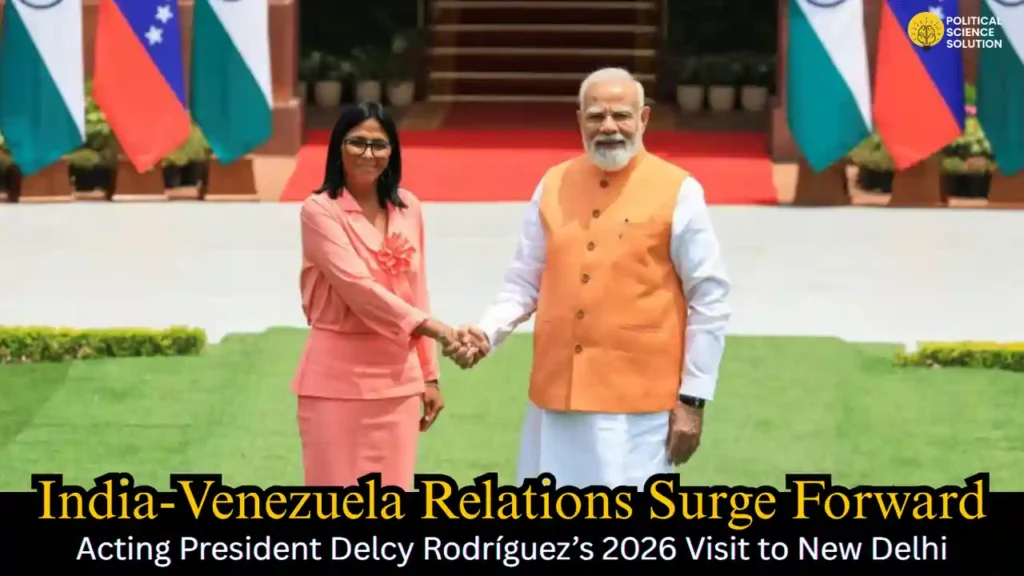
New Delhi: In a significant diplomatic engagement amid shifting global energy dynamics, Indian Prime Minister Narendra Modi held comprehensive talks with Venezuela’s Acting President Delcy Eloína Rodríguez Gómez in New Delhi. The meeting, which reviewed the entire breadth of bilateral relations, underscored the growing strategic importance of ties between the two nations, particularly in energy security and cooperation within the Global South.
This high-level visit comes at a pivotal moment for both countries. Venezuela, navigating a complex political transition following the events surrounding former President Nicolás Maduro, has positioned India as a trusted and reliable partner. For India, diversifying energy imports amid disruptions in West Asia has made Venezuelan crude oil a critical component of its energy strategy.
Strong Foundations: Bilateral Trade and Economic Ties
Bilateral trade between India and Venezuela reached US$ 678.94 million in the financial year 2025-26, with Indian exports standing at approximately US$ 210 million. Indian exports to Venezuela primarily include mineral fuels and oils, pharmaceuticals, cotton, and nuclear reactors along with machinery and mechanical appliances. In return, India imports a range of commodities from Venezuela, notably crude oil, mineral waxes, iron and steel, aluminium, vegetables, copper, lead, and zinc.
The energy partnership forms the cornerstone of this relationship. Venezuela boasts one of the world’s largest proven oil reserves, and in May 2026, it emerged as the third-largest oil supplier to India. This resurgence in oil trade reflects India’s proactive approach to securing stable and diversified energy sources, especially as global markets grapple with uncertainties caused by conflicts in West Asia, including the U.S.-Israel tensions with Iran and disruptions in the Strait of Hormuz.
Beyond economics, cultural and people-to-people connections enrich the bilateral bond. Spiritual organizations such as the Sathya Sai Organization, Brahma Kumaris, and Radha Soami Satsang have established active centers in Venezuela, fostering deeper interpersonal and cultural exchanges between the citizens of both nations.
Delcy Rodríguez’s Working Visit: A Comprehensive Review of Ties
Acting President Delcy Rodríguez arrived in India on June 3, 2026, for a five-day working visit scheduled until June 7. Accompanied by a high-level delegation that included ministers responsible for Foreign Affairs, Economy and Finance, Science and Technology, Communication and Information, and Transportation, Rodríguez engaged in extensive discussions aimed at elevating cooperation across multiple sectors.
Prime Minister Narendra Modi warmly welcomed the Venezuelan leader at Hyderabad House on June 4, describing India’s partnership with Venezuela as being of “immense importance” for the Global South. Modi emphasized expanding collaboration in energy, critical minerals, technology, agriculture, health, and people-to-people ties. “As a valued partner in Latin America, our close cooperation with Venezuela holds immense importance for the Global South. We will continue to work together for the mutual benefit of the people of our nations,” Modi stated following the meeting.
Rodríguez, who has visited India multiple times previously—including as Foreign Minister in 2015 and as Vice President in 2019, 2023, 2024, and 2025—highlighted India as “one of the main destinations” for Venezuela’s energy exports. Energy security was described as a fundamental pillar of the bilateral relationship in a statement from the Venezuelan government.
The visit also included a key meeting between Rodríguez and Union Minister for Petroleum and Natural Gas Hardeep Singh Puri. Puri announced that an Indian technical team would soon visit Venezuela to explore additional avenues for energy partnerships. Venezuelan crude has already gained prominence, ranking among the largest suppliers to India in April and May 2026. Indian public sector undertakings (PSUs) maintain existing investments in Venezuela’s energy sector and are eager to expand them while seeking new opportunities.
Energy Security at the Heart of Discussions
The timing of the visit is particularly strategic. India has ramped up imports of Venezuelan crude since early 2026 to offset supply challenges from West Asia. Historically, before U.S. sanctions in 2019 disrupted flows, Venezuela was India’s fifth-largest oil supplier, contributing significantly to bilateral trade that peaked near $6.4 billion in 2019-20. Indian refiners, including Reliance Industries, have shown renewed interest following the easing of certain restrictions.
Discussions focused on forging a robust energy partnership that goes beyond short-term supplies to include long-term investments, downstream collaboration in petrochemicals, fuel-processing technologies, and renewable energy initiatives. ONGC Videsh Limited (OVL) already holds a 40 percent stake in the joint venture Petrolera Indovenezolana SA with Corporacion Venezolana del Petroleo (CVP) for oil production and exploration in the San Cristobal field.
External Affairs Ministry Secretary (East) Rudrendra Tandon noted the perfect complementarity between the two economies: Venezuela’s vast oil reserves align with India’s growing and stable demand for energy. No formal government-to-government energy agreement was signed during this visit, but conversations laid the groundwork for an enhanced “energy relationship.” Rodríguez was also expected to interact with private sector oil majors.
The delegation’s itinerary included visits to energy, pharmaceutical, and automobile sector sites across India, including a trip to Gujarat, providing firsthand exposure to Indian technological and industrial capabilities. Rodríguez, a devotee of the late spiritual leader Sathya Sai Baba, planned a visit to the Sathya Sai Baba Ashram, further blending diplomatic and cultural dimensions.
Political Transition and Diplomatic Nuance
The engagement occurs against the backdrop of Venezuela’s ongoing political transition after the U.S. military action in January that led to the detention of President Nicolás Maduro. India has adopted a measured diplomatic approach, referring to Rodríguez as “Acting President” while maintaining constructive engagement with the friendly government in Caracas.
Officials described frank conversations on Venezuela’s political situation during official talks and the subsequent working lunch. Tandon emphasized that India views the current Venezuelan leadership as one interested in deepening partnership, reciprocating the warmth traditionally shared between the two nations. Both sides collaborate closely not only bilaterally but also at multilateral forums, reinforcing their shared commitment to the Global South.
The 65th anniversary of diplomatic relations, celebrated in 2024, provided additional context for strengthening these longstanding bonds. The visit, originally linked to the deferred International Big Cats Alliance Summit, successfully pivoted to substantive bilateral discussions.
Expanding Horizons: Pharmaceuticals, Technology, and Beyond
While energy dominated the agenda, the talks covered a full spectrum of cooperation areas. Pharmaceuticals and healthcare emerged as promising sectors where India’s expertise in manufacturing and technology can support Venezuela’s needs. Trade and investment, transportation, agriculture, critical minerals, and renewable energy were also highlighted as avenues for mutual growth.
The Venezuelan press release described the bilateral relationship as being in an “excellent state” and focused on strengthening both nations’ roles in the geopolitical context of the Global South through mutually beneficial macroeconomic agreements. A comprehensive review of the mutual cooperation map was undertaken, setting the stage for concrete outcomes.
Indian companies are keen to build upon historical investments while exploring newer frontiers. The visit is expected to produce a roadmap for deeper engagement, potentially reviving commercial links that were impacted by earlier sanctions and global events.
Cultural and Spiritual Bridges
The people-to-people dimension received attention through the presence of Indian spiritual organizations in Venezuela. Rodríguez’s personal connection to the Sathya Sai Baba movement adds a unique layer to the diplomatic engagement, illustrating how soft power complements hard economic interests.
Looking Ahead: Strategic Implications for Both Nations
As global energy markets remain volatile due to the Iran-related conflicts and other geopolitical shifts, the India-Venezuela partnership offers a model of South-South cooperation. For India, securing reliable oil supplies supports economic growth and energy security. For Venezuela, access to Indian markets, technology, and investments aids economic transformation during its political transition.
Observers anticipate that this visit will translate into expanded Indian investments in Venezuelan energy assets, increased crude shipments, and new collaborations in pharmaceuticals, renewables, and technology transfer. The forward-looking approach of the Indian government, as articulated by Minister Puri and Secretary Tandon, signals confidence in building resilient and multifaceted ties.
The delegation-level talks at Hyderabad House, followed by sector-specific meetings, demonstrated the seriousness with which both sides approach this relationship. With Rodríguez’s extensive prior experience engaging with India, continuity and momentum are assured.
Conclusion: A Promising Chapter in Bilateral Relations
The successful visit of Acting President Delcy Rodríguez marks another milestone in India-Venezuela relations. By focusing on energy complementarity, trade diversification, technological collaboration, and shared global aspirations, both nations are positioning themselves to navigate an increasingly complex international landscape.
As India seeks to bolster its energy security and Venezuela pursues economic stabilization and partnerships, the foundation laid during these discussions promises substantial mutual benefits. The emphasis on the Global South further elevates this relationship beyond bilateral gains to a broader vision of solidarity among developing nations.
This engagement not only revives historical oil ties but also opens new doors for comprehensive cooperation. With technical teams set to travel, private sector interactions underway, and high-level political commitment evident, India and Venezuela are charting a course toward a more robust and dynamic partnership in the years ahead.
FAQs
Q1: What is the significance of Acting President Delcy Rodríguez’s visit to India in June 2026?
A: Acting President Delcy Eloína Rodríguez Gómez’s five-day working visit (June 3–7, 2026) is aimed at strengthening bilateral ties across energy, trade, investment, pharmaceuticals, healthcare, transportation, renewable energy, and technology. The visit includes high-level meetings with Prime Minister Narendra Modi and key ministers, site visits to Indian energy, pharma, and auto facilities, and discussions on deeper cooperation within the Global South. It comes at a critical time as India diversifies its crude oil imports amid West Asia tensions and Venezuela undergoes political and economic transformation.
Q2: How important is energy cooperation in current India-Venezuela relations?
A: Energy partnership is the cornerstone of bilateral ties. Venezuela, with one of the world’s largest proven oil reserves, emerged as India’s 3rd largest oil supplier in May 2026. Bilateral trade stood at US$ 678.94 million in FY 2025-26. Indian PSUs like ONGC Videsh Limited already have investments (40% stake in Petrolera Indovenezolana SA in the San Cristobal field), and an Indian technical team is scheduled to visit Venezuela soon to explore further opportunities. Discussions also cover long-term crude supply security, petrochemicals, fuel processing, and renewable energy collaboration.
Q3: What are the main items in India-Venezuela bilateral trade?
A: In FY 2025-26, India exported goods worth around US$ 210 million, primarily mineral fuels & oils, pharmaceuticals, cotton, nuclear reactors, and machinery. India’s imports from Venezuela include crude oil, mineral waxes, iron & steel, aluminium, vegetables, copper, lead, and zinc. Before 2019 sanctions, Venezuela was India’s 5th largest oil supplier with bilateral trade peaking near $6.4 billion in 2019-20. Trade has resumed strongly in 2026 following geopolitical disruptions in the Strait of Hormuz.
Q4: What is the current political context of Venezuela and how is India responding?
A: Venezuela is in a political transition following the U.S. military action in January 2026 that led to the detention of President Nicolás Maduro. India has engaged constructively with the Acting President Delcy Rodríguez, referring to her in that capacity while maintaining warm and friendly relations. Indian officials held frank discussions on the situation during the visit and view the current leadership as keen on partnership with India. Both countries continue close collaboration at multilateral forums and emphasize shared Global South objectives.
Q5: Are there strong cultural and people-to-people ties between India and Venezuela?
A: Yes. Several Indian spiritual organizations, including the Sathya Sai Organization, Brahma Kumaris, and Radha Soami Satsang, have established centers in Venezuela. Acting President Delcy Rodríguez, a devotee of Sathya Sai Baba, is expected to visit the Sathya Sai Baba Ashram during her trip to India. These cultural links complement the strong diplomatic, economic, and energy partnerships, adding a soft-power dimension to the bilateral relationship.