

New Delhi: In the bustling Malviya Nagar area of South Delhi, a devastating fire ripped through a multi-storey building operating as a bed-and-breakfast on June 3, 2026, claiming at least 21 lives, including 11 foreign nationals primarily from Central Asia and Africa. More than 40 others were rescued and hospitalized, with officials warning the toll could rise. Preliminary investigations point to a short circuit as the likely trigger, though electrical systems remain under scrutiny. This incident is not an anomaly but the latest chapter in a grim pattern of preventable fire disasters plaguing Indian cities.
Fire hazards have long been flagged as a critical risk. The United Nations Global Assessment Report 2018 highlighted fire as one of the major threats. Beyond flames, fires deplete oxygen leading to asphyxiation, release toxic gases that choke the lungs, and can cause explosions. Nationally, the National Crime Records Bureau (NCRB) documented 5,888 fire-related deaths in 2024 alone. Residential areas bear the heaviest burden of fatalities, underscoring deep-rooted vulnerabilities in urban planning and safety enforcement.
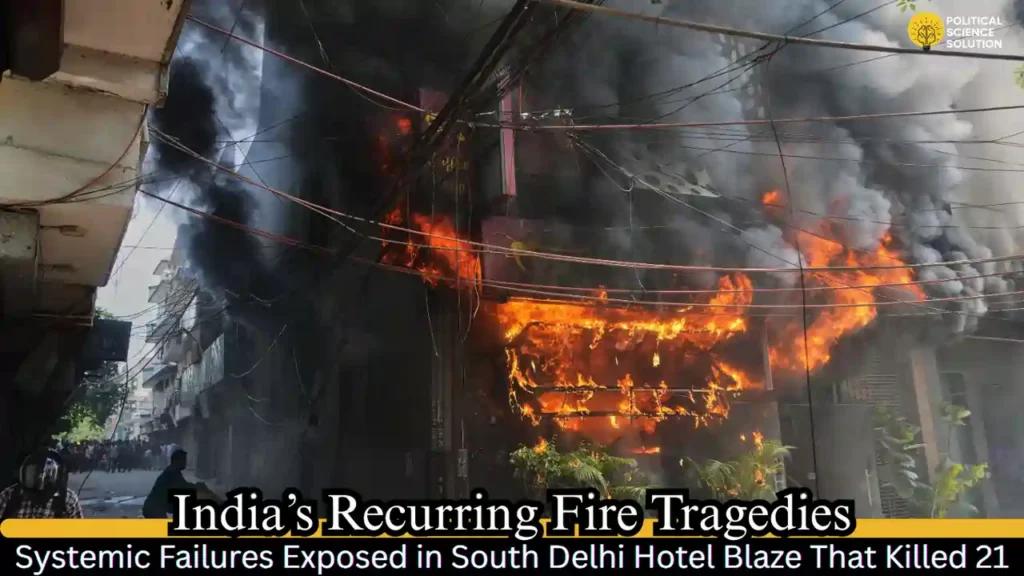
The South Delhi Incident and Immediate Aftermath
The building in Malviya Nagar, functioning as a bed-and-breakfast catering to patients and attendants at a nearby private hospital, was originally residential but underwent extensive unauthorized modifications. Reports indicate missing fire safety clearances, illegal structural additions, and inadequate compliance with building norms. Police secured the site as investigations continued, with the owner allegedly fleeing. Local residents played a crucial role in rescues, including aiding a foreign national.
This tragedy echoes similar recent events:
- June 4, 2026, Bihar ICU Fire: A suspected short circuit in a private hospital in Muzaffarpur killed four patients.
- May 3, 2026, Delhi Vivek Vihar Residential Fire: Short circuit in an air-conditioning unit claimed nine lives and injured four.
- March 18, 2026, Delhi Palam Building Fire: Short circuit in a ground-floor shop led to nine deaths.
- March 16, 2026, Odisha Hospital ICU Fire: Short circuit in the Trauma Care ICU of SCB Medical College, Cuttack, killed at least ten patients.
The list of such incidents across hospitals, hotels, and residential buildings reveals a recurring cycle driven by missing clearances, faulty wiring, unauthorized constructions, and lax enforcement.
Comparison with Goa’s Romeo Lane Nightclub Tragedy
The Delhi hotel fire shares parallels with the December 6, 2025, blaze at Birch by Romeo Lane nightclub in Arpora, North Goa, which killed 25 people (20 staff and 5 tourists). Both involved major safety lapses and high casualties, but differed in context. In Delhi, the blaze started in the basement restaurant or kitchen of a converted residential structure. In Goa, fireworks or a cylinder explosion during a late-night party intensified the fire in a venue lacking emergency exits and clearances, hampered further by its narrow lane location.
Regulatory violations were central in both: illegal additions and missing approvals in Delhi; absent safety clearances in Goa. Legal fallout saw owners fleeing—pursued in Delhi, deported from Thailand in Goa—and facing charges like culpable homicide and negligence. A striking detail from Goa: a belly dancer reportedly continued performing amid the chaos.
Why Fire Incidents Persist in India: Deep-Rooted Systemic Issues
India’s urban fire safety gaps stem from poor compliance with building by-laws, weak enforcement, and low safety awareness. Rapid urbanization, socio-economic pressures, and political complicity enable illegal constructions, including encroachments and fire safety violations. The Observer Research Foundation notes uneven enforcement influenced by local pressures and corruption, fostering a “violate first, comply later” culture through regularizations and penalties that lack deterrence.
Common lapses across tragedies include:
- Blocked or locked exits, obstructed emergency staircases with goods or furniture.
- Poor electrical maintenance: faulty wiring, overloaded circuits, uninspected transformers.
- Absent or non-functional fire systems: smoke detectors, alarms, sprinklers with dead batteries.
- Lack of valid Fire Safety NOCs and National Building Code (NBC) violations.
- Unsafe storage of flammables like gas cylinders near heat sources.
- Inadequate emergency preparedness: missing signage, drills, and training leading to panic.
Investigations consistently highlight these patterns rather than isolated failures.
Fire Safety Regulations and Institutional Framework in India
Fire services are a state subject under Article 243W and the Twelfth Schedule of the Constitution, assigned to Urban Local Bodies. States have their own Fire Service Acts, supplemented by the National Building Code (NBC) 2016 from the Bureau of Indian Standards (BIS), which covers fire prevention, safe design, evacuation norms, and protection systems.
Key institutions include:
- National Disaster Management Authority (NDMA): Issues guidelines for strengthening fire services, modernization, and capacity building.
- Standing Fire Advisory Council (SFAC): Apex body under the Ministry of Home Affairs, advising on standards for stations, equipment, manpower, and training.
- Scheme for Expansion and Modernization of Fire Services: Home Ministry initiative based on 15th Finance Commission recommendations.
Despite this, gaps persist: weak training, inadequate equipment and funding, low awareness, irregular drills, and non-uniform laws. Response times ideally 3-5 minutes in cities (up to 20 in rural areas) are undermined by massive shortages—97% in fire stations, 80% in vehicles, 96% in personnel.
Model Building Byelaws 2003 mandate Fire Safety NOC from the Chief Fire Officer for occupancy certificates.
Shared Responsibility: Beyond Government Accountability
While authorities bear primary enforcement responsibility, experts emphasize individual vigilance. Travelers and guests should check emergency exits, evacuation maps, assembly points, room locks, deadbolts, and window operability upon arrival. In public spaces, alertness to hazards is crucial.
If trapped with blocked routes:
- Stay in the room, close the door.
- Seal gaps with wet towels or clothing to block smoke.
- Open a window slightly for fresh air if safe.
- Signal for help with cloth, flashlight, or phone.
- Call emergency services with exact location.
What to avoid: Panic, returning for belongings, using lifts, toggling electrical switches, or jumping from heights without protection.
Learning from Global Best Practices
Countries minimizing fire tragedies enforce strict codes, early detection, suppression systems, regular inspections, and rapid evacuation. Key elements include compartmentation with fire-resistant materials, sprinklers, smoke alarms, real-time monitoring (e.g., Dubai), performance-based engineering (EU, Australia), mandatory drills (Japan), and strong penalties (Singapore).
Examples:
- UK: Post-Grenfell fire risk checks and upgrades.
- US: NFPA standards emphasizing sprinklers, alarms, drills.
- Japan and Germany: Fire-resistant design and compartmentalization.
Strong laws, enforcement, built-in systems, and preparedness form the universal core.
Delhi’s Persistent Struggle: From Karol Bagh to Hauz Rani
Delhi has witnessed repeated disasters:
- February 2019, Hotel Arpit Palace, Karol Bagh: 17 dead; locked exits, combustible materials, short circuit suspected.
- December 2019, Anaj Mandi Factory: 43 dead (including minors); illegal units, single narrow exit, smoke inhalation primary cause.
- May 2022, Mundka Commercial Building: 27 dead; no clearances or extinguishers, delayed fire service response.
- March 2025, Bikkgane Biryani, Connaught Place: LPG leak injured six severely.
Post-Kamala Mills (Mumbai, 2017) inspections in Delhi revealed widespread violations, yet patterns persist: illegal basements, blocked exits, missing NOCs, overloaded wiring, poor ventilation.
Commercial kitchens heighten risks with open flames, high-heat equipment, LPG, and oils. NFPA data (US context) shows cooking equipment causing over 60% of such fires globally relevant due to shared dynamics. Basements exacerbate smoke accumulation, the leading killer.
The Path Forward: Urgent Reforms Needed
These tragedies demand accountability, stricter enforcement, capacity building for fire services, mandatory compliance, regular audits, and public awareness campaigns. Urban bodies must address capacity constraints and political interference. Individuals, while not substitutes for systemic fixes, must prioritize personal safety checks.
As India urbanizes rapidly, bridging the gap between regulations and reality is imperative to prevent “Tarikh pe Tarikh” recurring disasters. The Malviya Nagar fire is a stark reminder: lives lost to negligence are preventable. Comprehensive modernization, uniform standards, and zero-tolerance enforcement could safeguard citizens and visitors alike.
FAQs
4. What should I do if I am trapped in a building during a fire?
Common lapses include:
- Blocked or locked emergency exits and staircases
- Faulty or overloaded electrical wiring and circuits
- Absence or malfunction of fire alarms, smoke detectors, and sprinklers
- Lack of valid fire safety certificates (NOCs)
- Illegal structural modifications and unauthorized constructions
- Poor storage of LPG cylinders and other flammables
- Inadequate emergency signage, evacuation plans, and staff training
These violations have been repeatedly documented in investigations of major fires in Delhi, Bihar, Odisha, and other states.
1. What caused the South Delhi Malviya Nagar hotel fire on June 3, 2026?
The fire that killed 21 people, including 11 foreign nationals, in a bed-and-breakfast operating from a converted residential building in Malviya Nagar, South Delhi, was prima facie caused by a suspected short circuit, likely originating from the basement restaurant or kitchen area. The building had undergone extensive unauthorized modifications, lacked valid fire safety clearances, and reportedly violated multiple building norms. This incident follows a pattern seen in several recent Delhi fires where faulty electrical systems played a major role.
2. Why do fire tragedies keep recurring in Indian cities like Delhi?
Fire incidents recur due to systemic failures including poor enforcement of building by-laws, widespread illegal constructions, missing or invalid Fire Safety NOCs, blocked emergency exits, non-functional fire safety equipment (smoke detectors, sprinklers), poor electrical maintenance, and unsafe storage of flammable materials. Weak institutional capacity, political interference, rapid urbanization, and a “violate first, comply later” culture further exacerbate the problem. Despite existing laws like the National Building Code 2016, compliance and accountability remain major challenges.
3. What are the major fire safety lapses commonly found in Indian hotels, hospitals, and residential buildings?
Common lapses include:
- Blocked or locked emergency exits and staircases
- Faulty or overloaded electrical wiring and circuits
- Absence or malfunction of fire alarms, smoke detectors, and sprinklers
- Lack of valid fire safety certificates (NOCs)
- Illegal structural modifications and unauthorized constructions
- Poor storage of LPG cylinders and other flammables
- Inadequate emergency signage, evacuation plans, and staff training
These violations have been repeatedly documented in investigations of major fires in Delhi, Bihar, Odisha, and other states.
4. What should I do if I am trapped in a building during a fire?
If all escape routes are blocked:
- Stay calm and remain in your room. Close the door and seal gaps around doors, windows, and vents with wet towels, sheets, or clothing to block smoke.
- If possible, open a window slightly for fresh air.
- Signal for help by waving a bright cloth or using your phone’s flashlight from the window.
- Call emergency services (fire brigade/police) immediately and provide your exact location. Avoid using lifts, going back for belongings, switching electrical appliances, or jumping from high windows unless it is the only last-resort option.
5. Who is responsible for fire safety in hotels and public buildings in India — the government or individuals?
Fire safety is a shared responsibility. The government and local authorities (Municipalities, Fire Services, NDMA) are primarily responsible for enforcing the National Building Code 2016, issuing NOCs, conducting inspections, and maintaining fire infrastructure. However, hotel owners/operators must ensure compliance, while guests and visitors should practice personal vigilance — checking emergency exits, evacuation maps, and room safety features upon arrival. Experts recommend combining strong systemic enforcement with individual awareness to prevent tragedies.