

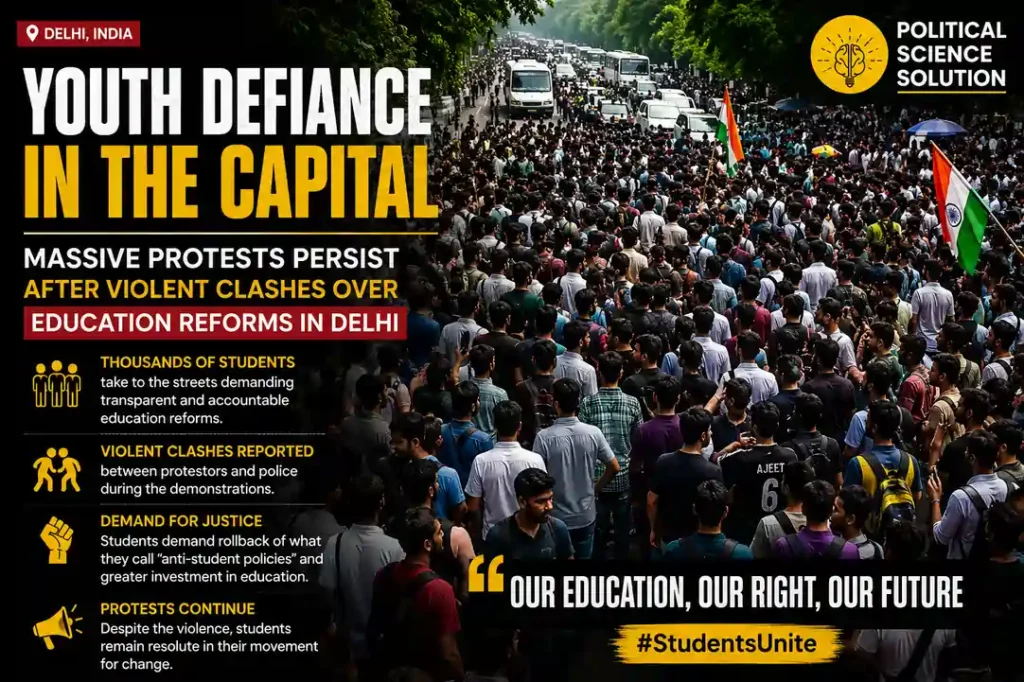
New Delhi, July 21, 2026 — One day after security forces unleashed a heavy-handed operation against demonstrators, thousands of young Indians once again filled the grounds of Jantar Mantar, refusing to let their call for education reform fade amid batons and tear gas. The Cockroach Janta Party (CJP), a vibrant youth-driven initiative, has transformed a spark of satire into a sustained national movement demanding accountability from the highest levels of government.
Origins of the Cockroach Janta Party Movement
The protests center on long-standing grievances within India’s education sector, particularly the mishandling of competitive examinations that shape the futures of millions. At the heart of the current unrest lies the National Eligibility cum Entrance Test (NEET) controversy. Nearly 2.28 million aspirants sat for the medical entrance examination on May 3, only for authorities to cancel the test shortly afterward following widespread reports of a question paper leak. A re-examination took place weeks later, but the fallout proved tragic. Families reported that more than 20 students took their own lives, devastated by the scandal’s disruption and perceived injustice.
This anger coalesced around the CJP, which draws its unusual name from remarks made earlier this year by the Chief Justice of India. During a public observation, the judge likened certain unemployed young people entering journalism and activism to “cockroaches.” He later clarified that the comment referred specifically to individuals holding questionable or fabricated degrees. Rather than silencing criticism, the statement galvanized a generation already frustrated with systemic barriers.
Abhijeet Dipke, the founder of the CJP, and his supporters established a prolonged sit-in at Jantar Mantar, a historic site in central Delhi long associated with public demonstrations. The movement gained significant traction when Sonam Wangchuk, the respected Ladakh activist known for his work on climate issues and education, arrived on June 28 and began an indefinite hunger strike in solidarity. Wangchuk’s involvement elevated the protest’s profile, attracting attention from across the country and beyond.
The Violent Events of July 20
Tensions reached a boiling point on July 20 as the Monsoon Session of Parliament commenced. Organizers called for a march toward the legislative complex, drawing tens of thousands of participants—primarily young men and women—who traveled independently from various states. Defying restrictions on large gatherings, the crowd attempted to advance despite police barricades.
What followed was a chaotic and violent confrontation. Security personnel, including uniformed officers and plainclothes individuals with masked faces, moved aggressively to disperse the assembly. Eyewitnesses described scenes of panic as protesters fled baton charges and tear gas volleys. At least 60 demonstrators sustained injuries, ranging from head wounds requiring immediate bandaging by volunteer doctors to broken limbs. Reports emerged of women being struck, with one particularly troubling allegation involving Gitanjali Angmo, Sonam Wangchuk’s wife, who was reportedly pulled by her hair and assaulted while representing her husband at the march. CJP spokespersons also claimed a 12-year-old girl suffered a head injury and that dozens of others endured similar trauma.
Authorities offered a starkly different account. Delhi Police stated that 118 of their personnel were injured during the unrest. They reported detaining 70 protesters and accused the crowd of aggressive behavior, including hurling stones and other objects, attempting to breach barricades, vandalizing official vehicles, and damaging public property. Senior officers maintained that repeated loudspeaker warnings had been issued urging dispersal, emphasizing that prohibitory orders under relevant legal provisions were in effect across the district to safeguard Parliament and maintain order during the session.
As the crackdown unfolded, police dismantled the main stage and temporary shelters at Jantar Mantar. The operation coincided with a brief meeting between CJP representatives and Union Health Minister JP Nadda. The minister described the discussion as cordial and requested that protesters cooperate in restoring normalcy. However, participants characterized the four-hour wait and 10-minute interaction as disappointing, yielding only vague promises without firm commitments.
Aftermath and Reclamation of the Protest Site
By evening, with internet services reportedly restored in the area, videos of the clashes spread rapidly across social media platforms. These visuals appeared to show security forces striking protesters, including instances of individuals lying on the ground. In response, the CJP hardened its position. Supporters reclaimed the protest site and posted messages asserting that the peaceful agitation would not end. “Despite the police brutality, the brave protestors of CJP are back,” one statement declared, calling on residents of Delhi to join what they framed as a “now or never” moment.
Abhijeet Dipke publicly apologized to supporters, especially young women who faced violence from male officers, acknowledging that more could have been done to protect them. He mentioned visiting a critically injured female protester in the hospital. The group urged injured supporters and those needing legal assistance to reach out.
Opposition Reactions and Political Criticism
The government has so far refrained from detailed public comment on the use of force. Opposition parties, however, have been vocal in their criticism. Rahul Gandhi, the Leader of Opposition, led a group of Congress parliamentarians in a march to Prime Minister Narendra Modi’s residence on Tuesday, seeking explanations for the previous day’s events. Gandhi described the students’ demands as entirely legitimate and characterized the Prime Minister as perhaps the most anti-youth leader in India’s history. On social media, he called for both Modi and Home Minister Amit Shah—who oversees Delhi Police—to take responsibility and resign, accusing the administration of evading parliamentary debate on issues affecting the nation’s youth.
The CJP has received endorsements from a wide spectrum of voices, including major opposition parties, farmer organizations, social activists, and figures from the entertainment industry. This broad support underscores the protest’s resonance beyond any single political affiliation.
Political Analysis and Implications
In a thoughtful analysis published shortly after the clashes, senior journalist Harish Khare suggested that July 20 represented a significant crossing of political boundaries. He pointed to the abrupt replacement of the Delhi Police Commissioner on July 17—barely 11 months into his tenure—as potentially linked to internal frustrations over the handling of Wangchuk’s hunger strike rather than isolated corruption issues. Khare argued that the Home Ministry may have underestimated the depth of public discontent and overestimated its control over public spaces. The resulting police action, in his view, reflected an attempt to regain narrative dominance but instead exposed vulnerabilities in the ruling establishment’s approach to dissent.
Khare recalled how the current dispensation has historically worked to limit opposition expressions on the streets, viewing such gatherings as potential threats. The large turnout on July 20, which some newspapers hailed as the biggest demonstration near Parliament in 14 years, shattered that sense of unchallenged authority. He warned that the events could create lasting unease among those in power, particularly as young participants channeled personal frustrations into collective action. This, he noted, might impact future political calculations, including prospects within the ruling coalition.
Current Status and Broader Significance
Despite the violence, the CJP leadership continues to reject police characterizations of the protest as violent. As the protests enter another day, central Delhi remains on edge. Heavy security presence persists around key government areas, while Jantar Mantar once again buzzes with determination. Organizers insist their movement is not merely reactive but seeks a fundamental conversation about the future of education in the country.
The standoff highlights deeper challenges facing India’s young population. With aspirations for quality education and stable careers often thwarted by leaks, irregularities, and perceived favoritism, many see the current system as failing its most ambitious citizens. The NEET episode has become emblematic of these failures, amplifying calls for structural changes that go beyond individual ministerial accountability.
Prime Minister Modi and his senior colleagues now face the task of addressing this groundswell of youth discontent at a time when the ruling party has long projected an image of strong governance and popular support. How the administration responds—whether through engagement, further restrictions, or policy adjustments—may shape political dynamics for months to come.
The CJP’s ability to sustain momentum after such a forceful crackdown suggests that the frustrations of India’s youth cannot be easily dispersed. For now, the tents remain pitched, the slogans echo, and the demand for change grows louder with each passing hour.
FAQs
1. What is the Cockroach Janta Party (CJP) and why is it protesting?
The Cockroach Janta Party (CJP) is a youth-led satirical political movement that emerged after India’s Chief Justice used the term “cockroach” to describe unemployed youth turning to journalism and activism. The movement evolved into a serious campaign demanding major education reforms, stricter action against exam paper leaks, and the resignation of Union Education Minister Dharmendra Pradhan. Protesters, who have been camping at Jantar Mantar in Delhi for over a month, highlight systemic failures in competitive exams like NEET and the lack of accountability following scandals that affected millions of students.
2. What happened during the July 20, 2026 police crackdown in Delhi?
On July 20, tens of thousands of CJP supporters tried to march toward Parliament, defying prohibitory orders. Police used batons (lathi charge), tear gas, and forceful dispersal, injuring at least 60 protesters. Reports include head injuries, broken bones, and allegations that women and even a 12-year-old girl were assaulted. Police claimed 118 personnel were injured, detained 70 protesters, and accused demonstrators of stone pelting and vandalism. The stage and tents at Jantar Mantar were dismantled. Protesters reclaimed the site by evening and vowed to continue the agitation.
3. Who is Sonam Wangchuk and what is his role in the protests?
Sonam Wangchuk, a noted Ladakh-based climate activist and educationist, joined the CJP protest on June 28, 2026, and began an indefinite hunger strike supporting the demands for education reform. He was forcibly removed by police on Saturday and hospitalized, where he continues fasting. His wife, Gitanjali Angmo, was reportedly assaulted during the July 20 events while representing him. Wangchuk’s participation has significantly boosted the movement’s visibility and drawn support from opposition parties and celebrities.
4. How have political leaders and the government responded to the CJP protests?
Opposition leaders, including Rahul Gandhi, strongly condemned the police violence, calling the students’ demands legitimate and describing PM Modi as anti-youth. Gandhi led a march to the PM’s residence demanding accountability and resignations. The government’s response has been limited — Health Minister JP Nadda met CJP leaders but offered no concrete assurances. Police defended their actions citing law and order needs during the Monsoon Session. The ruling BJP has dismissed the protests as disruptive, while analysts suggest the events reflect miscalculations by the Home Ministry under Amit Shah.
5. What are the main demands of the protesters and what is the current status?
The primary demands include overhauling India’s education system, accountability for the NEET-2026 paper leak (which led to the exam cancellation and over 20 student suicides), and Dharmendra Pradhan’s resignation. Protesters also seek an end to police brutality and genuine dialogue. As of July 21, 2026, the peaceful protest continues at Jantar Mantar despite the previous day’s crackdown. CJP leaders have called for nationwide support, stating “this is now or never.” The movement remains active with calls for more participants to join in Delhi.