
New Delhi: The 18th BRICS Summit took place in New Delhi on 12 and 13 September 2026 under India’s chairship, drawing leaders and senior representatives from the 11-member grouping to Bharat Mandapam. The two-day event produced the New Delhi Declaration, a set of practical frameworks on resilience and innovation, extensive bilateral engagements led by Prime Minister Narendra Modi, and repeated affirmation of BRICS as a platform for the Global South. The summit theme, “Building for Resilience, Innovation, Cooperation and Sustainability,” guided discussions against a backdrop of geopolitical tension in West Asia, the continuing Ukraine conflict, and debates over unilateral trade measures.
BRICS now comprises Brazil, Russia, India, China, South Africa, Egypt, Ethiopia, Iran, the United Arab Emirates, Saudi Arabia and Indonesia. Collectively the members represent nearly half the world’s population and approximately 40 percent of global GDP. Indian officials stressed throughout that the grouping is not directed against any country but seeks greater voice and agency for emerging economies in global institutions.
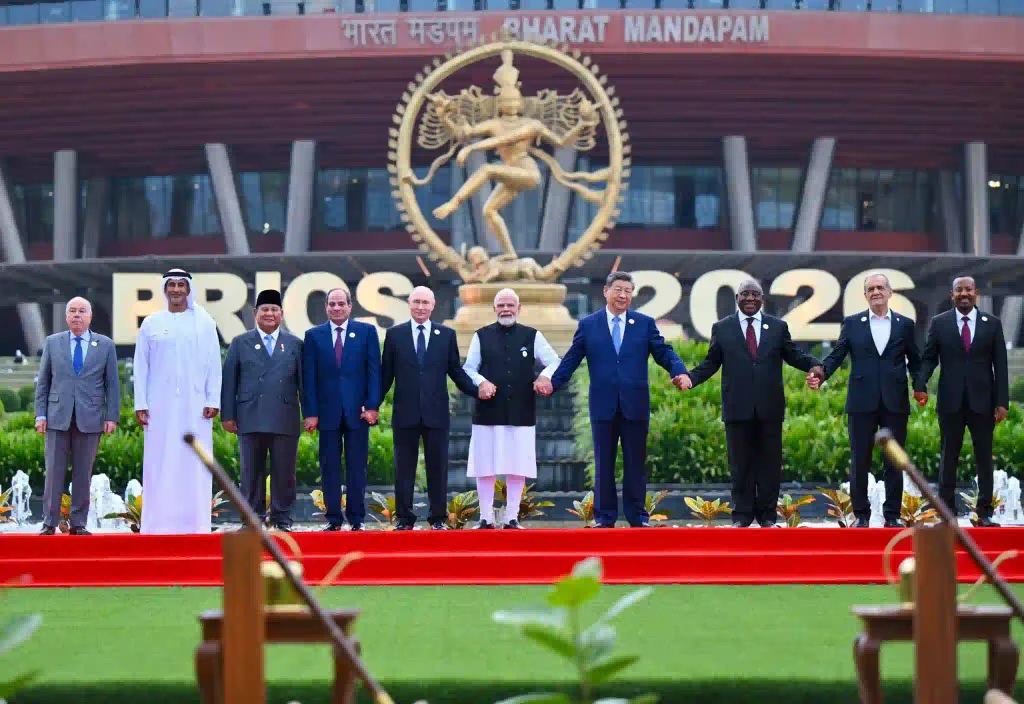
Day 1: Adoption of the New Delhi Declaration
On 12 September the leaders adopted the New Delhi Declaration despite recognised differences, particularly over the conflict involving Iran and the war in Ukraine. The text expressed deep concern over continued escalation of tensions in the Middle East and called for maximum restraint. It deliberately avoided naming the United States, Israel, Iran or any Gulf state. Language on deliberate attacks on civilian infrastructure and peaceful nuclear facilities under International Atomic Energy Agency safeguards was retained, offering an indirect reference to earlier strikes on Iranian sites.
On Ukraine the declaration limited itself to a general call for international disputes to be resolved through dialogue, consultation and diplomacy. It did, however, criticise unilateral sanctions not authorised by the United Nations Security Council, a formulation of clear importance to Russia.
Palestine received more explicit treatment. The declaration stated firm opposition to forced displacement of Palestinians and to any attempt to change the geography or demography of the occupied Palestinian territory. It called for an end to the war in Gaza, unhindered humanitarian access, continued support for UNRWA, and full United Nations membership for Palestine. Leaders reaffirmed support for a two-state solution based on the 1967 borders with East Jerusalem as the capital of a sovereign Palestinian state.
The document also raised concern over unilateral tariff and non-tariff measures that distort trade, opposed sanctions lacking Security Council authorisation, and reiterated commitment to multipolarity and reform of global institutions including the UN Security Council and the Bretton Woods system. It welcomed the Guwahati Declaration of BRICS anti-drug agencies, endorsed the International Big Cat Alliance, and gave fresh impetus to cooperation in Traditional, Complementary and Integrative Medicine.
Diplomats and observers described the adoption of a 140-paragraph consensus document as a significant achievement. Oman’s Ambassador to India, Issa Alshibani, said India had once again demonstrated its ability to bring multiple countries to agreement, noting that many had doubted a declaration would emerge. South African President Cyril Ramaphosa later praised the Indian organisation of more than 350 meetings across 30 cities. Assam Chief Minister Himanta Biswa Sarma and BSP leader Mayawati both described the outcome as evidence of pragmatic and inclusive Indian leadership.
India’s four-pillar agenda and concrete frameworks
Prime Minister Modi framed the entire summit around four pillars: resilience, innovation, cooperation and sustainability. On the second day he stated that rising global tensions were producing widespread negative effects on ordinary people and that pandemics, climate disasters and supply-chain disruptions had demonstrated that no crisis remains confined to one region.
Consensus was therefore reached on a BRICS Integrated Early Warning System for the prevention of and response to infectious diseases. Early Warning Data Integration Guidelines were formulated for disaster management. The BRICS Logistics Supply Chain Cooperation Framework was established to improve reliability and resilience. The BRICS Incubator Network will connect startups and incubators across member states, while a proposed BRICS Startup Innovation Fund will support scalable solutions. The BRICS Network on Digital Agriculture will deploy artificial intelligence, geospatial technology and digital public infrastructure to address farmers’ needs.
Modi warned against the weaponisation of technology and critical minerals, arguing that such practices could hinder shared progress. He highlighted the contribution of the BRICS Business Council to the development of member economies and noted that the Global South’s confidence in BRICS had increased because voices were heard and solutions were crafted with, rather than merely for, developing countries. He described BRICS as having reached a “coming of age” moment and called for the “pyramid of privilege” to become a “platform of partnership.”
Chinese and Russian contributions
Chinese President Xi Jinping addressed the second session and advanced five initiatives aimed at deepening ties with emerging markets, maintaining open and mutually beneficial cooperation, safeguarding industrial and supply chains, and building a large integrated market. He proposed that China lead the creation of an open-source artificial-intelligence zone for BRICS countries and support cooperation on large language models. Xi rejected the logic of “might makes right,” stating that international rules must be written by all countries and that Global South nations should jointly defend sovereign equality, non-interference and peaceful settlement of disputes. He thanked Modi for hosting the summit before departing Delhi.
Russian President Vladimir Putin proposed a new insurance mechanism and a collaborative grain-market initiative among BRICS members. He noted that the New Development Bank was handling projects worth 140 billion dollars and stressed that the grouping possessed independent routes for capital, labour and technology. Kremlin spokesman Dmitry Peskov later confirmed that both Modi and Xi had offered their services to facilitate peace talks on Ukraine and that Putin had welcomed the readiness.
Extensive bilateral diplomacy
Across both days Modi conducted a dense schedule of bilateral meetings. On the final day alone he held talks with Kazakhstan President Kassym-Jomart Tokayev covering political, trade, defence, connectivity, energy, critical minerals and emerging technologies; with Egyptian President Abdel Fattah El-Sisi; with South African President Cyril Ramaphosa, during which he invited South Africa to join the International Big Cat Alliance; with Philippines President Ferdinand R. Marcos Jr., advancing the Strategic Partnership established in 2025 and welcoming Manila’s decision to join the Coalition for Disaster Resilient Infrastructure; with Uganda Vice President Jessica Rose Epel Alupo, reaffirming support for Uganda’s Vision 2040; and with Nigerian Vice President Kashim Shettima Mustapha, reviewing trade, defence, energy, agriculture, health and digital technologies.
Additional meetings included African Union Chairperson and Burundi President Évariste Ndayishimiye, with discussion of an early fourth India-Africa Forum Summit, and External Affairs Minister S. Jaishankar’s talks with Saudi Foreign Minister Prince Faisal bin Farhan Al Saud. Malaysian Prime Minister Anwar Ibrahim met Leader of the Opposition Rahul Gandhi for breakfast before departing. Iranian President Masoud Pezeshkian criticised unilateral sanctions for their impact on global food security and called for expanded trade in national currencies. UAE representatives stressed that de-escalation in the Middle East remained critical for supply-chain and economic security; Abu Dhabi Crown Prince Sheikh Khaled bin Mohamed Al Nahyan met Pezeshkian on the sidelines.
Side developments and domestic reaction
United Nations Secretary-General António Guterres told the summit that institutional structures must reflect today’s multipolar realities and called for reform of the Security Council and Bretton Woods institutions. WHO Director-General Tedros Adhanom Ghebreyesus thanked India for its support of universal health coverage and the Pathogen Access and Benefit Sharing Annex.
A domestic political exchange arose over the all-vegetarian menu at the gala dinner hosted by Modi. Rahul Gandhi observed that a large majority of Indians are non-vegetarian; Congress spokesperson Pawan Khera asked why the government had chosen to conceal that aspect of Indian culture. BJP spokespersons replied that the opposition was reducing a successful consensus-building exercise to menu criticism. Delhi Police detained more than 60 members of the Tibetan Youth Congress who protested near Bharat Mandapam against Xi’s presence.
By the evening of 13 September most visiting leaders—including Putin, Xi, El-Sisi, Anwar Ibrahim, Abiy Ahmed and Lavrov—had departed. External Affairs Minister Jaishankar publicly thanked the MEA team for a successful summit.
The 18th BRICS Summit therefore combined carefully calibrated political language that preserved consensus with a concrete set of frameworks on health early warning, disaster data integration, logistics, startups, digital agriculture and traditional medicine. It demonstrated both the grouping’s capacity to maintain dialogue amid sharp differences and India’s ability to host and steer a large multilateral gathering to documented outcomes over two full days.
FAQs
1. What was the main outcome of the BRICS Summit 2026?
The primary outcome was the unanimous adoption of the New Delhi Declaration on 12 September 2026. The 140-paragraph document expressed concern over escalating tensions in the Middle East without naming specific countries, called for maximum restraint, opposed unilateral tariffs and sanctions not authorised by the UN Security Council, and strongly supported a two-state solution for Palestine based on the 1967 borders with East Jerusalem as the capital. It also advanced practical frameworks on early-warning systems for infectious diseases, disaster-management data integration, logistics supply chains, digital agriculture, startups, and traditional medicine.
2. What were India’s four pillars and key initiatives announced at the summit?
Prime Minister Narendra Modi structured India’s chairship around four pillars: resilience, innovation, cooperation and sustainability. Concrete results included consensus on a BRICS Integrated Early Warning System for infectious diseases, Early Warning Data Integration Guidelines for disaster management, the BRICS Logistics Supply Chain Cooperation Framework, the BRICS Incubator Network, a proposed BRICS Startup Innovation Fund, and the BRICS Network on Digital Agriculture that will use AI, geospatial technology and digital public infrastructure. Modi also warned against the weaponisation of technology and critical minerals.
3. Which major bilateral meetings did PM Modi hold during the summit?
On the sidelines of the two-day summit Modi held more than 15 sit-down bilateral meetings. Key engagements included talks with Kazakhstan President Kassym-Jomart Tokayev, Egyptian President Abdel Fattah El-Sisi, South African President Cyril Ramaphosa (with an invitation to join the International Big Cat Alliance), Philippines President Ferdinand R. Marcos Jr. (advancing the Strategic Partnership and welcoming Manila’s entry into the Coalition for Disaster Resilient Infrastructure), Uganda Vice President Jessica Alupo, Nigerian Vice President Kashim Shettima Mustapha, and African Union Chairperson Évariste Ndayishimiye. External Affairs Minister S. Jaishankar also met Saudi Foreign Minister Prince Faisal bin Farhan Al Saud.
4. How did BRICS address the conflicts in West Asia and Ukraine?
The New Delhi Declaration expressed deep concern over continued escalation in the Middle East and called for maximum restraint while deliberately avoiding any direct naming of the United States, Israel, Iran or Gulf states. It raised concern over attacks on civilian infrastructure and IAEA-safeguarded nuclear facilities. On Ukraine it limited itself to a generic call for dialogue and diplomacy, while criticising unilateral sanctions lacking UN Security Council authorisation. Kremlin spokesman Dmitry Peskov later confirmed that both Modi and Chinese President Xi Jinping had offered their services to facilitate Ukraine peace talks.
5. Why was the adoption of the New Delhi Declaration considered a diplomatic success?
Many observers had doubted that the expanded 11-member grouping could reach consensus given sharp differences between members such as Iran and the UAE over the West Asia conflict. India’s chairship successfully bridged these gaps through carefully generalised language, preserving the group’s unity. Leaders including South African President Cyril Ramaphosa and Oman’s Ambassador to India publicly praised New Delhi’s organisational effort (more than 350 meetings across 30 cities) and its ability to deliver a joint declaration when success had seemed uncertain.