

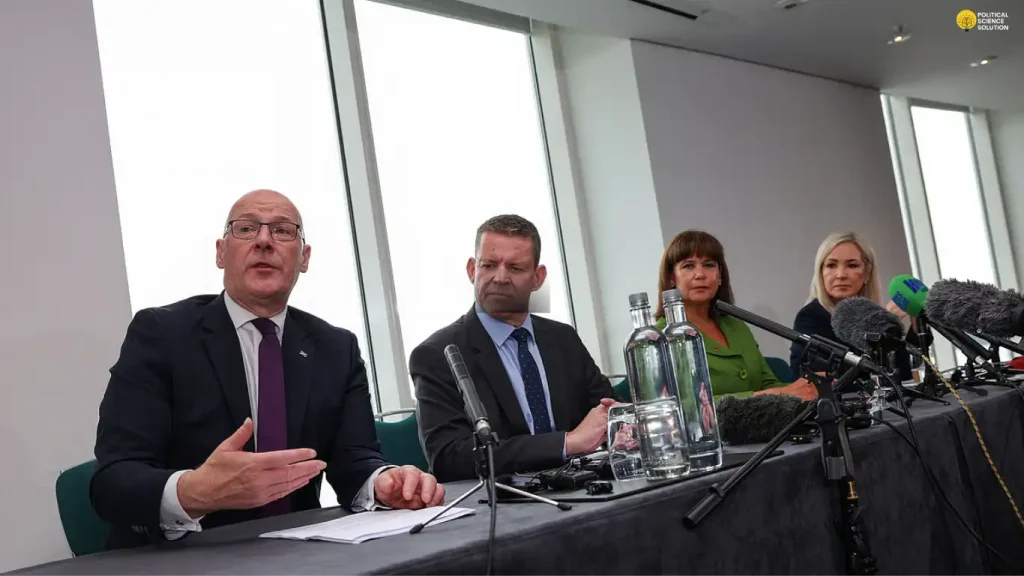
New Delhi: A significant political gathering took place in Cardiff Bay on Monday as the first ministers of Scotland, Wales and Northern Ireland came together with a shared message. For the first time since devolution began, all three nations are led by politicians who support leaving the United Kingdom. John Swinney of the Scottish National Party, Rhun ap Iorwerth of Plaid Cymru and Michelle O’Neill of Sinn Féin signed a memorandum of understanding asserting that Westminster has no authority to prevent democratic decisions by their peoples. Sinn Féin president Mary Lou McDonald also took part in the discussions.
The leaders attended in their roles as heads of their respective parties. Their joint statement declared that the period of Westminster control is approaching its conclusion. It stressed that each nation holds the right to determine its own path and that no central government can override the will of the people.
Key Statements from the Joint Agreement
The memorandum of understanding contained clear language on constitutional rights. It noted that people across the islands and beyond now see first ministers in Scotland, Wales and Northern Ireland all committed to independence. The document affirmed that the future of these nations belongs within the European Union and that momentum supports constitutional change.
Swinney described the occasion as a pivotal point in the United Kingdom’s constitutional development. He argued that the May elections produced leaders who believe their countries must decide their own futures. He called self-determination an inalienable right and referred to Andy Burnham as the final prime minister of the United Kingdom, predicting that Scottish voters would choose independence if offered a referendum.
O’Neill highlighted the unique character of each nation while identifying a common view that Westminster fails to serve their interests effectively. McDonald labelled the meeting historic and insisted on the right to hold referendums. She stated that no prime minister can remove that option from consideration.
Differing Approaches to Independence Timelines
Ap Iorwerth adopted a more cautious stance on timing. He spoke of increasing awareness that the current system fails to deliver and that genuine power must move closer to communities. He pointed to the May Senedd election as providing a mandate for a more confident and prosperous Wales with greater control over its destiny. When asked about the practical meaning of the memorandum for Wales, he replied that the people of Wales alone will decide their future. The timetable, he explained, depends on when public opinion shifts, and his responsibility is to build that support.
Plaid Cymru has already excluded any independence referendum before the next Senedd election in 2030. The Welsh government instead plans to create a national commission that will prepare groundwork for possible future independence discussions. In the shorter term, ministers are seeking transfers of additional powers, including responsibility for policing and youth justice. Burnham has indicated openness to some of these requests.
Separate Cooperation Deal Between Wales and Scotland
Later on Monday, Swinney and ap Iorwerth signed a further agreement between their two governments. Although not legally binding, the document commits both administrations to press for fairer treatment in UK funding systems and greater influence over constitutional matters. It also outlines joint efforts on reducing child poverty and strengthening benefits from European Union relationships.
During a second press conference, Swinney declined to back reform of the Barnett Formula. Welsh ministers have long argued that the formula underfunds Wales, while Scotland is generally regarded as receiving more favourable outcomes. Swinney observed that funding arrangements differ across the United Kingdom and that each nation must advocate for its own interests. Ap Iorwerth stressed that flexibilities already available to Scotland should at least be extended to Wales.
Background on Legal Pathways and Public Opinion
The United Kingdom consists of four countries operating under three legal systems. England and Wales share one system, Scotland maintains its own based on Scots law, and Northern Ireland operates a distinct system rooted in English common law with local legislation. Devolution transfers many domestic powers to elected institutions while reserving matters such as defence and foreign affairs for London. No nation can leave the United Kingdom unilaterally.
Scotland held an independence referendum in 2014 after receiving approval from Westminster. Voters chose to remain by 55 percent to 45 percent. Wales currently lacks any legal mechanism that would allow the Senedd to call its own independence vote. In Northern Ireland the Good Friday Agreement sets a different process. The British government must organise a referendum on Irish unity if the Secretary of State concludes that a majority is likely to support it.
Recent surveys show varying levels of support. One poll recorded 47 percent backing for Scottish independence. Another found 36 percent support for Irish reunification in Northern Ireland. In Wales support for independence stood at 32 percent. Academic observers have described the Cardiff meeting as a deliberate attempt by the nations to place the constitutional question on the agenda themselves, while also exploring practical cooperation on energy, European links and economic development.
Reactions from UK Government and Opposition Parties
The gathering followed comments by United States President Donald Trump during a visit to Ireland. He expressed enthusiasm for a united Ireland while acknowledging that the United Kingdom would have its own view. Burnham restated that his position on Irish unity remains unchanged and that a referendum on Northern Ireland leaving the United Kingdom is not currently under consideration.
During parliamentary questions Burnham appeared to suggest that a second Scottish referendum could be considered if clear public consensus emerged, drawing a comparison with the Northern Ireland process. Swinney welcomed the remarks. Burnham later clarified that another Scottish vote remains off limits and that he had only been illustrating the absence of existing consensus. Swinney had written requesting discussions on a legal mechanism for a referendum. The reply confirmed the government’s position against a second vote.
The UK government stated that the prime minister remains committed to progress across all four nations and strongly supports the union. The devolved leaders are due to meet him next month. Ap Iorwerth observed that Burnham still has much to understand about the difference between national devolution and regional or city-level arrangements in England, while expressing hope for constructive relations.
Welsh opposition parties responded critically. The Labour leader in Wales accused Plaid Cymru of offering little since the election and of focusing on breaking up the United Kingdom rather than delivering for people. The Welsh Conservative leader urged the first minister to concentrate on pressures facing the National Health Service and declining school standards instead of constitutional questions. Reform UK’s Welsh representative argued that the first minister has failed to address waiting lists and education performance while finding time to promote the break-up of the United Kingdom.
What the Cardiff Meeting Means Going Forward
The memorandum and the accompanying Welsh-Scottish agreement create no new legal powers. They serve as a coordinated political declaration of principle. Scotland continues to seek a referendum process. Wales prioritises institution-building and extra powers while postponing any vote until after 2030. Northern Ireland remains bound by the conditions set out in the Good Friday Agreement. The three leaderships share a common insistence that their peoples, rather than Westminster alone, must shape constitutional outcomes.
The Cardiff events place the current political reality of the devolved nations firmly on the public record. Whether that reality produces lasting change will depend on shifts in public opinion, future elections and the responses of the UK government. For the moment the leaders have recorded their shared language of self-determination and invited wider attention to the direction they intend to pursue.
FAQs
1. Why did the leaders of Scotland, Wales and Northern Ireland meet in Cardiff on Monday?
They gathered as party leaders to sign a memorandum of understanding asserting that their nations have the right to self-determination. The statement declared that no Westminster government can block democracy and that the central government’s dominance is ending. It was the first time since devolution that all three nations have been led by politicians who support leaving the United Kingdom.
2. What exact commitments did the memorandum of understanding contain?
The document stated that the future of the nations belongs in the European Union, that momentum is behind constitutional change, and that each nation will decide its own path in its own way and time. It emphasised that people across the islands and worldwide can see first ministers in Scotland, Wales and Northern Ireland all committed to independence from the UK.
3. How did the Welsh first minister’s position differ from those of Scotland and Northern Ireland?
Rhun ap Iorwerth refused to set any timetable for a Welsh independence referendum and confirmed Plaid Cymru will not seek one before the 2030 Senedd election. He focused instead on building public support, creating a national commission to prepare future options, and securing extra powers such as policing and youth justice. In contrast, John Swinney and Michelle O’Neill openly called for referendums.
4. What additional agreement was signed between the Welsh and Scottish governments?
Later the same day the two first ministers signed a separate, non-binding cooperation deal. It commits both governments to press for fairer UK funding arrangements and greater constitutional powers, while also working jointly on child poverty and maximising European Union relationships. Swinney declined to endorse reforming the Barnett Formula.
5. What legal barriers currently prevent independence votes, and how has the UK government responded?
Scotland cannot hold a referendum without Westminster approval; its 2014 vote required that consent. Wales has no legal power for the Senedd to call its own independence referendum. Northern Ireland’s route is set by the Good Friday Agreement, which requires the Secretary of State to judge that a majority is likely to support Irish unity. Prime Minister Andy Burnham initially appeared open to a second Scottish vote if clear consensus existed but later stated it remains off limits.