

New Delhi: The Union Ministry of Home Affairs has extended the Armed Forces (Special Powers) Act, 1958, across specified disturbed areas of Manipur, Nagaland and Arunachal Pradesh for another six months starting October 1, 2026. Gazette notifications released on Friday confirmed the decision after a fresh review of the law-and-order situation in these northeastern states. The Act will remain operative unless withdrawn earlier by the Centre.
This latest extension comes against the backdrop of continuing ethnic tensions in Manipur, unresolved political negotiations in Nagaland, and residual insurgent activity along the Arunachal-Assam border. The notifications reaffirm the Centre’s assessment that special powers for the armed forces are still required in the notified territories.
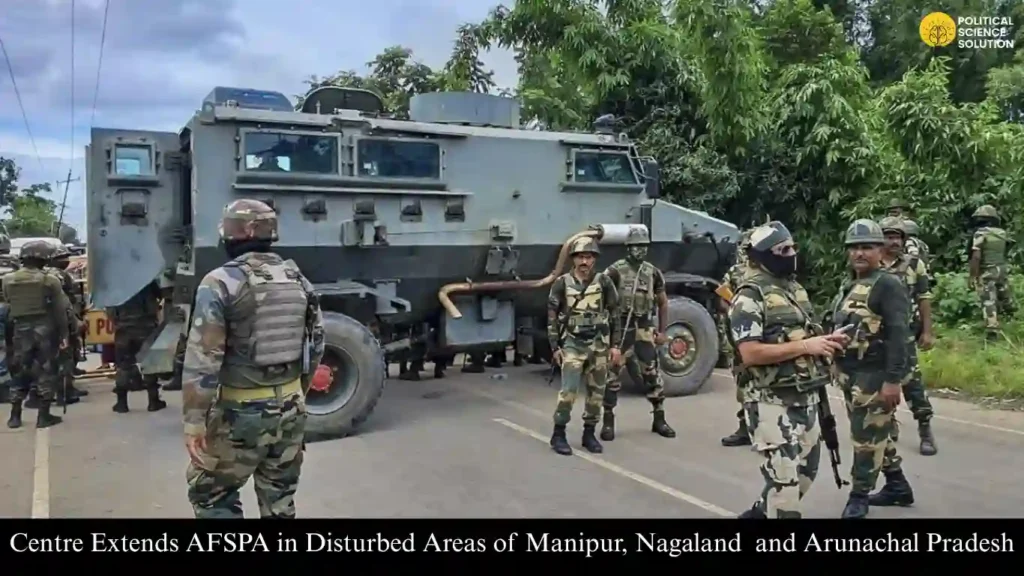
Details of the Extension in Manipur
In Manipur the Ministry of Home Affairs has declared the entire state a disturbed area under Section 3 of the AFSPA, with one clear set of exclusions. Areas falling under the jurisdiction of 13 police stations in five valley districts have been kept outside the Act’s ambit. These police stations are Imphal, Lamphel, City, Singjamei, Patsoi, Wangoi, Porompat, Heingang, Irilbung, Thoubal, Bishnupur, Nambol and Kakching. They lie within Imphal West, Imphal East, Thoubal, Bishnupur and Kakching districts.
The rest of Manipur, including the hill districts and remaining valley areas, continues under the disturbed-area notification. This arrangement will stay in force until the end of March 2027 unless reviewed and modified earlier.
Coverage in Nagaland
Nagaland’s extension covers nine full districts: Dimapur, Niuland, Chumoukedima, Mon, Kiphire, Noklak, Phek, Peren and Meluri. In addition, the Act applies to areas under 21 police stations located in five other districts—Kohima, Mokokchung, Longleng, Wokha and Zunheboto.
These zones have historically been linked to the movement of armed groups and the unfinished Naga political dialogue. The Centre has maintained the law in these pockets while progressively shrinking its presence elsewhere in the state.
Application in Arunachal Pradesh
In Arunachal Pradesh the AFSPA has been extended in the three districts of Tirap, Changlang and Longding. It also covers the jurisdictions of the Namsai, Mahadevpur and Chowkham police stations in Namsai district, which share a border with Assam.
These areas have long been associated with insurgent transit routes and residual militant activity originating from neighbouring states and across the international border.
Understanding the Armed Forces (Special Powers) Act
The Armed Forces (Special Powers) Act was enacted in 1958 to equip the armed forces and Central Armed Police Forces with special operational powers in regions facing insurgency or serious internal-security challenges. Once an area is notified as disturbed, security personnel gain authority to use force, including lethal force, against individuals acting in violation of prohibitory orders. They may arrest without a warrant and enter and search any premises without a warrant.
The statute also provides legal immunity: no prosecution, suit or other legal proceeding can be initiated against personnel for actions taken under the Act without the prior sanction of the Central government. These extraordinary powers and the requirement of Central sanction for prosecution have made the law the subject of sustained public debate and judicial scrutiny over the decades.
Who Can Declare an Area Disturbed
Section 3 of the AFSPA empowers both the Central government and the concerned state governments to issue disturbed-area notifications. This dual authority explains why the geographical application of the law has not always been decided solely by the Union Home Ministry.
For many years the Manipur state government itself issued and renewed the notifications. That practice shifted after the ethnic violence that erupted on 3 May 2023. Since then the Ministry of Home Affairs has taken the lead in issuing the periodic orders for Manipur, while continuing to do so for Nagaland and Arunachal Pradesh. In Assam the state government remains the notifying authority.
Evolution of AFSPA in Manipur Before and After the 2023 Violence
AFSPA has been in operation in Manipur since 1981. Its footprint, however, had been steadily contracting in the years preceding the 2023 conflict. The Imphal municipal area was withdrawn from the Act’s coverage in 2004. A more substantial rollback began in 2022. Between 1 April 2022 and 1 April 2023 the state government removed the disturbed-area declaration from every police-station jurisdiction in the Manipur Valley, citing improved security conditions and a greater sense of public safety. The Act continued only in the hill regions.
The ethnic violence that began on 3 May 2023 between Meitei and Kuki communities reversed that trend. On 14 November 2024 the Ministry of Home Affairs reimposed AFSPA in the jurisdictions of six police stations spread across five districts: Sekmai and Lamsang in Imphal West, Lamlai in Imphal East, Jiribam in Jiribam district, Moirang in Bishnupur and Leimakhong in Kangpokpi. These were among the areas from which the law had earlier been withdrawn. The Centre stated that the restoration was necessary to enable well-coordinated operations by security forces and to contain the activities of insurgent groups.
Disagreement Between the Centre and the Manipur Government
The November 2024 reimposition did not enjoy the support of the Manipur government. On 15 November 2024 the state Cabinet under then Chief Minister N. Biren Singh decided to recommend that the Centre review and withdraw the notification in the public interest. The recommendation was formally conveyed to the Union Home Secretary the next day.
The divergence was notable because both the Centre and the state were then governed by the same political party. Subsequent political changes altered the equation further. President’s Rule was imposed in Manipur on 13 February 2025 and revoked on 4 February 2026. The latest extension has been issued under the restored elected government framework but continues to reflect the Centre’s security assessment.
Why the Latest Notification Matters
Prior to the 2023 violence the direction of policy in Manipur had been towards progressive reduction of AFSPA-covered territory. By April 2023 every valley police-station area stood outside the Act. The November 2024 notification marked a partial reversal. The current arrangement still exempts 13 police stations in five valley districts while keeping the remainder of the state under the disturbed-area declaration. This demonstrates how the security situation that followed the ethnic conflict interrupted the earlier process of shrinking the law’s geographical footprint.
Continuation of AFSPA in Nagaland and Arunachal Pradesh
In Nagaland the persistence of the Act is closely tied to the presence and movement of armed insurgent groups and the unresolved Naga political issue. The Centre has held negotiations with the National Socialist Council of Nagaland (Isak-Muivah) and the Naga National Political Groups. In 2022 security officials indicated that uncertainty over the conclusion of the peace process was one reason the law continued in selected areas of Nagaland and neighbouring states.
In Arunachal Pradesh application has remained concentrated in districts affected by insurgent movement and areas adjoining Assam. Tirap, Changlang and Longding have therefore stayed under the Act, along with the three specified police-station jurisdictions in Namsai district.
Rollback of AFSPA Elsewhere in the Northeast
The geographical reach of AFSPA across the Northeast has declined considerably compared with the situation a few years ago. Tripura revoked the Act entirely in 2015 under a CPI-M-led state government. Meghalaya remained under the law for 27 years until the Centre withdrew it from 1 April 2018.
Assam offers another significant example. Until 31 March 2022 the Act applied across the whole of Assam. From 1 April that year successive reductions left it confined to the three districts of Tinsukia, Charaideo and Sivasagar. The Assam government has stated that security conditions improved significantly over the past three years, yet retained the law in these districts because the United Liberation Front of Asom (Independent) remains the state’s only major active militant group and uses routes through Arunachal Pradesh and Nagaland to reach camps in Myanmar. The three districts are also considered vulnerable because of their location along the Assam-Nagaland and Assam-Arunachal Pradesh borders.
The earlier reductions coincided with a decline in insurgency-related violence and the surrender or arrest of militants. Security officials argued that where the deployment of the Army itself had declined, retaining the special statutory powers available under AFSPA had become increasingly difficult to justify. The Centre presented the shrinking footprint as part of the broader improvement in the Northeast’s security situation. Manipur remains the important exception to that trajectory.
Situation in Jammu and Kashmir
Jammu and Kashmir is governed by a separate statute—the Jammu and Kashmir Armed Forces (Special Powers) Act, 1990—and therefore falls outside the scope of the present notifications covering the Northeast.
Ongoing Violence and Security Challenges in Manipur
The extension in Manipur occurs amid continuing ethnic strife that began in May 2023. Around 43,000 people displaced by the violence continue to live in relief camps. The Manipur government informed the state assembly in September 2026 that 306 people had been killed and 49 remained missing between May 2023 and 31 August 2026. Other tallies have placed the cumulative death toll higher.
In recent months a Naga-Kuki fault-line has emerged in the hill districts. Human Rights Watch reported that at least seven people were killed in clashes in late August 2026, bringing deaths in such incidents to 34 since February. Armed groups have been involved in shootings, hostage-taking, arson and highway blockades through 2026.
On 24 September 2026 suspected militants of the Kuki National Army-Burma attacked a village in Kamjong district near the Myanmar border, killing four Tangkhul Naga civilians. The same day the proscribed Revolutionary People’s Front reiterated its demand for an independent Manipur, alleging that the Government of India has adopted military measures to suppress the armed movement in the state.
Separately, protests were held in Manipur by the opposition Congress party on the issue of the Special Intensive Revision of voter lists, demanding the resignation of the Chief Election Commissioner.
Broader Implications for the Northeast
The present system is no longer one in which AFSPA uniformly covers large parts of the Northeast. Its application has been progressively narrowed to particular states, districts and even individual police-station jurisdictions on the basis of periodic security assessments. The latest six-month extension underscores that while substantial progress has been made in reducing the law’s footprint in Assam, Tripura and Meghalaya, the security environment in Manipur, selected districts of Nagaland and the border areas of Arunachal Pradesh continues to require the special powers granted under the 1958 Act.
Further reviews will determine the position after March 2027. Until then the armed forces will continue to operate with the enhanced legal framework in the notified territories of the three states.
FAQs
1. What is the Armed Forces (Special Powers) Act and why has it been extended again in 2026?
The Armed Forces (Special Powers) Act, 1958, is a law that grants special operational powers to the armed forces and Central Armed Police Forces in areas declared “disturbed” due to insurgency or serious internal security challenges. Once an area is notified, personnel can use force (including lethal force) against those violating prohibitory orders, arrest without a warrant, and search premises without a warrant. It also provides legal protection: no prosecution or legal proceedings can begin against them without prior Central government sanction.
In September 2026 the Union Ministry of Home Affairs extended the Act for six months from 1 October 2026 in parts of Manipur, Nagaland and Arunachal Pradesh after reviewing the prevailing law-and-order situation. The extension continues until March 2027 unless withdrawn earlier.
2. Which exact areas of Manipur, Nagaland and Arunachal Pradesh remain under AFSPA after the latest notification?
In Manipur the entire state is notified as a disturbed area except the jurisdictions of 13 police stations in five valley districts: Imphal, Lamphel, City, Singjamei, Patsoi, Wangoi, Porompat, Heingang, Irilbung, Thoubal, Bishnupur, Nambol and Kakching (located in Imphal West, Imphal East, Thoubal, Bishnupur and Kakching).
In Nagaland the Act covers nine full districts—Dimapur, Niuland, Chumoukedima, Mon, Kiphire, Noklak, Phek, Peren and Meluri—plus areas under 21 police stations in the five districts of Kohima, Mokokchung, Longleng, Wokha and Zunheboto.
In Arunachal Pradesh it applies to Tirap, Changlang and Longding districts, and to the Namsai, Mahadevpur and Chowkham police station areas in Namsai district bordering Assam.
3. Why does AFSPA continue in most of Manipur despite earlier withdrawals?
Before the ethnic violence that began on 3 May 2023, AFSPA’s footprint in Manipur had been shrinking. The Imphal municipal area was removed in 2004, and between April 2022 and April 2023 the state government withdrew the disturbed-area declaration from all valley police-station jurisdictions, citing improved security. The 2023 Meitei-Kuki conflict reversed that trend.
The Centre reimposed the Act in six police-station areas in November 2024 to enable coordinated security operations. The latest notification keeps most of the state under AFSPA while still exempting the 13 listed valley stations. Official figures shared in the Manipur Assembly in September 2026 recorded 306 deaths and 49 missing persons between May 2023 and 31 August 2026, with around 43,000 people still living in relief camps. Fresh clashes, including a September 2026 attack in Kamjong district that killed four Tangkhul Naga civilians, have kept the security situation tense.
4. How has the geographical reach of AFSPA changed across the Northeast in recent years?
AFSPA’s coverage has narrowed significantly in several states. Tripura revoked it completely in 2015. Meghalaya, which had the Act for 27 years, saw it withdrawn from 1 April 2018. In Assam the law once applied statewide; successive reductions have left it only in Tinsukia, Charaideo and Sivasagar districts because of residual activity by ULFA (Independent) and the districts’ border locations.
Manipur is the main exception to this broader contraction. While the Act was being progressively lifted from the valley until 2023, the ethnic conflict led to its partial restoration and continued application across most of the state. In Nagaland and Arunachal Pradesh the law remains tightly focused on specific districts and police-station areas linked to insurgent movement and unresolved political issues.
5. Who has the power to declare an area “disturbed” under AFSPA, and has there been disagreement between the Centre and Manipur on this?
Both the Central government and state governments can issue disturbed-area notifications under Section 3 of the Act. For decades the Manipur government itself handled the periodic renewals. After the 2023 violence the Ministry of Home Affairs took the lead.
When the Centre reimposed AFSPA in six police-station jurisdictions on 14 November 2024, the Manipur Cabinet under then Chief Minister N. Biren Singh immediately recommended its withdrawal in the public interest and conveyed the decision to the Union Home Secretary. The divergence was notable because both governments were then led by the same party. President’s Rule was later imposed in Manipur from 13 February 2025 to 4 February 2026. The latest 2026 extension reflects the Centre’s continued security assessment rather than a joint state-Centre decision.