

New Delhi: In a powerful display of youth discontent sweeping across India, hundreds of protesters gathered at Delhi’s historic Jantar Mantar on June 6, 2026, marking the first major demonstration at the site since the 2023 wrestlers’ protest. Organized under the banner of the rapidly rising Cockroach Janta Party (CJP), the event responded directly to founder Abhijeet Dipke’s widespread social media appeal. Demonstrators demanded the immediate resignation of Union Education Minister Dharmendra Pradhan, citing severe irregularities in the National Eligibility cum Entrance Test (NEET-UG) and ongoing issues with the Central Board of Secondary Education (CBSE) examination systems.
This protest represented more than a reaction to exam scandals. It highlighted deep frustration among India’s young generation regarding systemic failures in education, lack of political accountability, and what many described as an “electoral autocracy.” With over 22 lakh candidates affected by the NEET-UG cancellation and persistent problems in CBSE’s new on-screen marking (OSM) system, the gathering at Jantar Mantar symbolized a broader awakening among Gen-Z and young professionals.
Origins and Explosive Rise of the Cockroach Janta Party
The Cockroach Janta Party emerged as a satirical online movement in mid-May 2026, following controversial remarks by Chief Justice of India Surya Kant. The CJI reportedly referred to government critics and unemployed youth as “cockroaches” and “parasites,” comments that sparked widespread outrage despite a later clarification claiming media misquotes. What started as a meme-driven parody account quickly transformed into a significant political phenomenon, attracting massive support from young Indians disillusioned with the current system.
Abhijeet Dipke, a 30-year-old political strategist and Boston University graduate previously associated with the Aam Aadmi Party (AAP), founded the CJP. Operating from the United States where he pursues higher education, Dipke leveraged social media platforms to mobilize supporters. The CJP’s Instagram page garnered over 22 million followers in a remarkably short time, reportedly surpassing the Bharatiya Janata Party’s (BJP) follower count on the platform. Its X (formerly Twitter) account faced blocking on national security grounds, prompting the creation of a new handle @Cockroachisback.
This digital surge reflected mounting anger over recurring examination mishaps. The NEET-UG 2026 exam, held last month across 5,432 centers with more than 22 lakh aspirants, was canceled on May 12 due to alleged paper leaks. A re-examination is scheduled for later in June. Meanwhile, CBSE faced sharp criticism for deficiencies in its OSM system, leading to government-ordered re-exams and official transfers, though critics argue political accountability remains absent.
Scenes from the Ground: Flowers, Books, and Defiant Voices at Jantar Mantar
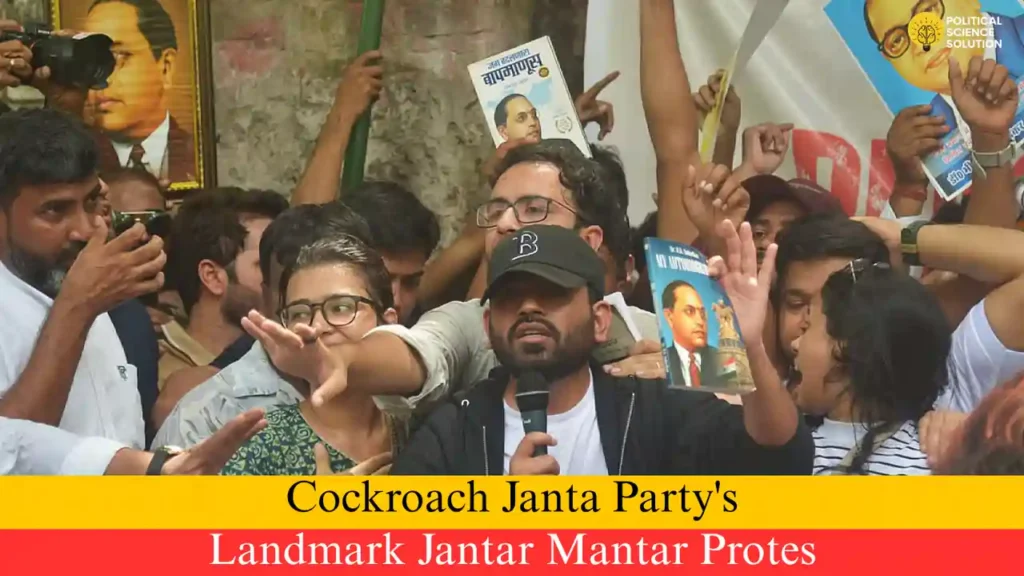
Protesters began assembling at Jantar Mantar as early as 10 AM on June 6, with numbers swelling significantly by noon. The crowd consisted largely of young students, parents, young professionals, and teachers. Many carried flowers and books as symbolic gestures of protest, holding banners that explicitly called for Dharmendra Pradhan’s resignation. Members of Left-affiliated student organizations were present, along with CPI(ML) general secretary Dipankar Bhattacharya and CPI’s Annie Raja, who extended support to the gathering.
Sameeksha, a 19-year-old college student who appeared for NEET (UG) in 2025, shared a personal story that resonated with many attendees. She revealed fighting with her parents to join the protest, emphasizing concerns for her younger sister in Class 12 facing board exams next year. “My parents did not want me to come here. If I don’t fight for my rights then who will? … There is no political accountability,” she stated, highlighting systemic issues from paper leaks to flawed marking systems.
Jaswant, a lawyer present at the event, captured the prevailing sentiment: “We are an electoral autocracy. There is anger against the government. If they call us names like anti-national urban naxal we will have no way but to protest. This protest is the outpouring of the frustration of youngsters.” He referenced the CJI’s remarks as the spark that turned satire into a growing movement with potential national reach.
Somil Sheoran, a doctor, expressed the emotional toll: “India is facing a lot of problems but calling us cockroaches is demeaning us. If you cannot support us, don’t demean us.” Robin Maheshwari, another doctor from Punjab’s Bathinda, described the CJP as “an informal opposition which is actually very powerful,” noting that party affiliations mattered less than the collective voice of the youth emerging in the absence of government empathy.
Abhijeet Dipke’s Leadership and On-Ground Mobilization
Abhijeet Dipke arrived in New Delhi from the US specifically for the protest. Upon landing, he was greeted by supporters chanting his name. Police had met him at the airport and granted permission for the demonstration. Initially planning to seek formal approval at Parliament Street police station, Dipke redirected followers to Jantar Mantar on Saturday morning.
Carrying a copy of India’s Constitution and Dr. B.R. Ambedkar’s “My Autobiography,” Dipke addressed the crowd directly. He spoke about the fear gripping families: “My mother and sister were crying. They were scared that this government would put me in jail. This fear is not my mother’s alone. In this country, every mother has this fear when their child raises their voice against this government. How long will we live in fear of this government?”
Dipke issued a firm ultimatum, initially giving the government until 5 PM for Pradhan to resign. He asked protesters if they wanted to continue the sit-in until the demand was met and announced plans to expand the movement nationwide if unmet. Later in the evening, the CJP extended the deadline to seven days before escalating protests across the country. “Cockroaches don’t ever fear,” Dipke declared, reinforcing the movement’s resilient spirit.
CJP chief spokesperson Saurav Das later told media outlets that the response had been overwhelming despite efforts to derail the movement. “This movement is leaderless, and there is no one or two leaders. Every student who has been affected is a leader,” Das emphasized. He noted that youth had decided the education system must change, welcoming participants adhering to Gandhian principles of peaceful protest. The sole immediate aim remained the education minister’s resignation.
Broader Context: Youth Unemployment, Exam Scandals, and Political Repercussions
The protest unfolded against a backdrop of significant challenges for India’s youth. With nearly 400 million people aged 15 to 29, generating suitable non-farm jobs remains a critical issue despite economic growth. Urban youth unemployment hovered around 14% in April, with many educated individuals trapped in low-paid or mismatched roles.
Activists like Sonam Wangchuk joined the afternoon session, urging deeper systemic reforms. “The foundation of a Viksit Bharat lies not in Delhi’s private schools but in schools located in villages. The children of all elected representatives should study in government schools,” Wangchuk told the gathering, stressing the need for stakeholding among those running the system.
The government response came swiftly. BJP president Nitin Nabin criticized the protest in Ranchi, stating, “Some people, sitting abroad, think that they will dictate the direction to India’s youth.” He argued that today’s youth wanted to contribute positively to nation-building rather than engage in what he termed negative politics, warning against attempts to undermine democratic standards. Senior cabinet minister Kiren Rijiju accused the group of seeking support from Pakistan and “anti-India” elements, though Dipke shared data indicating 95% of Instagram followers were based in India.
Police presence with riot gear and barricades highlighted the sensitivities around public dissent. The movement’s rapid growth and transition from online satire to street action have raised questions about its potential evolution into a broader political force.
What Lies Ahead for the Cockroach Janta Party Movement?
As the CJP extends its seven-day deadline for Dharmendra Pradhan’s resignation, uncertainty remains about its long-term trajectory. Will it remain an informal, leaderless youth platform focused on education reforms, or transform into a structured political entity? Protesters and leaders alike stressed that affiliations were secondary to addressing core issues of accountability and systemic change.
The protest at Jantar Mantar has already succeeded in amplifying voices long marginalized in national discourse. By channeling anger over NEET paper leaks, CBSE failures, youth unemployment, and perceived demeaning rhetoric, the CJP has created a new language of resistance rooted in self-deprecating humor and collective determination.
For India’s vast youth population, this moment represents a critical juncture. As Abhijeet Dipke and thousands of “cockroaches” declared, the time for silent frustration has ended. The coming days and weeks will test whether this digital-born movement can sustain momentum, influence policy, and reshape the contours of youth politics in the world’s largest democracy.
The Cockroach Janta Party’s debut offline protest has undeniably rattled the establishment. With calls for nationwide expansion, demands for political accountability in education, and a firm rejection of fear, the movement signals that India’s young citizens are no longer content to remain passive observers. Their message is clear: genuine reform in the education system and empathetic governance are non-negotiable.
FAQs
1. What is the Cockroach Janta Party and how did it originate?
The Cockroach Janta Party (CJP) is a youth-driven satirical movement that began in mid-May 2026 on social media. It originated after Chief Justice of India Surya Kant’s reported remarks likening government critics and unemployed youth to “cockroaches” and “parasites.” Although the CJI later clarified the comments were misquoted, the phrase was embraced by young Indians as a symbol of resistance. Founded by Abhijeet Dipke, the CJP rapidly grew into a major online platform with over 22 million Instagram followers, surpassing even major political parties. It evolved from meme-based satire into a broader voice against education system failures, youth unemployment, and lack of political accountability.
2. Who is Abhijeet Dipke and what is his role in the movement?
Abhijeet Dipke is the 30-year-old founder of the Cockroach Janta Party. A political strategist and Boston University graduate with prior links to the Aam Aadmi Party (AAP), he flew from the United States to lead the first offline protest in New Delhi on June 6, 2026. Dipke mobilized supporters through social media calls and addressed the crowd at Jantar Mantar, carrying copies of the Indian Constitution and Dr. B.R. Ambedkar’s autobiography. He emphasized fearlessness (“cockroaches don’t ever fear”), issued a resignation deadline for the Education Minister, and positioned the movement as leaderless, with every affected student acting as a leader.
3. Why did the Cockroach Janta Party protest at Jantar Mantar on June 6, 2026?
The protest demanded the resignation of Union Education Minister Dharmendra Pradhan following major scandals in the NEET-UG 2026 exam (canceled on May 12 due to alleged paper leaks affecting over 22 lakh candidates) and serious flaws in the CBSE’s new on-screen marking (OSM) system. Protesters highlighted the absence of political accountability, recurring exam irregularities, and the demeaning “cockroach” label. Hundreds of young students, parents, doctors, lawyers, and teachers gathered with flowers, books, and banners to express frustration over a failing education system, youth unemployment (urban rate ~14%), and what many called India’s “electoral autocracy.”
4. What happened during the Jantar Mantar protest and who participated?
The June 6 protest marked the first major gathering at Jantar Mantar since the 2023 wrestlers’ protest. Crowds started forming by 10 AM and swelled by noon. Participants included students like 19-year-old NEET aspirant Sameeksha, doctors such as Somil Sheoran and Robin Maheshwari, and lawyer Jaswant. Left-affiliated student groups, CPI(ML) leader Dipankar Bhattacharya, CPI’s Annie Raja, and activist Sonam Wangchuk also joined. Protesters carried national flags, books, and flowers while chanting slogans. Dipke addressed the crowd, set a 5 PM resignation deadline (later extended to seven days), and announced potential nationwide expansion. Police maintained a heavy presence with barricades and riot gear.
5. What are the next steps for the Cockroach Janta Party movement?
The CJP has given the government seven days for Education Minister Dharmendra Pradhan to resign. If unmet, the movement plans to expand protests across India. Spokesperson Saurav Das described it as a leaderless, peaceful, Gandhian effort open to all who support systemic education reform. Key demands include full political accountability, better examination processes, and long-term changes such as elected representatives sending their children to government schools. The group aims to sustain momentum from its massive online following while transitioning into a broader informal opposition focused on youth issues, jobs, and empathetic governance.