

New Delhi: In a landmark moment for global diplomacy, the 20th G20 Leaders’ Summit concluded in Johannesburg, South Africa on Sunday, marking the first time the world’s most powerful economies convened on African soil. Under the powerful African philosophy of Ubuntu – “I am because we are” – the summit adopted a sweeping 122-paragraph Johannesburg Declaration emphasizing solidarity, equality, and sustainability, even as the United States under President Donald Trump boycotted the entire event and Argentina distanced itself from the final text.
The two-day summit (22–23 November 2025), hosted by South African President Cyril Ramaphosa, delivered a strong message that multilateralism remains alive despite rising unilateral tendencies, trade wars, and geopolitical fractures.
G20 Summit 2025 Johannesburg
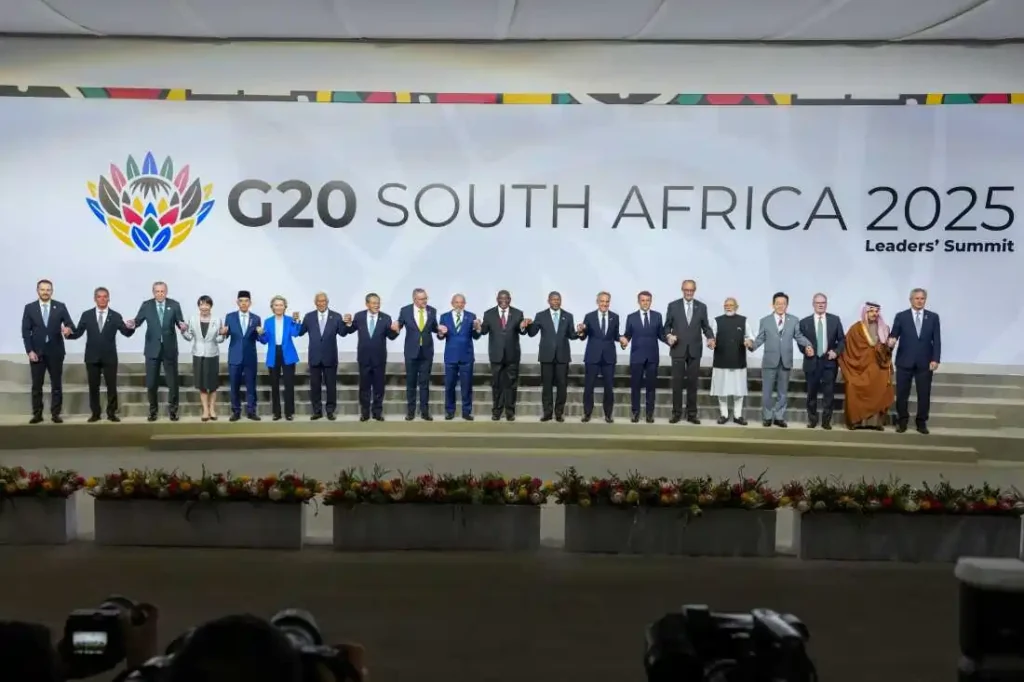
Why the United States Boycotted the G20 2025 Summit
President Donald Trump chose not to attend, citing widely debunked claims of “large-scale killings and land grabs” targeting South Africa’s white minority farmers. The White House later insisted U.S. officials would only appear for the ceremonial handover of the G20 presidency, but South Africa refused to conduct the traditional handover with what it called a “junior U.S. official,” calling it an insult to the dignity of the African presidency.
The symbolic handover was postponed and will now take place next week through diplomatic channels. Despite the absence of the U.S. leader, the rotating presidency formally passed to the United States, which will host the 2026 summit at Trump’s Doral golf resort in Florida.
Argentine President Javier Milei, a close Trump ally, also skipped the summit, and Buenos Aires later expressed reservations about the declaration.
Johannesburg Declaration: 10 Game-Changing Takeaways
Despite the high-profile absences, the remaining G20 members – including China, India, Brazil, Russia, Germany, France, Japan, the UK, Canada, and host South Africa – achieved “overwhelming consensus” on a forward-looking document. Here are the ten most crucial outcomes:
- Historic First African Summit & Ubuntu Philosophy Leaders explicitly invoked Ubuntu as the guiding spirit, stressing that “individual nations cannot thrive in isolation.”
- New IMF Seat for Sub-Saharan Africa A landmark decision created the 25th IMF Executive Board chair exclusively for Sub-Saharan Africa and channeled over $100 billion in reallocated Special Drawing Rights (SDRs) to vulnerable nations.
- Strengthened Debt Sustainability Acknowledging crippling debt levels, members committed to faster, more predictable debt treatments under the G20 Common Framework with greater transparency.
- Climate Finance Scaled from Billions to Trillions Developing nations need $5.8–5.9 trillion by 2030 for NDCs; leaders pledged urgent mobilization of new climate finance.
- Just Energy Transition & Mission 300 With over 600 million Africans still without electricity, the G20 backed tripling renewable energy capacity globally and endorsed “Mission 300” to connect 300 million people to electricity by 2030.
- G20 Critical Minerals Framework (Voluntary) A new framework focuses on sustainable and secure critical mineral supply chains, with emphasis on local beneficiation and recycling in developing countries.
- Global Food Security & Right to Food With 720 million people facing hunger in 2024, leaders reaffirmed the Right to Food and committed stronger support to African smallholder farmers and the African Continental Free Trade Area (AfCFTA).
- AI for Africa Initiative A new initiative ensures equitable benefit-sharing from artificial intelligence, with safeguards for human rights, transparency, and trustworthy AI governance.
- Nelson Mandela Bay Youth & Gender Targets Ambitious goals: reduce the NEET (Not in Education, Employment or Training) rate by 5% and achieve 25% gender parity in labor-force participation by 2030.
- UN Security Council Reform Push A strong call for “transformative reform” of the UNSC to reflect 21st-century realities, with explicit demands for greater representation of Africa, Asia-Pacific, and Latin America & the Caribbean.
India’s Six Big Ideas That Shaped the Summit
Prime Minister Narendra Modi, who attended in person, used the platform to propose six major global initiatives that received wide appreciation:
- Global Traditional Knowledge Repository – A digital platform to preserve and harness collective human wisdom from indigenous and traditional practices worldwide.
- Africa Skills Multiplier – Training and certifying 1 million African trainers to multiply youth skilling across the continent.
- Global Healthcare Response Team – A standing group of G20 health experts ready for rapid deployment during pandemics or health crises.
- Open Satellite Data Partnership – Free sharing of satellite data for agriculture, fisheries, and disaster management, especially benefiting developing nations.
- Critical Minerals Circularity Initiative – Focus on recycling, innovation, and resilient supply chains for minerals vital to clean energy.
- G20 Initiative on Countering the Drug-Terror Nexus – A new framework to disrupt drug trafficking (including fentanyl) as a funding source for terrorism.
On the sidelines, India and Italy jointly launched an initiative to counter terrorist financing.
Terrorism, Women’s Empowerment, and Global Conflicts
The declaration delivered clear language on several sensitive issues:
- A single-line paragraph unequivocally stated: “We condemn terrorism in all its forms and manifestations.”
- Strong reaffirmation of women-led development and removing all forms of discrimination against women and girls.
- Noted “immense human suffering” caused by ongoing wars, obliquely referencing U.S.-led tariff wars and conflicts in Ukraine, Sudan, DRC, and the Occupied Palestinian Territory.
Reactions from World Leaders
- President Cyril Ramaphosa (South Africa): “Shared goals outweigh our differences. This declaration is a renewed commitment to multilateral cooperation.”
- President Luiz Inácio Lula da Silva (Brazil): “Multilateralism is more alive than ever,” pointing to the success of both G20 Johannesburg and the just-concluded COP30 in Belém.
- Chancellor Friedrich Merz (Germany): Called the U.S. boycott “not a good decision” and noted a global realignment forming new alliances.
- President Recep Tayyip Erdoğan (Türkiye): Reiterated accusations of “genocide” in Gaza and said Ankara is evaluating deployment of Turkish forces to any future international stabilization mission in Gaza.
Background: What is the G20?
Founded in 1999 after the Asian financial crisis, the G20 comprises 19 countries (Argentina, Australia, Brazil, Canada, China, France, Germany, India, Indonesia, Italy, Japan, South Korea, Mexico, Russia, Saudi Arabia, South Africa, Türkiye, UK, USA), plus the European Union and now the African Union as a permanent member.
The group accounts for 85% of global GDP, 75% of international trade, and two-thirds of the world population. The rotating presidency is managed by a Troika (previous, current, next). For 2025, the Troika consisted of Brazil → South Africa → United States.
Why the 2025 Johannesburg Summit Will Be Remembered
- First G20 ever held in Africa.
- Declaration adopted on the opening day (Saturday 22 November) – breaking tradition of last-day announcements.
- Strongest-ever language on UNSC reform and African representation in global governance.
- Successful pushback against unilateralism; proof that the “rest” can move forward without the West’s biggest player.
- Cemented the rising influence of the Global South agenda after consecutive presidencies by Indonesia, India, Brazil, and now South Africa.
As the G20 caravan moves to an uncertain 2026 under U.S. presidency, the Johannesburg Declaration stands as a powerful testament that – in the spirit of Ubuntu – global cooperation can survive even when one of its biggest members chooses to sit out.
The world now watches whether Washington will build on the Johannesburg outcomes or attempt to rewrite the rules when it takes the chair next year.
FAQs
1. Why did the United States boycott the G20 Summit 2025 in South Africa?
President Donald Trump refused to attend, citing discredited claims of widespread persecution and land seizures targeting white farmers in South Africa. The U.S. also objected to parts of the draft declaration. In the end, no senior American official participated in the leaders’ sessions, and the traditional handover of the G20 presidency was postponed after South Africa refused to conduct it with a junior U.S. representative.
2. Was a declaration adopted even without the United States?
Yes. On the very first day (22 November 2025), the remaining G20 members adopted the full 122-paragraph Johannesburg Declaration with “overwhelming consensus.” South African President Cyril Ramaphosa stated the document “cannot be renegotiated” after months of preparation. Argentina expressed reservations but did not block consensus.
3. What is “Ubuntu” and why was it the central theme of the summit?
Ubuntu is a Southern African philosophy that translates to “I am because we are,” emphasizing interconnectedness, shared humanity, and collective well-being. For the first-ever G20 summit held on African soil, South Africa chose the theme “Solidarity, Equality, Sustainability” and placed Ubuntu at the heart of the declaration as a counter-narrative to rising unilateralism and protectionism.
4. What were the biggest achievements of the Johannesburg Declaration?
Key highlights include:
Explicit condemnation of terrorism in all forms and strong focus on women’s empowerment
Creation of a new (25th) IMF Executive Board seat for Sub-Saharan Africa
Commitment to scale climate finance from billions to trillions
Strongest-ever G20 language calling for UN Security Council reform and greater African/Asia-Pacific/Latin American representation
Launch of the voluntary G20 Critical Minerals Framework
New targets for youth employment and 25% gender parity in labor force by 2030
5. What new initiatives did India propose at the 2025 summit?
Prime Minister Narendra Modi presented six major ideas:
G20 Initiative on Countering the Drug-Terror Nexus (especially fentanyl-funded terrorism) India and Italy also jointly launched a new initiative to counter terrorist financing.
Global Traditional Knowledge Repository
Africa Skills Multiplier (to train 1 million certified African trainers)
Global Healthcare Response Team of G20 experts
Open Satellite Data Partnership for agriculture and disaster management
Critical Minerals Circularity Initiative