

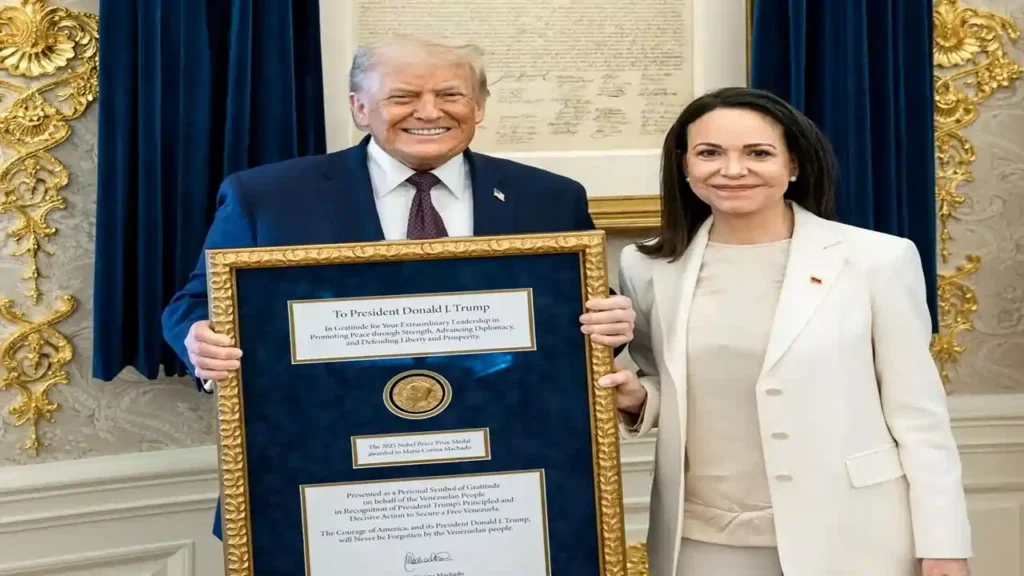
New Delhi: In one of the most symbolically charged diplomatic moments of recent years, Venezuelan opposition leader María Corina Machado personally handed her 2025 Nobel Peace Prize medal to the U.S. President Donald Trump during a private Oval Office meeting on Thursday afternoon.
The gesture, which Machado described as recognition of Trump’s “unique commitment” to the freedom of the Venezuelan people, has intensified debate about U.S. policy toward Venezuela’s post-Maduro transition and the meaning of the Nobel award itself.
Historical Context of the Nobel Peace Prize
Established under the will of Alfred Nobel, the Nobel Peace Prize honors individuals or organizations that have done “the most or the best work for fraternity between nations, for the abolition or reduction of standing armies and for the holding and promotion of peace congresses.”
Since World War II, the Norwegian Nobel Committee has primarily recognized four main areas of work: arms control and disarmament, peace negotiations, advancement of democracy and human rights, and efforts to create a better organized and more peaceful world. In the 21st century, contributions to combating man-made climate change and environmental threats have also become relevant considerations.
The prize consists of a gold medal (18 carats, 196 grams, 6.6 cm in diameter), a diploma, and a monetary award currently set at 11 million Swedish kronor. Notable Indian recipients include Mother Teresa (1979), the 14th Dalai Lama (1989), and Kailash Satyarthi (2014).
Importantly, while the honor and title of Nobel laureate are non-transferable — once announced, the decision is final, irrevocable, and cannot be shared or reassigned — the physical medal itself may be gifted, loaned, auctioned, or displayed by others. A well-known precedent occurred in 2022 when Russian journalist Dmitry Muratov auctioned his medal for more than $103 million to support Ukrainian refugees.
The Norwegian Nobel Committee’s Clear Position
In response to speculation surrounding Thursday’s event, the Nobel Committee issued multiple clarifying statements over the past week. Their position remains unequivocal:
“Once a Nobel Prize is announced, it cannot be revoked, shared, or transferred to others. The decision is final and stands for all time.”
A separate post from the Nobel Peace Center on X (formerly Twitter) added: “A medal can change owners, but the title of a Nobel Peace Prize laureate cannot.”
Symbolic Gesture Draws on 200-Year-Old Historical Parallel
During her remarks to reporters outside the White House, Machado explicitly connected her action to a celebrated moment in shared hemispheric history. In 1825, the Marquis de Lafayette sent a gold medal bearing the likeness of George Washington to Simón Bolívar as a symbol of solidarity between the United States and the independence struggles of South America.
“Two hundred years later,” Machado declared, “the people of Bolívar are giving back to the heir of Washington a medal — in this case the Nobel Peace Prize medal — as recognition for his unique commitment to our freedom.”
Timing and Venezuela’s Rapidly Evolving Political Reality
The presentation comes just weeks after U.S. special forces captured former President Nicolás Maduro in Caracas on January 3, 2026, in a high-profile snatch operation. Maduro was subsequently transferred to the United States, where he faces federal drug-trafficking charges.
Since Maduro’s removal, Delcy Rodríguez — his longtime vice president — has assumed the role of acting president. The Trump administration has described Rodríguez as “extremely cooperative” and has engaged her directly in diplomatic discussions.
On Wednesday, January 14, Trump and Rodríguez held what both sides described as a “productive and courteous” telephone conversation characterized by “mutual respect.” Hours later, the U.S. government announced the completion of its first direct purchase of Venezuelan crude oil since the operation — a transaction valued at approximately $500 million.
U.S. naval forces also reported boarding a sixth tanker suspected of carrying sanctioned Venezuelan oil on Thursday morning.
Trump’s Response and Longstanding Nobel Interest
President Trump, who has repeatedly expressed his personal desire to be awarded the Nobel Peace Prize, responded enthusiastically to the gesture on social media:
“Maria presented me with her Nobel Peace Prize for the work I have done. Such a wonderful gesture of mutual respect. Thank you Maria!”
The White House later released an image showing Trump holding the medal in a large, gold-colored frame bearing the inscription:
“To President Donald J. Trump In Gratitude for Your Extraordinary Leadership in Promoting Peace through Strength”
— described as a “Personal Symbol of Gratitude on behalf of the Venezuelan People.”
White House officials confirmed that the president intends to keep the medal.
Machado’s Capitol Hill Meetings and Opposition Perspective
After leaving the White House, Machado traveled to Capitol Hill where she met with more than a dozen senators from both parties. Supporters outside the building chanted “María, presidente” and waved Venezuelan flags as she spoke briefly to the press.
Democratic Senator Chris Murphy (Connecticut), who participated in the meeting, reported that Machado described the human rights situation inside Venezuela as largely unchanged under Rodríguez, whom he called a “smooth operator” steadily consolidating power with apparent American acquiescence. Murphy expressed significant skepticism about the prospects for genuinely competitive elections in the near term.
Freddy Guevara, co-founder of the opposition party Voluntad Popular and a former political prisoner now living in exile, defended the medal presentation, insisting it was not a tactical maneuver for personal endorsement but rather a principled recognition of Trump’s decisive role in removing Maduro.
Competing Priorities: Oil, Stability, and Democracy
Despite describing Machado as a “wonderful woman who has been through so much” and a “freedom fighter,” President Trump has consistently declined to endorse her as the leader of a transitional government, citing what he views as insufficient domestic support inside Venezuela.
The Trump administration has repeatedly emphasized that its primary focus in Venezuela is securing reliable access to the country’s oil resources and achieving economic stabilization, rather than immediately installing a new political leadership.
As Venezuela enters what may prove to be the most consequential political transition in more than two decades, Thursday’s dramatic medal ceremony has become a powerful visual symbol of the competing narratives now shaping the country’s future: the opposition’s demand for full democratic restoration versus Washington’s apparent preference for pragmatic engagement and energy-market stability.
Frequently Asked Questions
1. Can María Corina Machado actually transfer the Nobel Peace Prize to Donald Trump?
No. The Norwegian Nobel Committee has made it very clear that the Nobel Peace Prize itself — meaning the official honor, title, and status of being a laureate — cannot be transferred, shared, revoked, or given to anyone else. Once the prize is announced, the decision is final and permanent.
What was transferred on January 15, 2026, was only the physical gold medal (18-carat, 196 grams). The Nobel Committee has repeatedly stated: “A medal can change owners, but the title of a Nobel Peace Prize laureate cannot.” María Corina Machado remains the sole 2025 Nobel Peace Prize laureate.
2. Why did María Corina Machado decide to give the medal to President Trump?
According to Machado’s own statements, she presented the medal as a symbolic recognition of what she called Donald Trump’s “unique commitment” to the freedom of the Venezuelan people, particularly following the U.S. operation that removed Nicolás Maduro from power on January 3, 2026.
She also drew a historical parallel to 1825, when the Marquis de Lafayette gifted a George Washington medal to Simón Bolívar as a sign of brotherhood between the United States and Venezuela in their shared struggle against tyranny. Machado framed the 2026 gesture as a 200-year reciprocal act of gratitude.
Many analysts interpret the move as an attempt to build personal rapport with President Trump and influence U.S. policy during Venezuela’s delicate political transition.
3. What has been the Trump administration’s position on supporting Machado as Venezuela’s leader?
Despite the warm public language — Trump has called Machado a “wonderful woman” and a “freedom fighter” — the administration has consistently declined to endorse her as the leader of a transitional or future government.
White House officials, including Press Secretary Karoline Leavitt, have described Machado as a “remarkable and brave voice” but maintain that she currently lacks sufficient domestic support inside Venezuela to lead in the short term. Instead, the Trump administration has engaged directly with acting President Delcy Rodríguez, describing her as “extremely cooperative” and prioritizing secure access to Venezuelan oil over immediate installation of opposition figures.
4. What is the current focus of U.S. policy toward Venezuela following Maduro’s removal?
The Trump administration has emphasized two main priorities:
- Securing reliable access to Venezuela’s oil resources. On January 14, 2026, the U.S. completed its first direct purchase of Venezuelan crude (valued at approximately $500 million) since Maduro’s capture, and U.S. forces have boarded multiple tankers suspected of carrying sanctioned oil.
- Maintaining pragmatic diplomatic engagement with the current acting government led by Delcy Rodríguez, who has expressed willingness to travel to Washington and proposed reforms to attract foreign investment in Venezuela’s oil sector.
While the administration has welcomed the release of some political prisoners, officials have indicated that rapid, full-scale democratization is not the immediate priority compared to energy market stability and economic rebuilding.
5. Is the Nobel Peace Prize medal still considered Machado’s, even after she gave it away?
Yes — in terms of the official Nobel honor. The Norwegian Nobel Committee’s rules are unambiguous: the title and laureateship belong exclusively to María Corina Machado and cannot be reassigned.
The physical medal is now in President Trump’s possession (the White House confirmed he intends to keep it), similar to how other laureates have gifted, loaned, or auctioned their medals in the past (most notably Dmitry Muratov’s 2022 auction that raised over $103 million for Ukrainian refugees). The distinction between the intangible honor and the tangible object remains the key legal and symbolic point emphasized by the Nobel organizers.