

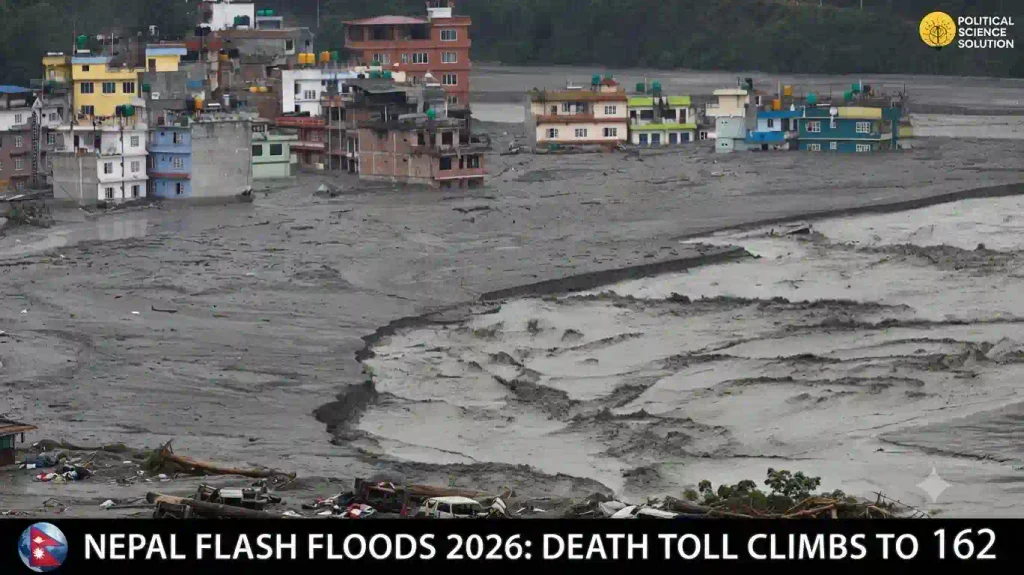
New Delhi: A catastrophic flash flood triggered by a glacial collapse has devastated communities along the Nepal-Tibet border, killing at least 162 people in Nepal and leaving hundreds unaccounted for on both sides of the frontier. The disaster, which struck early on Wednesday in Rasuwa district near the Tibet border, sent massive volumes of water, mud, and debris surging down the Bhote Koshi and Trishuli rivers, destroying homes, bridges, roads, and hydropower facilities. As of Thursday morning, Nepal’s disaster agency reported 823 people still out of contact, while Chinese state media indicated 558 missing in Tibet’s Gyirong county, including 260 foreign nationals. Search, rescue, and relief operations continue under challenging conditions of destroyed infrastructure, soft mud, and forecast rain.
Rising Death Toll and Missing Persons Across Borders
Nepal Police confirmed the death toll in the Bhotekoshi River flash flood had risen to 162 by Thursday, one day after the waters tore through three districts. Earlier figures had stood at 157 and then 160. Chinese authorities reported three deaths in Gyirong county but warned of potentially major casualties as teams reach more remote areas. The border crossing at Gyirong serves as a primary route for tourists and trade between China and Nepal, amplifying the human impact.
Hundreds of tourists and travellers remain missing. Nepal’s Department of Tourism stated that 468 tourists and travellers were out of contact, of whom 393 were foreign nationals and 75 Nepali. Earlier estimates put the figure near 579 tourists, including more than 400 foreigners. Among those unaccounted for are significant numbers of Indian nationals—reports cite 133 or 142 Indians—alongside 54 from the United States, 34 from Australia, 33 from the United Kingdom, and others from Malaysia, the Netherlands, Portugal, South Africa, South Korea, and additional countries. Alpine Eco Trek confirmed 12 British nationals on one of its tours across the Nepal-Tibet border were missing, along with two Irish and four South African nationals. The ages of the missing British citizens reportedly range from 13 to 65. Twenty-eight Nepalese police personnel are also among the missing. It remains unclear whether some individuals appear in both Nepalese and Chinese tallies.
Glacial Collapse Confirmed as Primary Cause
The US Geological Survey clarified the origin of the event. What was initially recorded as a 4.4-magnitude earthquake was in fact seismic energy generated by a glacial collapse and subsequent debris flow. The agency described “catastrophic” downstream impacts in both Nepal and Tibet. Climate specialists at the International Centre for Integrated Mountain Development noted that an ice-rock avalanche from a glacier on the Nepal side likely blocked the Lhende Khola, a tributary of the Bhote Koshi, before releasing a sudden surge. The same river had flooded twice within 14 months; the previous event was linked to the draining of a supraglacial lake in Tibet. Global warming and possible seismic activity in Tibet have been cited by observers as contributing factors. There was no heavy rainfall at the time of the disaster, leaving many residents and travellers unprepared.
Devastating Visual Evidence from Verified Footage
Verified video footage captured the force of the flood. In the Trishuli Bazaar area of Nuwakot district, approximately 25 kilometres northwest of Kathmandu, the Trishuli River rapidly swelled with sediment-laden water. Within seconds a bridge was ripped from its supports and carried downstream; multi-storey buildings collapsed. A second clip from the same location showed the aftermath—trees gone, buildings destroyed or coated in mud, the river level dramatically higher. Another video filmed from inside a bus recorded dozens of people fleeing on foot, mopeds, and vehicles as floodwaters surged along the valley road. Passengers can be heard shouting in alarm. Security footage from the Chinese side of the border showed a wall of mud and debris crashing over a multi-storey building while people ran for safety below.
Widespread Infrastructure Destruction
Damage to infrastructure has been extensive. At least 19 motorable bridges were destroyed. Roughly 40 kilometres of the Betrawati–Rasuwagadhi highway were washed away. Eight operational hydropower projects suffered heavy damage. The Nepal Electricity Authority reported that about 430 megawatts of production capacity from hydropower and solar facilities had been affected, disrupting electricity supply. The Trishuli hydropower project was among those hit. Roads, communications, and power systems in the region remain disrupted. The main road to Kathmandu was closed. In Rasuwa district, home to roughly 50,000 people, floodwaters remained too high in Syapru Besi and Timure for helicopters to land safely. The Nepal Army has been rescuing people from Mailung village, where 115 individuals were reported in need of extraction. Officials have warned of huge-scale loss in Timure, Syabrubesi, and Betrawati.
Survivor Accounts Reveal Sudden Horror
Survivors have described the suddenness of the event. Keshav Prasad Baral, 68, being treated in a Nuwakot hospital, said a huge gush of mud approached his home. He tried to pull his wife to the terrace, but she was swept away. Hours later a helicopter rescued him; his wife remains missing beneath the mud. Yee Liang, a Chinese businessman based in Kathmandu, reported losing contact with seven container trucks and their Nepalese staff in the area. Guan Daoxuan in Sichuan province lost contact with his wife, who worked for a state-run construction company on roads and bridges in Tibet. Strong winds have hindered helicopter inspections.
Nepal Intensifies Search, Rescue and Relief Operations
Nepal has intensified search, rescue, and relief operations. The Prime Minister’s Office stated that the government has activated Nepali Army and private-sector helicopters along with foot teams in Timure, Syabrubesi, and riverine areas. Essential food items, tents, medicines, and other relief materials have been delivered. Residents living near river banks have been urged to remain on high alert. Prime Minister Balendra Shah convened an emergency meeting of the National Disaster Risk Reduction and Management Authority and called for unity and patience. “The government takes full responsibility for your rescue, treatment, food and shelter,” he said. “In times of such a disaster, we all need to stand together.” Coordination is under way with medical teams, scouts, and the Red Cross.
India’s Swift Humanitarian Response and Helpline Activation
India has responded swiftly. Prime Minister Narendra Modi spoke with his Nepalese counterpart, conveying condolences and assuring all possible humanitarian assistance. “The people of India stand in solidarity with their sisters and brothers in Nepal at this difficult time,” Modi posted. External Affairs Minister S. Jaishankar announced the dispatch of 10 tonnes of Humanitarian Assistance and Disaster Relief material and essential medicines, delivered by an Indian Air Force C-130J aircraft. Items include temporary shelters, blankets, hygiene kits, solar lamps, and medicines. Multiple Indian states have activated helplines for citizens stranded in Nepal or Tibet. The Embassy of India in Nepal issued numbers 977 985 131 6807, 977 970 910 7500, and 977 981 032 6117, also available on WhatsApp. Karnataka activated its State Emergency Operation Centre at 1070 and 080-22253707. Telangana set up a coordination centre with contacts including Vandhana at 9871999044. West Bengal provided Kolkata Police helpline 18003455678 and WhatsApp 9874902880. Uttar Pradesh directed residents to call 1070. Maharashtra activated a toll-free control room at 1070 and additional numbers. Kerala listed 9447111844 and 9737132147. Rajasthan’s Disaster Management Department offered 1070, 112, and several Jaipur numbers. Odisha opened a 24×7 control room in New Delhi. Sikkim established dedicated numbers for its residents. Officials in Uttar Pradesh, Bihar, and Uttarakhand placed border districts on high alert and began evacuations, watching for possible rises in the Gandak and other Nepal-originating rivers. Bihar Chief Minister Samrat Choudhary directed officials to remain vigilant and indicated he might visit Valmikinagar if needed.
International Aid and Diplomatic Support
The United States extended deepest condolences and pledged 500,000 dollars in emergency assistance for shelter, relief items, water, sanitation, and hygiene. A disaster response advisor is being deployed. Australia’s Prime Minister Anthony Albanese confirmed 34 Australian nationals missing and described the event as “truly horrific.” Foreign Minister Penny Wong noted that information remained “very limited.” Australian authorities are liaising with local officials and tour operators. South Korea reported eight citizens working on a hydropower plant missing and ten others stranded; a task force has been formed and a rapid-response team prepared. The United Nations is mobilising supplies and personnel to support Nepal’s government-led response. UN Secretary-General António Guterres expressed sadness at the severe flooding.
Political Voices and Public Statements
Congress MP Shashi Tharoor, who travelled to Kathmandu on Wednesday, said he was “blissfully unaware” of the disaster until arrival. He noted the loss of life, the estimated thousands missing, the destruction of bridges and highway sections, and damage to hydropower projects. He expressed full support for India’s relief pledge and offered prayers for the missing, including many Indian tourists on the Kailash-Mansarovar Yatra.
China’s Response and Ongoing Challenges
China’s President Xi Jinping has called for all-out search efforts and strengthened monitoring to prevent secondary disasters. Thousands of personnel—firefighters, police, military, and engineering teams with life-detection equipment—have been deployed by both Nepal and China. Access remains difficult: roads and bridges are destroyed, deep soft mud hinders heavy machinery, and rain is forecast for the coming days. Communications and power outages continue to complicate coordination.
Regional Context and Climate Links
The Bhote Koshi River originates in Tibet, flows into Nepal’s Trishuli River, and eventually joins the Gandak in India. A flood on the same river last year killed nine people, left 24 missing, and washed away the Friendship Bridge, disrupting transport and trade for months. Scientists note that climate change is increasing the frequency and intensity of extreme weather events across the region, raising the risk of glacial lake outbursts and avalanche-triggered floods in the Himalayas.
As rescue teams press on, families across Nepal, India, China, Australia, the United States, the United Kingdom, and other nations wait for news of the missing. The full scale of the tragedy will become clearer only as access improves and recovery operations advance. Nepal continues to urge residents near vulnerable river banks to stay alert while governments and international partners coordinate relief.
FAQs
1. What caused the deadly flash floods in Nepal near the Tibet border?
The flash floods were triggered by a glacial collapse that generated seismic activity and a massive debris flow. The US Geological Survey confirmed that what was initially recorded as a 4.4-magnitude earthquake was actually the energy released by the glacial collapse and subsequent debris surge. Climate experts from the International Centre for Integrated Mountain Development stated that an ice-rock avalanche from a glacier on the Nepal side blocked the Lhende Khola (a tributary of the Bhote Koshi River) before releasing a sudden downstream surge. There was no heavy rainfall at the time, and factors such as global warming and possible seismic activity in Tibet have been cited as contributing elements. The same river system had experienced flooding twice within 14 months.
2. How many people have died and how many remain missing?
As of Thursday, Nepal Police confirmed at least 162 deaths in Nepal. Chinese state media reported three deaths in Tibet’s Gyirong county. Nepal’s disaster agency stated that 823 people remained out of contact. Around 468 tourists and travellers (including 393 foreign nationals and 75 Nepalis) were reported out of contact by Nepal’s tourism department, with earlier estimates closer to 579. Chinese media reported 558 people missing in Tibet, of whom 260 were foreign nationals. Among the missing are approximately 133–142 Indians, 54 US nationals, 34 Australians, 33 UK nationals, and others from several countries, along with 28 Nepalese police personnel. It is unclear whether some individuals have been counted in both countries’ figures.
3. What assistance has India provided and which helplines are available?
India dispatched 10 tonnes of Humanitarian Assistance and Disaster Relief material along with essential medicines via an Indian Air Force C-130J aircraft. The supplies include temporary shelters, blankets, hygiene kits, solar lamps, and medicines. Prime Minister Narendra Modi spoke with Nepal’s Prime Minister Balendra Shah and assured full humanitarian support. Multiple Indian states and the Embassy of India in Kathmandu have activated helplines. Key numbers include the Embassy of India (977 985 131 6807, 977 970 910 7500, 977 981 032 6117), Karnataka SEOC (1070 / 080-22253707), Uttar Pradesh (1070), Maharashtra (1070), West Bengal (18003455678), Kerala (9447111844 / 9737132147), and dedicated lines for Telangana, Rajasthan, Odisha, and Sikkim. Border districts in Uttar Pradesh, Bihar, and Uttarakhand have also been placed on high alert.
4. Which areas and infrastructure were most affected?
The floods primarily hit Rasuwa district in northern Nepal along the Bhote Koshi and Trishuli rivers, near the Tibet border, with impacts extending into Nuwakot and other nearby areas. At least 19 motorable bridges were destroyed, approximately 40 km of the Betrawati–Rasuwagadhi highway was washed away, and eight operational hydropower projects suffered heavy damage. About 430 megawatts of electricity generation capacity was affected. Roads, communications, and power systems remain disrupted, and the main road to Kathmandu was closed. In Tibet, Gyirong county (the main border crossing) was severely impacted. Villages such as Timure, Syabrubesi, Betrawati, and Mailung faced major destruction, with floodwaters preventing helicopter landings in some locations.
5. What is the current status of rescue operations and international support?
Nepal has intensified search, rescue, and relief efforts using army and private helicopters, foot teams, and delivery of food, tents, and medicines. Prime Minister Balendra Shah has called for unity and stated that the government is responsible for rescue, treatment, food, and shelter. China has deployed thousands of personnel and called for all-out search efforts. The United States pledged $500,000 in emergency aid and is sending a disaster response advisor. Australia is working to locate 34 missing citizens, South Korea has formed a task force for its missing nationals, and the United Nations is mobilising supplies and personnel. Challenges include destroyed roads and bridges, deep soft mud, communication outages, and forecast rain, which continue to slow access to the worst-hit areas.