

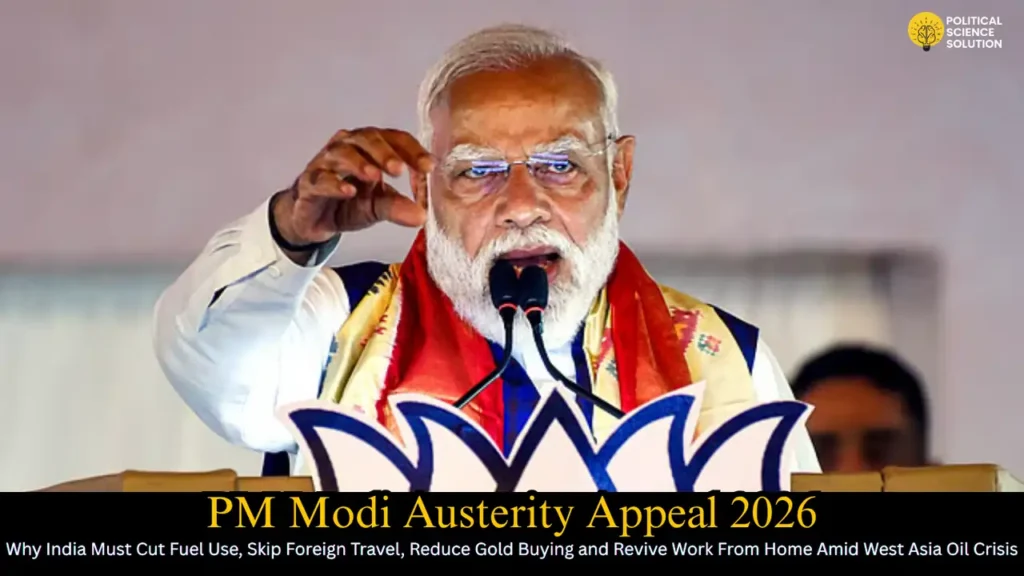
New Delhi: Prime Minister Narendra Modi has issued a strong call for voluntary austerity measures across India, urging citizens to make immediate behavioural changes to safeguard the economy amid severe disruptions caused by the ongoing conflict in West Asia. In his address delivered on May 10, 2026, in Hyderabad, the Prime Minister outlined a comprehensive seven-point plan focused on conserving fuel, saving foreign exchange, and building national resilience during what is being described as a major external economic shock.
The appeal comes as the Strait of Hormuz — the narrow chokepoint handling roughly one-fifth of global oil trade — remains under severe stress for over 75 days since the escalation of hostilities on February 28. Insurance premiums for oil tankers have skyrocketed, shipping schedules are heavily disrupted, and Brent crude oil prices have surged sharply from the $62-70 per barrel range seen for much of FY 2025-26 to above $110 per barrel by March 2026. Recent renewed attacks and retaliations have raised serious concerns about any quick resolution to the crisis.
India, which imports nearly 88-90% of its crude oil requirements, is facing direct and structural challenges. Much of this oil either originates from or passes through the Gulf region. Russia supplied 31.5% of India’s crude imports during the April-January period of FY 2025-26, but the broader disruption has still caused a significant spike in the country’s annual oil import bill, which typically ranges between $140 billion and $160 billion. A sustained $10 rise in crude prices alone is estimated to add $13-15 billion to the yearly import burden.
Pressure on Foreign Exchange Reserves and Rupee
India’s foreign exchange reserves currently stand near $690 billion. While this appears strong on paper, the reserves are under sustained pressure due to RBI interventions to support the rupee, capital outflows by foreign institutional investors, and the rising cost of oil imports. The current account deficit widened to $13.2 billion, or 1.3% of GDP, in the October-December quarter of 2025-26.
Gold imports have emerged as a major concern, hitting a record $71.98 billion in FY 2025-26 — a 24% increase from the previous year. This surge, driven largely by rising global prices, puts additional pressure on dollar outflows at a time when every discretionary foreign exchange expenditure matters. The Prime Minister specifically urged citizens to avoid buying more gold and to limit foreign travel and destination weddings for at least one year to help conserve precious foreign exchange reserves.
Key Details of PM Modi’s Seven-Point Austerity Appeal
In his speech, Prime Minister Modi asked Indians to treat the current situation as an economic emergency and revive the discipline observed during the COVID-19 pandemic. The main points include:
- Fuel Conservation and Reduced Travel: Citizens should use petrol, diesel, cooking gas, and other petroleum products judiciously. Limit unnecessary travel, prefer public transport such as metros, opt for carpooling and ride-sharing, and shift to electric vehicles wherever possible. The transport sector accounts for nearly half of India’s petroleum consumption.
- Work From Home Revival: Restart work-from-home practices and use video conferencing for meetings to reduce commuting and overall fuel demand. This measure aims to bring down road and air travel significantly.
- Avoid Foreign Travel and Destination Weddings: Skip overseas vacations and destination weddings for the next one year to save foreign exchange.
- Reduce Gold Purchases: Cut down on gold buying to ease pressure on the country’s external balances.
- Buy Local Products: Support the “Make in India” initiative by preferring domestically manufactured goods over imports, thereby reducing demand for foreign currency. Domestic supply constraints make this a direct call to consume more judiciously.
- Agricultural Reforms for Energy Security: Farmers should reduce chemical fertilizer usage by half and shift towards natural farming methods. Replace diesel-powered irrigation pumps with solar alternatives. These steps address both rising costs of imported fertilizers due to global energy shocks and long-term energy security in rural areas. The Prime Minister highlighted that while international urea prices are around Rs 3,000 per bag, Indian farmers receive it at just Rs 300, underscoring government support.
- Corporate and Logistics Measures: Industries should shift goods movement from road trucks to rail transport. Promote wider adoption of solar energy solutions. Additionally, households should reduce cooking oil consumption by 50% to save foreign exchange while also gaining health benefits.
The Prime Minister linked these actions to a broader definition of patriotism, stating that in these challenging times, living responsibly and fulfilling daily duties towards the nation is as important as other forms of national service. He noted that the government is making efforts on its part, including expanding access to LPG for the poor and piped natural gas connections, but collective public participation is essential.
This coordinated messaging also aligned with similar appeals made to the corporate sector by industry bodies, indicating the gravity of the situation.
Economic Challenges and Potential Risks
The West Asia crisis has already begun showing effects on multiple fronts. High-frequency economic indicators are reflecting damage, with risks of higher inflation, supply chain issues, and slower growth. The rupee has touched record lows in recent weeks, increasing the cost of all imports and adding to inflationary pressures. Sectors such as glass, plastics, and tiles manufacturing are seeing hundreds of thousands of jobs at risk due to energy and raw material shortages. Fertilizer supply constraints raise fears of lower agricultural output and rising food prices in the coming months.
India’s Strategic Petroleum Reserves, located in Visakhapatnam, Mangaluru, and Padur, hold approximately 5.33 million metric tonnes or about 37 million barrels. This provides emergency cover for only 9-10 days of crude needs. When combined with commercial inventories held by refineries, the total buffer extends to roughly 70-74 days under normal consumption levels. Reports suggest rising pressure on these reserves, although official confirmation on drawdowns is not available.
Experts point out that while supply-side management can buy time, only demand-side moderation through reduced consumption can fundamentally alter the equation. The government has so far refrained from increasing petrol and diesel prices at the pump, but analysts suggest revisions could become necessary soon.
Market Reaction to the Austerity Call
Financial markets reacted swiftly to the Prime Minister’s address. On May 11, 2026, the benchmark Sensex index dropped more than 1,000 points in early trading, with analysts attributing part of the decline to fears of prolonged economic disruption and the possibility of further measures.
Global Context and Responses by Other Countries
The International Energy Agency has called the current disruption in oil supplies the largest in history. Several nations have already implemented stronger measures. China directed its oil refineries to halt fuel exports temporarily, while facing higher domestic fuel prices and reduced airline operations. Some Australian states made public transport free or significantly cheaper to discourage private vehicle use. The Philippines declared a national emergency, offering subsidies to transport operators, reducing ferry services, and introducing a four-day work week for government employees. Sri Lanka implemented fuel rationing and similar weekly restrictions, including closures of educational institutions on certain days.
India’s approach remains focused on voluntary participation rather than immediate mandatory restrictions or price hikes.
Political Reactions and Broader Implications
Opposition leaders have criticised the timing and content of the appeal, arguing that it shifts the burden onto ordinary citizens. Congress leader Rahul Gandhi described the suggestions as evidence of planning shortcomings rather than mere advisories, accusing the government of transferring responsibility while avoiding direct accountability.
The address marks a notable shift in economic communication. For years, India’s growth story emphasized infrastructure development, manufacturing push, digital transformation, and high economic ambitions. The current crisis is forcing a stronger focus on resilience — the ability to withstand energy shocks, inflation spikes, currency volatility, and supply chain fragmentation arising from geopolitical conflicts.
Historical parallels from 2022, when Brent crude rose sharply from $80 to near $130 per barrel, showed how such events can directly affect household budgets through higher import bills, rupee depreciation, and elevated inflation.
The Road Ahead for India’s Economy
Prime Minister Modi’s appeal seeks to harness collective citizen action to moderate demand, particularly in the transport and consumption sectors, while encouraging long-term shifts such as greater use of solar energy, natural farming, and rail logistics. Whether voluntary restraint on the required scale can be achieved without formal enforcement mechanisms remains a key question. The COVID-era behavioural changes succeeded under conditions of fear and restrictions; the current economic challenge lacks those elements but carries deep macroeconomic consequences.
As the situation in West Asia continues without a clear end in sight, India faces a critical test. The coming months will likely bring challenges related to inflation management, agricultural production (especially with El Niño concerns), industrial output, and overall growth momentum. Success will depend on how effectively citizens, businesses, and policymakers respond to the call for prudent resource use and strategic adaptation.
The Prime Minister’s message serves as both an early warning and a call for unified national effort. By connecting everyday choices — from commuting patterns and wedding plans to farming practices and purchasing decisions — with the country’s economic security, the address aims to foster a sense of shared purpose.
India’s $690 billion forex buffer provides some cushion, but sustained pressures from higher oil costs and other imports mean careful management is essential. The government appears to be preparing the ground for potential tougher measures if voluntary actions prove insufficient.
This period of economic strain highlights the interconnected nature of global geopolitics and domestic realities. As India navigates these challenges, the focus on energy security, import substitution, and resilient growth will likely shape policy priorities in the months and years ahead.
The test of India’s economic resilience has begun. How citizens and institutions respond to this call for responsible consumption and patriotic action will play a decisive role in determining the trajectory through this difficult phase.
FAQs
1. Why did PM Modi urge Indians to follow austerity measures in May 2026?
Prime Minister Narendra Modi appealed to citizens on May 10, 2026, in Hyderabad to adopt voluntary austerity because of severe disruptions in the West Asia conflict, particularly the prolonged closure and stress in the Strait of Hormuz for over 75 days. This has caused a sharp surge in global crude oil prices (above $110 per barrel) and is putting heavy pressure on India’s foreign exchange reserves, rupee, and oil import bill. The measures aim to reduce fuel consumption, conserve dollars, and build economic resilience before the situation worsens.
2. What are the main points of PM Modi’s austerity appeal to Indians?
PM Modi suggested a seven-point plan that includes:
• Using petrol, diesel, and cooking gas judiciously and reducing unnecessary travel.
• Reviving Work From Home (WFH) and video conferencing to cut commuting.
• Avoiding foreign travel and destination weddings for one year.
• Reducing or stopping gold purchases.
• Buying local “Make in India” products instead of imports.
• Farmers halving chemical fertilizer use, adopting natural farming, and switching to solar pumps.
• Cutting household cooking oil consumption by 50%, shifting goods transport to rail, and promoting electric vehicles and solar energy.
3. How is the West Asia crisis affecting India’s economy?
The crisis has disrupted oil supplies through the Strait of Hormuz, causing India’s oil import bill to spike significantly. With 88-90% oil import dependency, the rupee has hit record lows, inflation pressures are rising, and sectors like glass, plastics, tiles, and agriculture face risks. Gold imports ($71.98 billion in FY 2025-26) and capital outflows are further straining the $690 billion forex reserves. Strategic petroleum reserves currently offer limited emergency cover.
4. Will petrol and diesel prices increase after PM Modi’s austerity appeal?
The government has so far avoided raising petrol and diesel prices, especially before recent elections. However, analysts believe a price hike may be unavoidable soon due to the sustained high global crude prices and pressure on oil marketing companies. The austerity appeal is seen as an attempt to moderate demand voluntarily before taking harder steps like direct price revisions or rationing.
5. Is PM Modi’s call for Work From Home and reduced gold buying enough to solve the crisis?
The appeal focuses on voluntary behavioural changes rather than mandatory rules. While it can help reduce fuel demand (transport consumes nearly 50% of petroleum) and save foreign exchange, experts say its success depends on large-scale public participation. It buys time through demand moderation but may need to be supported by stronger policy measures if the West Asia conflict continues for a long time. The government is also pushing longer-term solutions like solar energy, natural farming, and rail logistics.