

New Delhi: In a landmark ruling that balances human safety with animal welfare concerns, the Supreme Court of India on May 19, 2026, explicitly allowed authorities to euthanize rabid, incurably ill, or demonstrably dangerous and aggressive stray dogs. The apex court firmly declined to recall or modify its earlier November 7, 2025 directions mandating the complete removal of stray dogs from high-footfall public institutions such as schools, hospitals, railway stations, bus depots, and airports. This decision comes amid rising public anxiety over frequent dog bite incidents that have claimed lives and caused widespread injuries, particularly affecting children, the elderly, and international travelers.
The three-judge bench comprising Justices Vikram Nath, Sandeep Mehta, and N.V. Anjaria emphasized that the constitutional framework does not grant stray dogs an absolute or indefeasible right to occupy all public spaces regardless of their purpose or the risks they pose. This ruling marks a significant development in India’s ongoing struggle with urban stray animal management, prioritizing the right to life and dignity under Article 21 of the Constitution for human citizens.
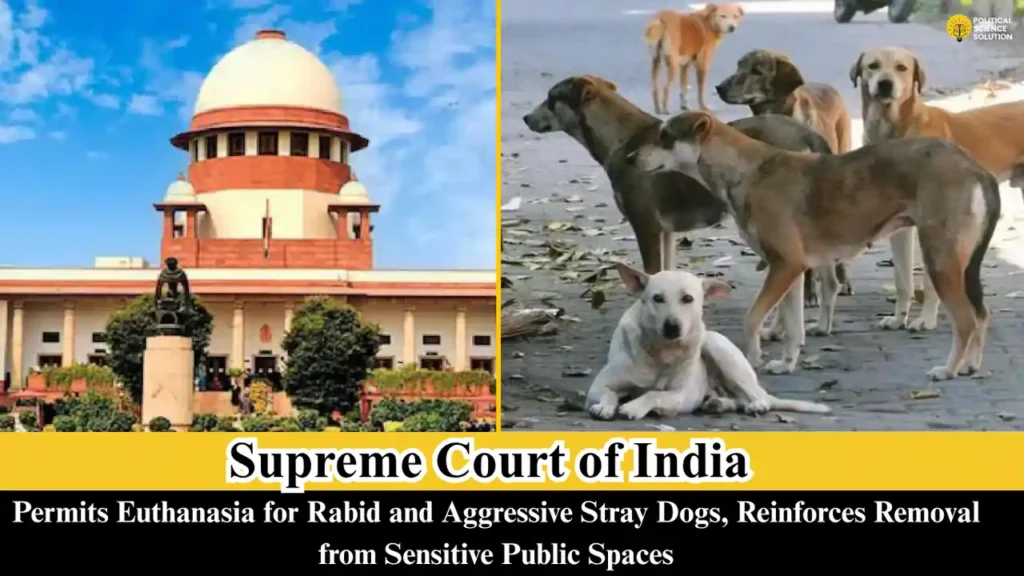
Understanding the Core of the Supreme Court Order
The Supreme Court clarified that dogs found occupying institutional premises cannot be classified as “street dogs” or “community dogs” under the Animal Birth Control (ABC) Rules, 2023. Consequently, they do not enjoy protections that would allow their re-release into these sensitive zones even after sterilization and vaccination. The bench observed that Article 21, which guarantees the right to live with dignity, extends to every citizen’s freedom to access public places without the constant fear of physical attacks or life-threatening dog bites.
“The State cannot remain a passive spectator where preventable threats to human life continue to proliferate in the face of statutory mechanisms specifically designed to address them,” the court noted, underscoring the urgency of the situation. This interpretation reinforces that public safety must take precedence when weighing human lives against the welfare of animals in high-risk scenarios.
The order was delivered while hearing petitions seeking modifications to the November 2025 directives. Several animal welfare organizations and dog lovers had approached the court arguing against mass relocation and removal measures, but the bench dismissed these pleas after careful consideration of ground realities.
Alarming Statistics Driving Judicial Intervention
The Supreme Court referred to multiple reports highlighting the escalating crisis. In Udaipur, approximately 1,750 dog-bite cases were recorded in 2026 so far, while Bhilwara reported 42 persons bitten in a single day. Tamil Nadu alone documented around 2.63 lakh dog-bite cases and 17 related deaths in the first four months of 2026. Even critical infrastructure like Delhi’s Indira Gandhi International Airport witnessed at least 31 dog-bite incidents since January 1, 2026.
These figures, coupled with tragic incidents involving children and vulnerable populations, compelled the court to act decisively. The bench stated it “cannot remain oblivious to harsh ground realities” where preventable attacks continue unabated despite existing laws.
Key Directives Issued by the Supreme Court
The judgment outlines a comprehensive set of actionable directions aimed at both immediate relief and long-term systemic improvement:
- Euthanasia as a Legally Permissible Measure: Municipal and local authorities are now empowered to euthanize rabid, incurably ill, or demonstrably dangerous/aggressive dogs following due assessment by qualified veterinary experts. This is positioned as a necessary step in areas where stray dog populations have reached alarming levels and pose continuous threats to public safety.
- Establishment of ABC Centres: Every district across States and Union Territories must have at least one fully functional Animal Birth Control Centre equipped with adequate veterinary infrastructure, trained personnel, and surgical facilities. The number of such centres should be scaled up based on population density and territorial needs. The court expressed disappointment over the lack of sustained efforts in the nearly two decades since the ABC framework was introduced.
- Anti-Rabies Preparedness: States must ensure adequate stocks of anti-rabies vaccines and immunoglobulins in all government medical facilities, alongside effective public health response mechanisms for dog-bite incidents.
- Protection for Officials: Local body officials performing duties in good faith are shielded from frivolous FIRs or criminal complaints. High Courts have been empowered to quash vexatious or malicious proceedings against such officials.
- Highway Clearance: The National Highways Authority of India (NHAI) has been directed to address the menace of stray cattle on highways to prevent accidents and ensure road safety.
- Enforcement of AWBI Rules: Strict compliance with Animal Welfare Board of India guidelines has been mandated for all States and UTs.
- Liability for Feeders: Animal welfare groups, NGOs, or student bodies feeding or maintaining stray dogs within educational institutions must file affidavits undertaking tortious liability. Failure to do so will result in prohibition of such activities on institutional premises.
- Judicial Monitoring Mechanism: Recognizing the administrative burden, the Supreme Court has directed all High Courts to initiate suo motu proceedings to monitor compliance with its August and November 2025 orders. Chief Secretaries must submit status reports by August 7, 2026, with consolidated reports to be placed before the apex court every four months. Non-compliance will invite contempt and disciplinary proceedings.
The matter has been posted for further hearing on November 17, 2026.
Ethical Dimensions and the Compassion Debate
While the ruling prioritizes human safety, it inevitably raises profound ethical questions. Animal rights advocates argue that permitting euthanasia risks transforming it into a convenient population control tool rather than a measure of last resort. There are concerns about potential misuse, arbitrary classification of dogs as “aggressive,” and the possibility of bias in implementation.
The Supreme Court itself has previously recognized, in cases like the 2014 Jallikattu judgment, that Article 21 protections can extend to animals, emphasizing their right to life and freedom from cruelty. The current order attempts a “constitutional balance” that tilts toward human preservation when lives are at stake, but critics worry about the precedent it sets for state authority over animal populations.
Questions of compassion versus mercy killing remain central. Is euthanasia a humane necessity in cases of suffering and rabies, or does it undermine the principles of non-violence enshrined in Indian culture and law? Implementation protocols, including veterinary assessments and transparency, will be crucial to address these ethical concerns.
Exploring Alternatives to Euthanasia
The judgment does not close the door on non-lethal solutions. Global best practices offer valuable insights. Italy’s “RandAgiamo” project, for instance, focuses on training, socialization, and promoting adoption of adult shelter dogs, demonstrating that rehabilitation and rehoming can reduce shelter burdens effectively.
Experts also advocate for mandatory registration and responsible pet ownership aligned with the World Organisation for Animal Health (WOAH) Terrestrial Animal Health Code. Strengthening community participation, expanding sterilization drives, improving waste management to reduce food sources for strays, and public awareness campaigns could complement the court’s directives.
Long-term success depends on addressing root causes: rapid urbanization, inadequate garbage disposal, and insufficient investment in animal birth control infrastructure. The Supreme Court’s emphasis on expanding ABC centres signals recognition of these systemic gaps.
Social Divide and Public Response
The stray dog issue has deepened societal divisions in India. On one side are citizens demanding safer public spaces, citing attacks on schoolchildren and the elderly. On the other are passionate animal lovers and NGOs who view mass removal and potential euthanasia as cruel and violative of welfare laws.
Earlier attempts at stricter measures, including a suo motu case in 2025 that led to mass capture directives in Delhi, had drawn sharp criticism, prompting administrative reassignment of the matter to a larger bench. The current nuanced approach seeks to harmonize the Prevention of Cruelty to Animals Act, 1960, with the ABC Rules, 2023, while acknowledging practical challenges.
Implications for States and Union Territories
State governments and local bodies now face heightened accountability. The transfer of monitoring to High Courts through suo motu cases ensures continuous oversight. Failure to act could result in contempt proceedings against erring officials, creating strong incentives for compliance.
Municipal corporations must rapidly scale up infrastructure, train personnel, and coordinate with veterinary experts. Public health departments need to bolster anti-rabies supplies and response protocols. The directive for at least one ABC centre per district represents a minimum benchmark that many regions currently fall short of meeting.
Broader Context of Animal-Human Conflict in Urban India
India’s stray dog population has grown alongside urbanization. Estimates suggest millions of strays in cities, drawn to unsecured garbage and human habitations. While many dogs coexist peacefully, a subset—especially those that are rabid or habituated to aggression—creates significant risks.
The Supreme Court’s intervention follows years of incremental judicial nudges and public outcry. By refusing re-release into sensitive areas, the court has closed a loophole that previously allowed sterilized dogs to return to high-risk zones, potentially perpetuating the cycle of conflict.
Looking Ahead: Implementation Challenges and Hope
The success of this judgment hinges on robust implementation. Challenges include resource constraints in smaller districts, ensuring veterinary assessments are fair and evidence-based, preventing misuse of euthanasia provisions, and maintaining transparency to build public trust.
Animal welfare organizations have an important role to play by focusing on genuine rehabilitation, adoption drives, and supporting large-scale sterilization rather than opposing all regulatory measures. Collaborative efforts between governments, NGOs, and communities could transform the stray dog management landscape.
The Supreme Court has sent a clear message: public safety cannot be compromised indefinitely. Yet it also underscores the need for humane, scientific, and sustainable solutions. As High Courts begin suo motu monitoring and States prepare status reports, the coming months will reveal whether this judicial intervention translates into tangible improvements on the ground.
This ruling is not merely about dogs or euthanasia—it reflects deeper questions about governance, urban planning, public health, and the evolving social contract between humans and animals in a densely populated democracy. For millions of citizens seeking safer streets, hospitals, and schools, the decision brings cautious hope. For animal advocates, it poses a challenge to innovate beyond feeding and protest toward comprehensive, welfare-oriented solutions.
FAQs
1. Can authorities now euthanize stray dogs in India following the Supreme Court order?
Yes. The Supreme Court has explicitly permitted municipal and local authorities to carry out euthanasia of rabid, incurably ill, or demonstrably dangerous/aggressive dogs. This can be done after due assessment by qualified veterinary experts in areas where stray dog populations have reached alarming levels and pose a continuing threat to public safety. The court clarified that euthanasia is a legally permissible measure to protect human lives, but it is not a blanket order for all stray dogs.
2. Does the Supreme Court order allow stray dogs to remain in schools, hospitals, railway stations, and airports?
No. The Supreme Court refused to recall its November 7, 2025 directions and has ordered the removal of stray dogs from high-footfall public institutions such as schools, hospitals, bus depots, railway stations, and airports. Dogs occupying these premises cannot be treated as “street dogs” or “community dogs” under the ABC Rules, 2023, and cannot be re-released into these areas even after sterilization and vaccination.
3. What new responsibilities have been placed on States and Union Territories?
The court has directed every district to establish at least one fully functional Animal Birth Control (ABC) Centre with proper infrastructure and staff. States must ensure adequate supply of anti-rabies vaccines and immunoglobulins, strictly enforce Animal Welfare Board of India rules, and submit compliance reports. High Courts will monitor implementation through suo motu proceedings, and non-compliance may lead to contempt action.
4. Are officials protected if they remove or euthanize stray dogs as per the order?
Yes. The Supreme Court has granted protection to local body officials performing their duties in good faith. High Courts have been empowered to quash frivolous, vexatious, or malicious FIRs or criminal complaints filed against such officials. This shield aims to encourage sincere implementation without fear of harassment.
5. What are the main ethical concerns and alternatives mentioned regarding the euthanasia directive?
Critics argue that allowing euthanasia risks misuse as an easy population control method instead of a last resort, and raises concerns about arbitrary classification of “dangerous” dogs. The order revives the debate between human safety (Article 21 rights) and animal welfare. Suggested alternatives include large-scale adoption and socialization programs (such as Italy’s RandAgiamo project), mandatory pet registration, responsible ownership, better waste management, and expanded sterilization drives to address the root causes humanely.