

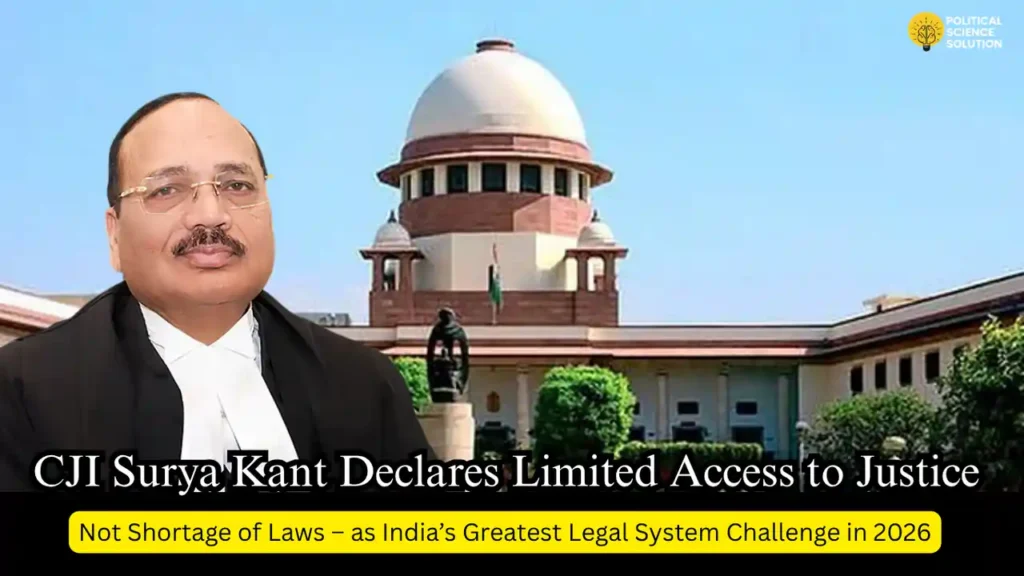
New Delhi: Chief Justice of India Surya Kant has issued a powerful call to action, declaring that the biggest challenge confronting the Indian justice system today is not the absence of laws but the severely limited access ordinary citizens have to the rights and remedies already enshrined in the statute books. Addressing a high-profile two-day North Zone Regional Conference in Dehradun on April 12, 2026, the CJI stressed that justice must literally reach “the doorstep of every last citizen in a timely manner” if the republic is to be judged by the rights it actually delivers rather than those it merely declares on paper.
The conference, titled “Justice Beyond Barriers: Rights, Rehabilitation, and Reform for the Most Vulnerable,” was jointly organised by the National Legal Services Authority (NALSA), the Uttarakhand High Court, and the Uttarakhand State Legal Services Authority. It brought together legal experts, judges, and policymakers to deliberate on regional challenges and practical solutions for bridging the widening gap between legal entitlements and ground-level reality.
In his keynote address, CJI Surya Kant painted a vivid picture of a justice system that, despite possessing one of the world’s most progressive constitutional frameworks, continues to fail vast sections of society due to systemic, economic, geographical, and cultural obstacles. “The mere existence of justice is not sufficient,” he remarked. “Rather, it must reach the doorstep of every last citizen in a timely manner. The strength of a republic should be measured not by its declared rights, but by the rights that are actually realised.”
The CJI drew special attention to the unique difficulties faced by hilly and mountainous states like Uttarakhand, where rugged terrain, poor connectivity, and limited infrastructure make physical access to courts extremely challenging. He shared insights gathered from his extensive travels and interactions across the country – from Army personnel stationed in the high-altitude frontiers of Ladakh, to tribal communities in Srinagar and Nagaland, and fishing villages along the coasts of Kerala. In each of these diverse settings, the recurring theme was the same: citizens are not struggling because they lack rights; they are struggling because they lack accessible platforms through which to claim those rights.
Deep-Rooted Barriers Blocking Access to Justice in India
The structured notes prepared for the conference, which the CJI referenced extensively, identified three major categories of barriers that continue to undermine the promise of equal justice.
Economic and Geographical Barriers remain the most immediate and visible hurdles. Poverty and the prohibitive cost of litigation keep justice out of reach for millions. A striking statistic highlighted in the India Justice Report 2025 reveals that around 75 per cent of India’s prisoners are undertrials, many of whom languish in jail simply because they cannot afford bail or legal representation. Geographical isolation compounds the problem. Residents of remote hilly and mountainous regions often have to travel long distances over difficult terrain just to reach the nearest court, turning the pursuit of justice into an expensive and exhausting ordeal.
Institutional and Procedural Barriers further erode public confidence. Systemic delays, overly complex procedures, inadequate court infrastructure, and chronic under-staffing have become normalised features of the system. Language remains a formidable wall: the continued dominance of English in higher courts alienates the vast majority of non-English-speaking litigants. Equally damaging is the paucity of awareness about legal rights and the persistent gaps in the delivery of free legal aid. Although schemes exist on paper, their implementation on the ground is often patchy and ineffective.
Social, Cultural, and Intersectional Barriers create an even more insidious form of exclusion. The notes described a phenomenon known as “black coat syndrome” – the deep fear, anxiety, and sense of alienation experienced by marginalised communities when they attempt to engage with the formal legal system. Discrimination and institutional apathy compound the trauma. Marginalised groups routinely face bias, while survivors of sexual assault endure secondary victimisation through social pressure, intimidation, and public humiliation during legal proceedings. Widespread corruption, vested interests resisting reform, and a resultant lack of public trust in the judiciary complete this troubling picture.
Constitutional Mandate and Concrete Initiatives Already Underway
Despite these formidable challenges, the CJI highlighted that India is not starting from scratch. The constitutional framework provides a strong foundation. Article 39A of the Constitution, reinforced by the Legal Services Authorities Act 1987, explicitly mandates the provision of free legal aid. The National Legal Services Authority (NALSA) serves as the apex body responsible for coordinating these efforts across the country.
Several practical initiatives are already in motion to translate this mandate into reality. The promotion of Alternative Dispute Resolution (ADR) mechanisms stands out as a cornerstone strategy. Lok Adalats, mediation, and pre-litigation conciliation are being actively encouraged because they offer speedy, cost-effective, and relationship-preserving solutions to disputes that would otherwise drag on for years in formal courts.
Decentralisation of justice delivery is another key pillar. The Gram Nyayalayas Act 2008 empowers local courts to provide affordable and expeditious justice at the grassroots level, particularly in rural India. Technological advancements are being leveraged aggressively through the E-Courts Mission Mode Project and the National Judicial Data Grid, which aim to bring transparency, efficiency, and remote access to case information.
Procedural reforms such as Fast Track Courts and Undertrial Review Committees are designed to reduce pendency and prevent prolonged incarceration of those yet to be convicted. Local and context-specific interventions – including the Access to Justice Project, One Stop Centres, and Women Help Desks – are being tailored to address the unique vulnerabilities of women, children, and other marginalised sections.
The CJI singled out one recent innovation for special praise: the “Nyay Mitra” portal launched by the Uttarakhand State Legal Services Authority. He described it as a significant and forward-looking step that leverages technology to make legal aid more accessible, especially in the state’s geographically challenging regions.
Regional Realities Demand Tailored, Context-Specific Strategies
Throughout his address, CJI Surya Kant repeatedly emphasised that one-size-fits-all solutions will not work. Different regions face distinctly different problems, and responses must be calibrated accordingly. Hilly states like Uttarakhand require special attention to terrain-related barriers. Tribal and border communities need culturally sensitive approaches that respect local customs while upholding constitutional rights. Coastal and fishing communities, as the CJI observed during his Kerala visit, face their own unique set of legal and livelihood-related challenges.
He described the conference itself as a vital platform for such region-specific deliberation. By bringing together stakeholders from the North Zone, the event aimed to foster practical strategies that ensure vulnerable sections of society are not further marginalised. The CJI urged all participants to focus on legal aid schemes, sustained awareness campaigns, and multi-service camps as proven tools for taking justice closer to the people.
Measuring the Success of Institutions by Justice Delivered
CJI Surya Kant concluded on a note of measured optimism mixed with urgency. He reminded the audience that the true test of the Constitution lies not in its landmark judgments or high-profile cases, but in the everyday availability of justice in the lives of ordinary citizens. The success of judicial institutions, he said, will ultimately be judged by how effectively they deliver justice to those who need it most – the poor, the marginalised, the geographically isolated, and the socially excluded.
By placing access to justice at the centre of the national conversation, the Chief Justice has set a clear agenda for 2026 and beyond. The message is unambiguous: India has the laws, the policies, and the constitutional vision. What it now needs is the collective will, innovation, and administrative grit to ensure that every citizen – regardless of location, language, economic status, or social background – can actually experience the protective embrace of the justice system.
As the two-day conference continues in Dehradun, stakeholders are expected to translate the CJI’s vision into actionable roadmaps. From strengthening the Nyay Mitra portal to expanding Lok Adalats and fast-tracking digital integration through the E-Courts project, the coming months will test whether India can move from declaring rights to actually realising them for every last citizen.
The Chief Justice’s address has already sparked widespread discussion among legal circles, policymakers, and civil society organisations. If the momentum generated in Dehradun is sustained, it could mark a turning point in India’s long-standing quest to make justice truly accessible, affordable, and accountable.
FAQs
Q1: What is the biggest challenge facing the Indian justice system according to CJI Surya Kant?
A: Chief Justice of India Surya Kant has clearly stated that the primary challenge is not the shortage of laws, but the limited access ordinary citizens have to justice. While India has robust laws and constitutional rights, millions of people cannot avail them due to distance, delay, high costs, and implementation gaps. Justice, he emphasised, must reach “the doorstep of every last citizen in a timely manner.”
Q2: What are the major barriers to access to justice highlighted in the conference?
A: The key barriers are divided into three categories:
• Economic & Geographical: Poverty, inability to afford bail (75% of prisoners are undertrials as per India Justice Report 2025), and difficult terrain in hilly/remote areas like Uttarakhand.
• Institutional & Procedural: Court delays, complex procedures, English-language dominance in higher courts, poor infrastructure, and ineffective legal aid.
• Social & Cultural: “Black coat syndrome” (fear and alienation among marginalised communities), discrimination, secondary victimisation of sexual assault survivors, corruption, and lack of public trust.
Q3: What initiatives did CJI Surya Kant mention to improve access to justice?
A: The CJI highlighted several ongoing measures:
• Constitutional mandate under Article 39A and the Legal Services Authorities Act 1987.
• Alternative Dispute Resolution (ADR): Lok Adalats, mediation, and pre-litigation conciliation.
• Gram Nyayalayas Act 2008 for decentralised rural justice.
• Technological solutions like the E-Courts Mission Mode Project, National Judicial Data Grid, and Uttarakhand’s Nyay Mitra portal.
• Fast Track Courts, Undertrial Review Committees, One Stop Centres, and Women Help Desks. He stressed the need for local, context-specific strategies tailored to different regions.
Q4: Why did CJI Surya Kant specially mention hilly states like Uttarakhand?
A: Hilly states face unique geographical challenges such as rugged terrain, poor connectivity, and limited infrastructure, which make reaching courts extremely difficult. The CJI noted that solutions must be customised for such regions. He praised Uttarakhand’s Nyay Mitra portal as an innovative step to bridge this gap and deliver justice in remote areas.
Q5: What is the core message of the North Zone Regional Conference “Justice Beyond Barriers”?
A: The conference emphasised that the real strength of India’s democracy lies in rights that are actually realised, not just declared. CJI Surya Kant urged judges, legal services authorities, and policymakers to focus on legal awareness, effective legal aid delivery, and Alternative Dispute Resolution so that vulnerable sections — including tribal communities, border populations, and women — receive timely and meaningful justice. He called for region-specific reforms instead of a one-size-fits-all approach.