

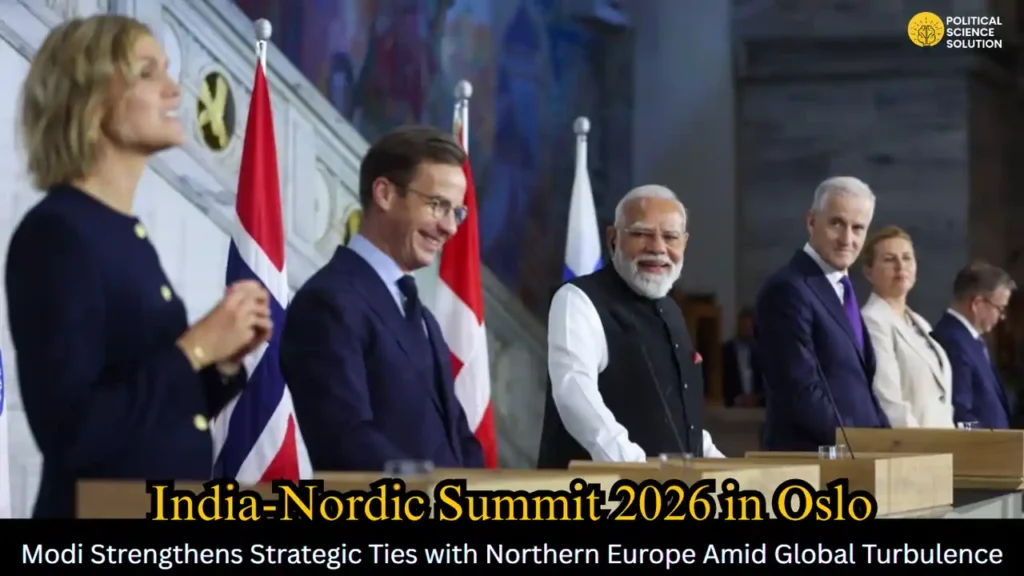
New Delhi: The third edition of the India-Nordic Summit concluded on Tuesday, marking a significant milestone in elevating bilateral and plurilateral cooperation between India and the five Nordic nations—Denmark, Finland, Iceland, Norway, and Sweden. Held in the Norwegian capital, the high-level gathering brought together Prime Minister Narendra Modi and his counterparts from the region to forge deeper collaboration in technology, sustainability, defense, and geopolitics, setting the stage for a future-oriented Green Technology and Innovation Strategic Partnership.
This summit arrives at a critical juncture for global affairs. With ongoing conflicts in Ukraine and West Asia disrupting supply chains and energy markets, alongside shifting U.S. trade policies under President Donald Trump, India is actively diversifying its international partnerships. The Nordic countries, known for their innovation-driven economies and commitment to a rules-based international order, offer complementary strengths to India’s ambitious development goals.
Historic Gathering and High-Level Participation
Prime Minister Narendra Modi co-chaired the summit alongside Norwegian Prime Minister Jonas Gahr Store, Danish Prime Minister Mette Frederiksen, Finnish Prime Minister Petteri Orpo, Icelandic Prime Minister Kristrún Frostadottir, and Swedish Prime Minister Ulf Kristersson. Modi’s presence in Oslo represents the first visit by an Indian Prime Minister to Norway in over four decades, since former Prime Minister Indira Gandhi’s trip in 1983.
The event builds on the foundations laid in previous summits: the inaugural meeting in Stockholm, Sweden in 2018, and the second in Copenhagen, Denmark in 2022. Leaders used the platform not only for bilateral discussions but to address collective challenges and opportunities in a rapidly changing world.
Prior to the main summit, Modi engaged in key bilaterals. On May 18, he met with Norway’s Store, upgrading ties to a Green Strategic Partnership and emphasizing investments in clean energy. In Sweden (May 17-18), discussions focused on doubling trade and investment within five years. His Netherlands visit (May 15-17) yielded a major semiconductor collaboration between Tata Electronics and ASML, alongside talks on defense and space.
Comprehensive Agenda: From Trade to Arctic Strategy
Discussions at the 2026 summit spanned multiple strategic domains. Trade and economic linkages topped the list, with leaders exploring ways to expand commerce in green technologies, renewable energy solutions, industrial machinery, pharmaceuticals, textiles, and consumer goods. India’s overall trade with the Nordic bloc reached approximately $19 billion in 2024, supported by major Nordic firms like Nokia (Finland), Volvo, and IKEA (Sweden) operating extensively in the Indian market. Indian shipyards also contribute significantly, handling about 11 percent of the Norwegian Shipowners’ Association’s order book.
The summit placed strong emphasis on climate action, energy security, and the green transition. India seeks to leverage Nordic expertise in sustainability, while Nordic nations aim to tap into India’s vast market and scaling capabilities. Specific highlights included Iceland’s geothermal energy prowess, Norway’s leadership in the blue economy and shipping, Sweden’s advancements in industrial and defense innovation, Finland’s strengths in telecommunications and digital technologies, and Denmark’s contributions in cybersecurity and health technologies.
A major outcome was the formal elevation of relations into a Green Technology and Innovation Strategic Partnership. This framework aims to combine Nordic innovation in sustainability with India’s massive scale to create globally relevant solutions. Cooperation will extend to universities, research labs, and startup ecosystems, promoting joint research, skill development, and talent mobility.
Trade agreements provided crucial momentum. Leaders welcomed the operationalization of the India-EFTA Trade and Economic Partnership Agreement (TEPA) with Iceland, Liechtenstein, Norway, and Switzerland, which targets $100 billion in foreign direct investment into India over 15 years and the creation of one million jobs. Progress on the broader India-EU Free Trade Agreement, signed earlier in 2026, was also noted as a complementary step toward resilient supply chains.
Deep Dive into the Arctic: India’s Expanding Footprint
A distinctive focus of the summit was India’s growing engagement in the Arctic region. Despite lacking direct borders, India has maintained a presence since signing the Svalbard Treaty in 1920, which grants signatories rights to scientific research, mining, and commercial activities under Norwegian sovereignty.
Key milestones in India’s Arctic journey include the 2007 scientific expedition, the establishment of the Himadri research station in 2008, and the deployment of IndARC, India’s first underwater moored observatory in Kongsfjorden, Svalbard, in 2014. This observatory monitors climate impacts, particularly how Arctic ice melt affects India’s monsoon patterns.
In 2013, India gained observer status in the Arctic Council, the primary intergovernmental forum for the region. India’s 2022 Arctic Policy underscores priorities in scientific research, environmental protection, economic development, transportation, governance, and capacity building. It also recognizes the Arctic as an arena of power competition.
At the Oslo summit, India proposed an India-Nordic Arctic mechanism to enhance coordination, given all Nordic countries’ membership in the Arctic Council. Discussions addressed challenges posed by Russia’s military buildup and China’s Polar Silk Road initiative. India is advancing its Eastern Maritime Corridor linking Indian ports with Russian Far East facilities to integrate Arctic shipping routes.
Nordic leaders expressed support for India’s scientific endeavors, though expectations for immediate binding agreements were tempered, with emphasis on working through established formats like the Arctic Council.
Geopolitical Dimensions and Global Challenges
Russia’s war in Ukraine and the broader impacts of conflicts in West Asia, including the U.S.-Israel actions involving Iran, figured prominently. These developments have strained energy security and global trade, prompting India to diversify supplies after facing U.S. tariffs linked to Russian oil imports.
While Nordic nations have been vocal critics of Russia, both sides acknowledged managed differences. India maintains longstanding defense ties with Russia but has strengthened Western partnerships. Leaders reiterated calls for cessation of hostilities in Ukraine and West Asia, a firm stance against terrorism without double standards, and commitment to multilateral reforms.
The summit saw the Nordic countries formally back India’s aspirations for permanent membership in a reformed United Nations Security Council (UNSC) and its bid for the Nuclear Suppliers Group (NSG).
Additional concrete outcomes included:
- Implementation of the ISRO-Norwegian Space Agency framework, plus a Swedish scientific payload for India’s Venus Orbiter Mission.
- Launch of dedicated Maritime Security Dialogues with Norway and Denmark under India’s MAHASAGAR vision and Indo-Pacific Oceans Initiative to counter illicit maritime activities.
- Expansion of the LeadIT 2.0 platform for industrial decarbonization, welcoming Iceland.
- Commitment to human-centric, open-source AI governance, building on India’s AI Impact Summit in New Delhi earlier in 2026.
- Agreement that Finland will host the fourth summit.
Opportunities: Leveraging Complementary Strengths
The partnership opens substantial avenues for India. Collaboration with Nordic leaders in semiconductors and 6G technology can reduce dependence on other suppliers. The EFTA investment commitments will accelerate the India Semiconductor Mission. Joint Arctic research will refine monsoon predictions, while green propulsion and ship-recycling standards can modernize Indian maritime infrastructure, including facilities like Alang.
In defense, relaxed FDI norms in industrial corridors invite co-production, such as missile components with Swedish firms. Cultural affinities, like the shared linguistic roots of “Sambandh” meaning relations, were highlighted as symbolic of deeper people-to-people bonds.
Prime Minister Modi noted that trade has grown four-fold over the past decade, with Nordic investments in India rising by around 200 percent, creating jobs on both sides.
Challenges on the Horizon
Despite optimism, hurdles remain. Divergent views on global conflicts require careful diplomacy. Strict Nordic and EU regulatory standards on environment, sustainability, and non-tariff barriers can affect Indian exports in steel and textiles. Intellectual property protections may complicate high-tech transfers, while logistics vulnerabilities—exemplified by disruptions in the Strait of Hormuz—impact corridors like IMEC.
Talent mobility faces immigration complexities in Scandinavia, and asymmetric labor frameworks need addressing for smoother skilled worker exchanges.
The Road Ahead: Concrete Steps for Implementation
To sustain momentum, both sides outlined forward-looking initiatives:
- Utilizing Norway’s SvalSat for real-time satellite data links.
- Developing green hydrogen maritime corridors with Denmark.
- Establishing Nordic defense clusters in Indian corridors like Tamil Nadu and Uttar Pradesh for UAV technologies.
- Harmonizing AI data governance protocols.
- Creating a dedicated tracking mechanism within NITI Aayog for EFTA investments.
The 3rd India-Nordic Summit has transformed what began as trade-focused engagements into a comprehensive strategic alliance. By pairing India’s demographic dividend, digital infrastructure, and manufacturing scale with the Nordic region’s excellence in clean tech, deep science, and governance models, the partnership promises resilient economic corridors and shared solutions to planetary challenges.
As global power dynamics evolve, this collaboration stands as a model of pragmatic, values-driven internationalism—rooted in democracy, innovation, and mutual prosperity. With the next summit slated for Finland, expectations are high for tangible deliverables that translate dialogue into enduring impact.
FAQs
1. What is the 3rd India-Nordic Summit 2026 and where was it held?
The 3rd India-Nordic Summit was held on 20 May 2026 in Oslo, Norway. It brought together Prime Minister Narendra Modi and leaders of Denmark, Finland, Iceland, Norway, and Sweden to strengthen cooperation in green technology, trade, defense, space, and the Arctic region.
2. What are the major outcomes of the India-Nordic Summit 2026?
Key outcomes include the elevation of ties to a Green Technology and Innovation Strategic Partnership, operationalization of the India-EFTA TEPA with $100 billion investment target, Nordic support for India’s UNSC permanent seat and NSG bid, space collaboration, maritime security dialogues, and expansion of the LeadIT 2.0 initiative.
3. Why is the Arctic region important in the India-Nordic Summit?
India aims to expand its scientific, strategic, and economic presence in the Arctic. The summit discussed establishing an India-Nordic Arctic mechanism, leveraging India’s observer status in the Arctic Council, joint research on climate impact, and countering influence from China and Russia in the region.
4. How will the summit benefit India’s economy and technology sector?
The summit promotes access to Nordic expertise in semiconductors, 6G, clean energy, defense co-production, and green hydrogen. It supports Make in India through increased FDI, job creation, resilient supply chains, and collaboration in AI, maritime technologies, and industrial decarbonization.
5. When and where will the next India-Nordic Summit be held?
The 4th India-Nordic Summit will be hosted by Finland. The leaders also agreed to continue deepening cooperation in sustainability, innovation, and multilateral reforms for shared prosperity and global stability.