

New Delhi: The National Human Rights Commission (NHRC) has taken a significant step forward in advancing the rights and welfare of transgender and gender-diverse individuals in India. On May 19, 2026, the Commission released its second comprehensive advisory—often referred to as Advisory 2.0—addressed to the Secretaries of 11 Union Ministries, the Office of the Registrar General and Census Commissioner, and the Chief Secretaries of all States and Union Territories. This updated guidance builds directly upon the Commission’s earlier September 2023 advisory and reflects ongoing stakeholder consultations, field interactions, and reviews of implementation challenges.
The latest advisory underscores the NHRC’s commitment to addressing persistent and emerging issues faced by transgender persons. It explicitly calls upon the Union government to review recent amendments to the Transgender Persons (Protection of Rights) Act, particularly those that removed provisions related to self-perceived gender identity. The Commission has highlighted community concerns and suggested that authorities revisit these changes to maintain an inclusive, rights-affirming framework sensitive to diverse lived experiences.
Background: Amendments to Transgender Law Spark Widespread Concern
In March 2026, Parliament passed amendments to the Transgender Persons (Protection of Rights) Act, 2019, introduced by the Union Ministry of Social Justice and Empowerment. These changes notably eliminated the clause that recognized transgender individuals’ right to self-perceived gender identity. Instead, the revised law introduced a more structured medical process for issuing gender certificates. The Ministry justified the move by stating that self-identification created difficulties in identifying genuine beneficiaries.
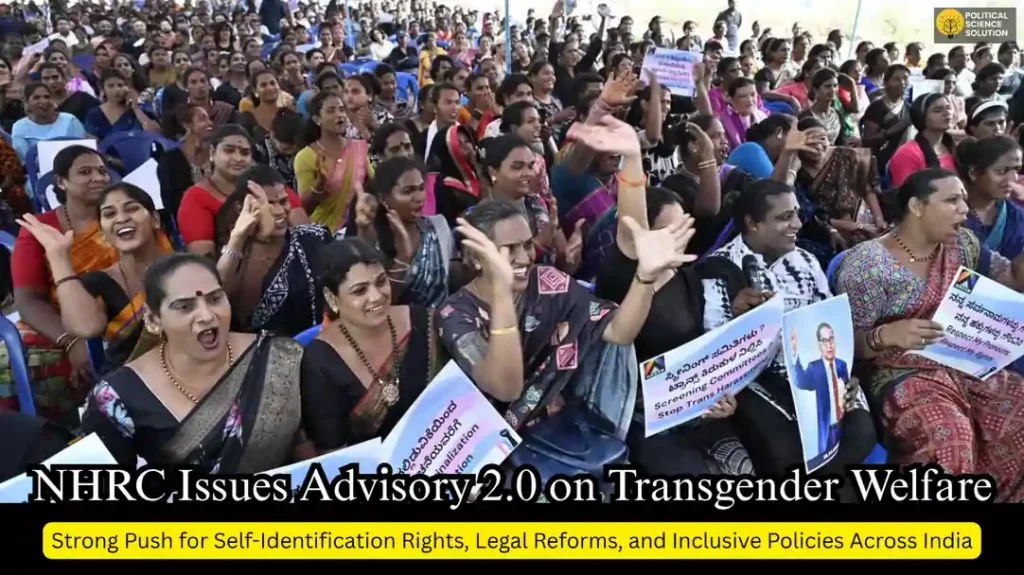
The amendments triggered strong protests across the country. Activists from groups such as the Coalition for Sex Workers and Sexual and Gender Minorities’ Rights (CSGMR), also known as CSMR Karnataka, demonstrated against the Bill. Many community members and even some members of the government’s own National Council for Transgender Persons expressed reservations through resignations and public statements. The NHRC’s Advisory 2.0 directly acknowledges these developments and the resulting unease within the transgender community regarding recognition and access to rights.
The Commission has urged the Centre to carefully examine the implications of these amendments and consider revisiting the concerns raised. This recommendation forms a central pillar of the new advisory, signaling an institutional push for balancing procedural safeguards with the need for dignity and inclusion.
Emphasis on Self-Identification in Key Areas
A recurring theme throughout the NHRC’s latest advisory is the importance of self-identification. The Commission has recommended that transgender and gender-diverse students be admitted to educational institutions based on their self-identified gender, without the requirement of medical or legal proof. This approach aims to remove barriers that could prevent access to education.
For elderly transgender persons, the advisory calls for a simplified gender certification process grounded in self-identification. It specifically advises against subjecting applicants to intrusive or medically invasive verification procedures. Similar principles are extended to prison inmates and correctional institutions, where the NHRC has stressed the need for gender-neutral facilities and processes that respect self-identified gender.
These recommendations appear to stand in contrast with the direction of the 2026 legislative amendments, creating a notable point of engagement between the human rights body and the executive.
Census 2027: Demand for Disaggregated Data Collection
In a forward-looking recommendation aimed at evidence-based policymaking, the NHRC has asked for the inclusion of distinct categories in the population enumeration phase of the ongoing Census 2027. Specifically, it has suggested separate columns or options to accurately record “intersex” persons, “transmen,” and “transwomen.”
The Commission believes that such disaggregated data will help generate reliable statistics on the transgender population, enabling better planning and targeted welfare interventions. This move is expected to address long-standing gaps in national data systems regarding gender diversity.
Transforming Education: Gender-Neutral Infrastructure and Inclusive Admissions
The advisory places strong emphasis on the right to education. Beyond self-identification-based admissions, the NHRC has called upon schools and higher educational institutions to introduce gender-neutral restrooms, hostels, and uniforms. These measures are intended to create safer and more welcoming environments for transgender and gender-diverse students.
By removing unnecessary documentation barriers and promoting inclusive infrastructure, the Commission hopes to reduce dropout rates and improve educational outcomes for this marginalized group.
Comprehensive Legal Framework Review
One of the most detailed sections of Advisory 2.0 focuses on reviewing and amending multiple laws to ensure gender inclusivity:
- Registration of Births and Deaths Act: The NHRC has recommended amendments to incorporate gender-inclusive procedures and recognition of self-identified gender. It has provided suggested wording for birth certificates, including options such as “male,” “female,” “intersex,” “indeterminate/not specified at birth,” and “prefer not to state at birth (to be updated later).”
- Juvenile Justice (Care and Protection of Children) Act: The Commission wants explicit inclusion of gender non-conforming children and provisions for gender-affirming placements.
- Personal and Secular Laws: Laws such as the Hindu Succession Act should be reviewed to clearly include transgender and intersex persons within definitions of “son,” “daughter,” “heir,” and “family.” This would ensure equal rights to inheritance and succession.
The NHRC has also advocated for the establishment of dedicated childcare institutions for children with diverse sex characteristics and gender identities, with at least one pilot home in each State and Union Territory.
These recommendations collectively aim to build a more cohesive and inclusive legal architecture that recognizes the rights of transgender and intersex individuals across different domains of life.
Gender-Affirming Healthcare and Child Protection
The advisory addresses healthcare concerns with sensitivity. It calls for the formulation of specific guidelines, rules, and Standard Operating Procedures (SOPs) for gender-affirming healthcare. Importantly, the NHRC has stated that medical institutions should not perform irreversible gender-affirming procedures on intersex children until they reach the legal age of consent.
This balanced approach seeks to protect the bodily autonomy of minors while ensuring access to appropriate care for adults.
Broader Welfare Measures: Workplace, Shelters, Property, and Prisons
The NHRC’s Advisory 2.0 covers ten key focus areas. In addition to data systems, legal frameworks, education, and healthcare, it highlights:
- Right to Property: Ensuring transgender persons can exercise inheritance and ownership rights without discrimination.
- Workplace Inclusivity: Developing policies and sensitization programs to create accepting professional environments.
- Shelter Homes: Strengthening and expanding dedicated shelter facilities for transgender persons in need.
- Prison and Correctional Settings: Implementing gender-sensitive protocols and infrastructure.
- Rights of Children: Special attention to children with diverse sex characteristics and gender expressions.
These measures reflect a holistic understanding of the challenges faced by transgender individuals throughout their lives—from childhood through old age.
Timeline for Implementation and Reporting
The NHRC has directed all concerned authorities to submit Action Taken Reports (ATRs) on the implementation of this advisory within two months. This deadline underscores the Commission’s seriousness about translating recommendations into tangible outcomes.
The Commission noted positive responses to its 2023 advisory and expressed hope that continued engagement will yield further progress. The latest document is positioned as an evolution based on real-world feedback and emerging needs.
Implications for Transgender Rights in India
The release of Advisory 2.0 comes at a critical juncture. While the 2026 amendments to the transgender law signaled a shift toward greater medical oversight, the NHRC’s intervention reopens the conversation around self-identification and broader inclusion. By engaging multiple ministries and all state governments, the Commission is attempting to create coordinated action across the federal structure.
Experts and activists view this advisory as a crucial reference point for future litigation, policy formulation, and advocacy efforts. The emphasis on data collection through the Census is particularly significant, as accurate numbers can strengthen demands for targeted schemes and budget allocations.
However, implementation remains the biggest challenge. States and Union Territories will need to allocate resources, train personnel, and overcome societal barriers to make these recommendations a reality. The two-month reporting timeline will serve as an early indicator of governmental commitment.
Conclusion: Towards a More Inclusive Society
The National Human Rights Commission’s Advisory 2.0 represents a detailed roadmap for protecting and empowering transgender persons in India. From self-identification in education and certification processes to sweeping legal reforms and improved data systems, the document touches upon nearly every aspect of life where discrimination and exclusion persist.
By urging a review of the 2026 amendments and placing community concerns at the center, the NHRC has reinforced its role as an independent guardian of human rights. As governments across the country begin preparing their action plans, the coming months will be decisive in determining how effectively these progressive recommendations translate into meaningful change on the ground.
This advisory not only updates and expands upon the 2023 guidance but also sets a higher benchmark for gender inclusivity in Indian governance. For the transgender community, it offers renewed hope that their voices are being heard at the highest levels of human rights institutions.
FAQs
1. What is NHRC Advisory 2.0 on Transgender Persons and when was it issued?
The National Human Rights Commission (NHRC) issued its second advisory (Advisory 2.0) on May 19, 2026, addressed to 11 Union Ministries, the Registrar General and Census Commissioner, and all States and Union Territories. This updated advisory builds on the Commission’s 2023 guidance and focuses on ten key areas to protect and promote the welfare of transgender and gender-diverse persons. It emphasizes self-identification, legal reforms, inclusive education, healthcare, and better data collection.
2. What is the NHRC’s stand on self-identification after the 2026 amendments to the Transgender Persons Act?
The NHRC has expressed concern over the 2026 amendments that removed the right to “self-perceived gender identity” and introduced a medical process for gender certificates. The Commission has urged the Union Government to review these changes and revisit community concerns to ensure the legal framework remains inclusive, rights-affirming, and sensitive to lived experiences. It strongly recommends admitting students and issuing certificates to elderly transgender persons based on self-identification without intrusive medical verification.
3. What changes has the NHRC recommended for Census 2027 regarding transgender and intersex persons?
The NHRC has called for distinct categories in the Census 2027 enumeration to separately record “intersex”, “transmen”, and “transwomen”. This recommendation aims to generate accurate, disaggregated national data on gender-diverse populations, which will help in better policy planning and targeted welfare schemes.
4. How does the NHRC Advisory address education, healthcare, and legal rights of transgender persons?
The advisory recommends:
- Admission of transgender and gender-diverse students based on self-identified gender, plus gender-neutral restrooms, hostels, and uniforms.
- Formulation of guidelines for gender-affirming healthcare and a ban on irreversible procedures on intersex children until they can consent.
- Amendments to laws including the Registration of Births and Deaths Act, Juvenile Justice Act, and Hindu Succession Act to recognize self-identified gender and ensure equal inheritance rights. It also calls for dedicated shelter homes, workplace inclusivity, and pilot childcare institutions for children with diverse gender identities in every State and UT.
5. What is the timeline for implementation of the NHRC’s latest transgender welfare advisory?
The NHRC has directed all concerned Union Ministries and State/UT governments to submit Action Taken Reports (ATRs) within two months of the advisory. This is an updated and expanded version of the 2023 advisory, prepared after reviewing implementation challenges, field visits, and stakeholder consultations.