

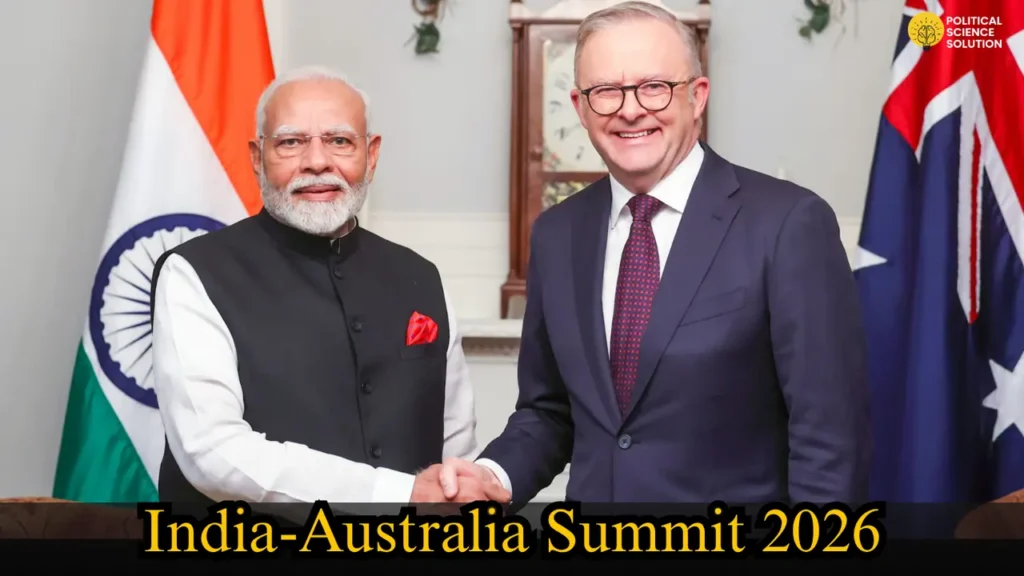
New Delhi: Prime Minister Narendra Modi’s visit to Australia for the Third India-Australia Annual Summit has delivered a transformative boost to bilateral relations. The leaders announced accelerated progress on a long-awaited Comprehensive Economic Cooperation Agreement (CECA), strengthened defence and maritime frameworks, and launched innovative partnerships in critical technologies, cyber security, and clean energy. This summit marks a strategic evolution in the relationship, moving beyond traditional cultural bonds toward deeper collaboration across security, economy, and technology in the Indo-Pacific region.
The two-day summit, held in Melbourne on the traditional lands of the Wurundjeri Woi-wurrung and Bunurong/Boon Wurrung peoples of the Kulin Nation, saw Prime Minister Modi hosted by Australian Prime Minister Anthony Albanese. The visit from July 8-10, 2026, culminated in a comprehensive Joint Statement that reaffirms and expands the Comprehensive Strategic Partnership (CSP) upgraded in 2020. Both nations, sharing democratic values and Commonwealth traditions, are positioning themselves as key partners in the Quad, G20, East Asia Summit, and Indian Ocean Rim Association (IORA) to promote a free, open, and prosperous Indo-Pacific.
Deep Roots and Growing Momentum in India-Australia Relations
Bilateral ties have matured significantly. Two-way trade is approaching $50 billion, propelled by the Economic Cooperation and Trade Agreement (ECTA) that took effect in December 2022 and removed tariffs on over 85% of Australian goods entering India. Defence cooperation includes joint military exercises such as AUSINDEX, AUSTRAHIND, and Malabar, alongside the Mutual Logistics Support Agreement signed in 2021. The Indian diaspora in Australia, now around one million strong and the largest overseas-born community, includes over 137,000 students contributing vibrantly to Australian society.
The summit highlighted this shift from the informal “Three Cs” — Cricket, Curry, and Commonwealth — to the more strategic “Four Ds”: Democracy, Defence, Diaspora, and Dosti (friendship). This evolution reflects a partnership ready to address 21st-century challenges ranging from supply chain vulnerabilities to climate impacts and regional security threats.
Landmark Defence and Maritime Security Advancements
Defence and security emerged as central pillars during the discussions. The Prime Ministers announced a Joint Declaration on Defence and Security Cooperation, signaling a major upgrade in ambition and depth. They established an Annual Defence Ministers’ Dialogue to foster regular high-level consultation and noted the increasing complexity of joint exercises under the Mutual Logistics Support Arrangement. Cooperation now spans all domains, with emphasis on enhanced interoperability, including with multilateral partners.
Maritime security received special attention. Leaders endorsed the India-Australia Maritime Security Collaboration Roadmap, committing to information sharing, capability development, capacity building, and operational coordination. A new Memorandum of Understanding between Australia’s Maritime Border Command and India’s Coast Guard aims to create a more secure maritime environment.
Defence industry ties are set to expand through a forthcoming Memorandum of Understanding on the Provision of Defence Articles and Defence Services. Australian defence industry missions to India and roundtable discussions are building connections between the sectors. Professional military education will benefit from a visiting Indian military instructor at the Australian Defence College in 2028-2029 and Australia’s hosting of the fourth General Rawat India-Australia Young Officers’ Exchange Program. Both sides also agreed to explore a bilateral innovation framework linking government, industry, academia, and research institutions, while expanding defence science and technology research into new domains.
Economic Security, Trade, and Critical Minerals: The Push for CECA
Economic ties received a strong push. Building on ECTA’s success in reducing non-tariff barriers, both leaders recommitted to fast-tracking an ambitious, balanced Comprehensive Economic Cooperation Agreement (CECA) to realize the full potential of economic relations. They highlighted complementarities between India’s “Make in India” and Australia’s “Future Made in Australia” initiatives across manufacturing, technology, and investment.
The CEO Forum convened during the visit underscored industry-led engagement. Progress under “A New Roadmap for Australia’s Economic Engagement with India” and the inaugural Track 1.5 Dialogue in Sydney in May 2026 were welcomed. Critical minerals cooperation stands out as a priority, with partnerships envisioned across government agencies, public and private firms, and research institutions to secure investments, long-term supply and offtake arrangements, and value-addition capabilities. Transparent, secure, and resilient supply chains — especially for energy and critical minerals — were deemed essential for economic security, supported through bilateral and multilateral channels.
Energy, Climate, Space, and Technology Breakthroughs
Energy security and climate action featured prominently. A Joint Statement on Energy Security reaffirms cooperation for reliable, affordable, and sustainable supplies, with renewable energy and electrification at the forefront. Australia’s role as COP31 President of Negotiations was acknowledged, alongside recognition of the vulnerabilities faced by small island states in the Pacific and Indian Oceans. The India-Australia Renewable Energy Partnership continues with initiatives like the Rooftop Solar Academy.
Space collaboration is advancing. Australia supports India’s Gaganyaan Human Space Flight Program through a temporary space tracking terminal on the Cocos Keeling Islands, with hopes for deeper ISRO-Australian Space Agency ties. Under the Australia-India Nuclear Cooperation Agreement, the finalized Administrative Arrangement paves the way for long-term Australian uranium exports to India for peaceful purposes under IAEA safeguards. Australia reiterated support for India’s Nuclear Suppliers Group membership.
A major new initiative, the Australia-India Partnership on Cyber, Critical Technologies and Supply Chains (PACTS), replaces the 2020 Framework Arrangement. Jointly overseen by India’s Deputy National Security Advisor and Australia’s Deputy Secretary of the International and Security Group, PACTS features five key pillars:
- Supply Chain Resilience and Diversification: Focus on secure technology supply chains, undersea cable security via the Quad, semiconductor research, and critical minerals coordination. Led by India’s National Security Council Secretariat.
- Critical Technologies: Collaboration in AI, space, telecommunications, biotechnology, and advanced materials, including joint research and international standards for trustworthy AI.
- Cyber Security: Enhanced efforts against cybercrime, resilience for critical infrastructure, bilateral mechanisms, data governance dialogue, and a cyber-technology skill incubator. Led by India’s Cyber Diplomacy Division, MEA.
- Digital Resilience: Expansion of digital public infrastructure (DPI) across the Indo-Pacific, supporting adoption of India’s DPI model in renewable energy, healthcare, education, and more. Led by Oceania Division, MEA.
- Defence Research Collaboration: Stronger links between Australia’s Defence Science and Technology Group and India’s DRDO, plus defence start-up partnerships and joint research in maritime surveillance and advanced materials. Led by India’s Ministry of Defence.
An annual Senior Officials’ Meeting will drive implementation.
People-to-People Ties, Education, Skills, and Culture
The leaders emphasized the human dimension. Australia announced $10 million for the Centre for Australia-India Relations’ Maitri grants to boost economic and people-to-people links. Parliamentary engagement is growing with new Friendship Groups in both legislatures. Education links are expanding with Australian universities establishing campuses in India: Flinders University in Bengaluru and Victoria University in Gurugram.
A new National Centre of Excellence for Skilling in Mining will be established in Bhubaneswar, Odisha, through partnership between Western Australia and India. Sports cooperation includes a new India-Australia Sports Collaboration Roadmap ahead of Australia’s 2032 Brisbane Olympics/Paralympics and India’s 2030 Ahmedabad Commonwealth Games. Cultural repatriation efforts were welcomed, including First Nations ancestors and Telugu remains, plus the return of several Indian cultural artefacts from Australian institutions.
Regional and Global Outlook: Indo-Pacific Stability and Multilateralism
Both Prime Ministers reaffirmed commitment to a rules-based Indo-Pacific, upholding UNCLOS principles on freedom of navigation and overflight while opposing unilateral actions that destabilize the region. They praised Quad outcomes from the May 2026 Foreign Ministers’ meeting in New Delhi and deepened Indian Ocean cooperation through IORA (under India’s chairship), the Indo-Pacific Oceans Initiative, and the Australia-India-Indonesia trilateral.
Support for the Pacific Islands Forum’s 2050 Strategy, ASEAN centrality, and the ASEAN Outlook on the Indo-Pacific was reiterated. On global issues, they expressed concern over Middle East escalations, the Ukraine war, and Myanmar, calling for restraint, diplomacy, and ASEAN-led solutions. Terrorism in all forms was unequivocally condemned, with specific reference to attacks at Pahalgam and Bondi Beach. Enhanced cooperation on countering radicalization, financing, and technology-enabled terrorism was pledged.
Reform of the United Nations Security Council received strong backing. Australia supports India’s permanent seat candidacy, while both nations back each other’s non-permanent bids (India 2028-2029, Australia 2029-2030).
Strategic Opportunities, Persistent Challenges, and the Road Ahead
The summit opens significant opportunities. Finalizing CECA promises to dismantle remaining barriers and optimize operations across vast markets. Critical minerals partnerships can fuel India’s semiconductor and EV ambitions through Australian lithium and cobalt. Space tracking enhancements will support Gaganyaan, while skilling initiatives address vocational gaps. Sports diplomacy and university campuses will further people-to-people bonds.
Challenges remain. Supply chain vulnerabilities to non-market influences, terrorism threats, maritime disruptions in West Asia, delays in trade negotiations, and slow UN reforms were acknowledged. The way forward includes fast-tracking uranium shipments, concluding CECA negotiations, operationalizing PACTS, launching trilateral maritime exercises, and aligning skilling certifications globally.
In conclusion, the Third India-Australia Annual Summit has charted an ambitious next phase for the CSP. By integrating defence MoUs, uranium exports, university campuses, critical technology frameworks, and resilient supply chains, the two democracies are building a comprehensive partnership that safeguards economic sovereignty, enhances regional stability, and contributes to a peaceful, prosperous Indo-Pacific. As implementation begins, this relationship is poised to deliver tangible benefits for citizens of both nations and the broader region in the years ahead.
FAQs
1. What were the major outcomes of the Third India-Australia Annual Summit 2026?
The summit, held in Melbourne from 8-10 July 2026 between Prime Minister Narendra Modi and Prime Minister Anthony Albanese, resulted in several landmark agreements. Key highlights include the announcement of a Joint Declaration on Defence and Security Cooperation, the launch of the India-Australia Maritime Security Collaboration Roadmap, and an MoU between Australia’s Maritime Border Command and India’s Coast Guard. Both leaders committed to fast-tracking the Comprehensive Economic Cooperation Agreement (CECA), finalized an Administrative Arrangement for Australian uranium exports to India, and launched the Australia-India Partnership on Cyber, Critical Technologies and Supply Chains (PACTS). Additional outcomes cover education (Australian university campuses in India), skilling partnerships, sports collaboration, and cultural repatriation efforts.
2. What is the Australia-India Partnership on Cyber, Critical Technologies and Supply Chains (PACTS)?
PACTS is a new bilateral framework that replaces the 2020 cyber cooperation arrangement. It focuses on five pillars: Supply Chain Resilience, Critical Technologies (AI, space, biotech, etc.), Cyber Security, Digital Resilience (including Digital Public Infrastructure), and Defence Research Collaboration. Overseen by senior officials from both countries, it aims to build secure supply chains, enhance cyber resilience, promote joint research between DRDO and Australia’s Defence Science and Technology Group, and support technology standards across the Indo-Pacific. It emphasizes collaboration with industry, academia, and start-ups to strengthen national security and economic resilience.
3. How will the summit impact trade and economic ties between India and Australia?
The leaders welcomed growth under the existing Economic Cooperation and Trade Agreement (ECTA) and pledged to accelerate negotiations for the more comprehensive CECA to remove remaining barriers and boost two-way trade, which is nearing $50 billion. Emphasis was placed on critical minerals partnerships for secure supply chains, complementarities between “Make in India” and “Future Made in Australia,” and increased investment flows. These steps are expected to benefit sectors like manufacturing, technology, agriculture, textiles, and energy, while supporting long-term supply and offtake arrangements for critical minerals essential for EVs and semiconductors.
4. What does the shift from ‘Three Cs’ to ‘Four Ds’ signify in India-Australia relations?
The traditional “Three Cs” (Cricket, Curry, and Commonwealth) represented cultural and historical bonds. The summit highlighted a strategic evolution to the “Four Ds” — Democracy, Defence, Diaspora, and Dosti (friendship). This reflects the deepening of the Comprehensive Strategic Partnership (CSP) into more substantive areas such as security cooperation, resilient supply chains, technology collaboration, and people-to-people ties (with the Indian diaspora in Australia now exceeding one million). It signals a future-oriented partnership focused on shared values, regional stability in the Indo-Pacific, and mutual prosperity amid global challenges.
5. How does the summit address defence, maritime security, and regional challenges?
Defence cooperation was elevated through an Annual Defence Ministers’ Dialogue, expanded joint exercises, professional military education exchanges (including an Indian instructor at the Australian Defence College in 2028-29), and defence industry ties. Maritime security efforts include the new Collaboration Roadmap and enhanced information sharing. Regionally, both countries reaffirmed support for a rules-based Indo-Pacific, Quad outcomes, IORA, ASEAN centrality, and UNSC reforms (with mutual support for each other’s candidatures). They also condemned terrorism (citing Pahalgam and Bondi Beach attacks), called for de-escalation in the Middle East and Ukraine, and committed to climate action and resilient supply chains.