

New Delhi: India and Mauritius have taken a decisive step to deepen their energy partnership through a five-year agreement that makes Indian Oil Corporation Limited the sole supplier of the island nation’s entire import requirement of petrol, diesel and aviation turbine fuel. The arrangement was formalised during Union Petroleum and Natural Gas Minister Hardeep Singh Puri’s official visit to Mauritius on 20 and 21 August, alongside a government-to-government memorandum of understanding covering wider cooperation in the oil and gas sector. Officials on both sides describe the pact as a major advance in energy security for Mauritius and a strategic expansion of India’s role as a reliable fuel supplier in the Indian Ocean region.
Five-Year Sales and Purchase Agreement with Indian Oil Corporation
At the heart of the partnership is a long-term sales and purchase agreement between Indian Oil Corporation and Mauritius’ State Trading Corporation. Under its terms, Indian Oil will meet the complete import needs of Mauritius for motor spirit (petrol), high-speed diesel and aviation turbine fuel. The five-year duration provides Mauritius with assured volumes and significantly reduces its exposure to international price volatility and potential supply disruptions.
This is the first long-term supply agreement of its kind concluded by an Indian public-sector oil marketing company outside South Asia in recent years. By locking in the full quantum of these three critical products, the contract gives Mauritian authorities greater predictability for budgeting, logistics planning and aviation operations. The arrangement is designed to serve as an anchor for the country’s fuel requirements at a time when global markets remain sensitive to geopolitical developments, particularly in West Asia.
Government-to-Government Memorandum of Understanding on Oil and Gas Cooperation
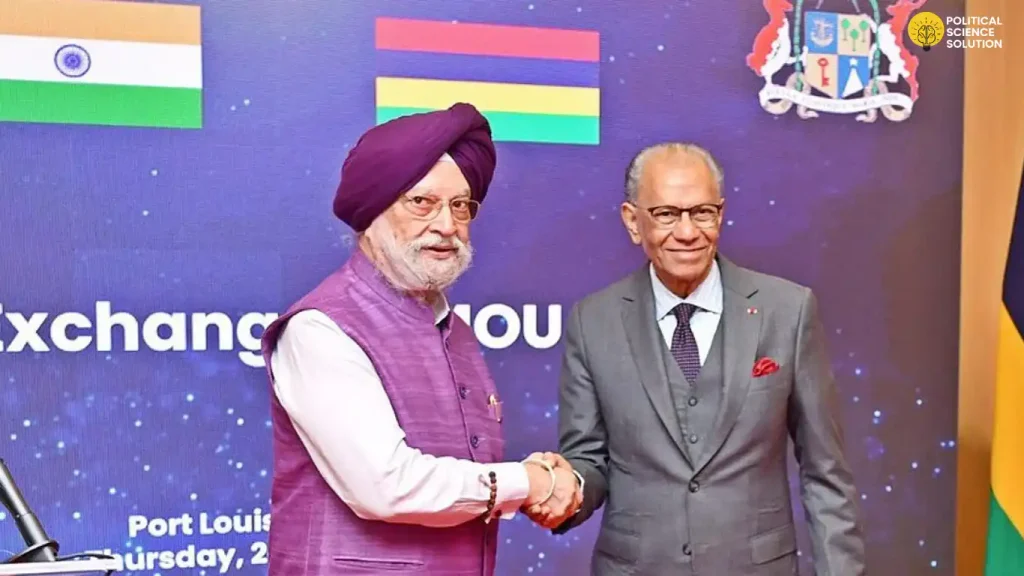
Alongside the commercial agreement, India and Mauritius exchanged a government-to-government memorandum of understanding that institutionalises longstanding energy ties. The MoU covers cooperation in petroleum product supplies, training and capacity building for Mauritian officials, and collaboration on biofuels. It was exchanged in the presence of Mauritian Prime Minister Dr Navinchandra Ramgoolam on 20 August, underscoring the political weight attached to the partnership.
The memorandum provides a structured framework for ongoing dialogue and technical cooperation. Training programmes are expected to help Mauritian officials gain deeper familiarity with India’s refining, distribution and quality-control systems, while capacity-building initiatives aim to strengthen institutional readiness on the Mauritian side. The inclusion of biofuels ensures that the partnership looks beyond conventional hydrocarbons toward longer-term energy transition goals.
Ministerial Visit and High-Level Bilateral Engagements
Minister Puri’s two-day visit featured a series of high-level meetings that reinforced the multi-dimensional nature of the relationship. On 20 August he called on Prime Minister Ramgoolam, in whose presence the MoU was exchanged and the sales and purchase agreement signed. The following day and throughout the visit, Puri held productive bilateral discussions with Energy and Public Utilities Minister Patrick Gervais Assirvaden, Commerce and Consumer Protection Minister John Michaël Tzoun Sao Yeung Sik Yuen, and Foreign Affairs, Regional Integration and International Trade Minister Dhananjay Ramful.
These interactions linked energy security to broader questions of trade facilitation, regional integration and economic resilience. The presence of the Mauritian prime minister at the formal exchange of documents highlighted the priority both governments attach to the new arrangements.
Groundbreaking of 27,500-Tonne Bunker Fuel Storage Facility
A concrete infrastructure milestone marked the visit when Minister Puri participated in the groundbreaking ceremony for India Oil (Mauritius) Limited’s 27,500-tonne bunker marine fuel storage facility at Mer Rouge in Port Louis. Also referred to as the MAP Land facility, the project has been developed at an investment of 25 million US dollars.
Once commissioned, the terminal will substantially expand bunkering capabilities in Mauritius and support the country’s ambitions to become a strategic maritime fueling hub. Officials noted that the facility aligns with Mauritius’ Blue Economy vision by improving services available to commercial shipping in the western Indian Ocean. Indian Oil Corporation has described the investment as a contribution to Mauritius’ longer-term economic trajectory, combining commercial opportunity with strategic infrastructure development.
India’s Refining Strength and Proven Record as a Regional Supplier
The ability of India to underwrite such a comprehensive commitment rests on its position as a major global refining hub. The country operates 23 refineries that together produce approximately 267 million metric tonnes of refined petroleum products annually, making India a net exporter of fuels. This scale already enables New Delhi to meet the full petroleum requirements of Nepal and Bhutan. Even during the ongoing instability in West Asia, India has continued to honour its supply commitments to these two neighbours, reinforcing its reputation as a dependable energy partner.
The Mauritius agreement extends this model into the Indian Ocean. By becoming the island nation’s anchor fuel supplier, India strengthens both its commercial footprint and its strategic presence in a region of growing geopolitical significance. The combination of refining capacity, logistical reliability and long-term contractual discipline positions India as a natural partner for countries seeking to reduce exposure to volatile global markets.
Biofuels Cooperation and the Global Biofuels Alliance
The memorandum of understanding also opens a dedicated channel for cooperation in biofuels through the exchange of knowledge, research and training. Mauritius is a founding member of the Global Biofuels Alliance, an initiative launched during India’s G20 Presidency. Under the Alliance’s country engagement programme, the Secretariat has partnered with Mauritius’ Ministry of Energy and Public Utilities to develop a Biofuels Country Landscape Policy framework.
On 21 August, Minister Puri and Minister Assirvaden jointly witnessed the formal launch of this framework. The document is intended to serve as a starting point for Mauritius as it explores pathways for integrating biofuels into its energy mix. By embedding biofuels collaboration within the broader oil and gas MoU, the two countries signal an intention to align immediate fuel security with longer-term transition objectives.
Strategic Implications for Indian Ocean Energy Security
Taken together, the five-year supply contract, the government-to-government memorandum, the bunker storage investment and the biofuels policy launch form a multi-layered partnership. For Mauritius the immediate gains are assured volumes of petrol, diesel and aviation turbine fuel, reduced price risk, and a clearer pathway toward greater energy resilience. For India the arrangement consolidates its role as a net exporter and reliable supplier while advancing broader strategic interests in the Indian Ocean.
The agreement also carries wider regional implications. India’s demonstrated ability to maintain supplies to Nepal and Bhutan under pressure has already enhanced its credibility. Extending that reliability to Mauritius through a whole-of-import, multi-year contract offers a practical template that other Indian Ocean partners may find attractive. The training, capacity-building and biofuels components further ensure that the relationship is not limited to commercial transactions but includes knowledge transfer and institutional strengthening.
Successful implementation will depend on efficient logistics, transparent pricing mechanisms and continuous coordination between Indian Oil Corporation and the State Trading Corporation. The memorandum of understanding provides an institutional platform for addressing operational questions and expanding cooperation as mutual interests evolve. The 27,500-tonne storage facility at Mer Rouge, once operational, will add physical infrastructure that supports both commercial bunkering and Mauritius’ Blue Economy aspirations.
In an era of persistent global energy uncertainty, the India-Mauritius partnership illustrates how carefully structured bilateral arrangements can deliver both commercial value and strategic reassurance. By covering the full spectrum of Mauritius’ import requirements for motor spirit, high-speed diesel and aviation turbine fuel, the five-year pact removes a critical vulnerability for the island nation while reinforcing India’s credentials as an anchor energy partner in the Indian Ocean.
FAQs
1. What exactly does the five-year fuel supply agreement between India and Mauritius cover?
The agreement requires Indian Oil Corporation Limited to supply Mauritius’ entire import requirement of motor spirit (petrol), high-speed diesel and aviation turbine fuel. Signed between Indian Oil and Mauritius’ State Trading Corporation, it runs for five years and is designed to give the island nation assured volumes while reducing exposure to global price volatility and supply disruptions.
2. When and how was the agreement formalised?
The long-term sales and purchase agreement was concluded during Union Petroleum and Natural Gas Minister Hardeep Singh Puri’s official visit to Mauritius on 20–21 August. It was exchanged alongside a government-to-government memorandum of understanding on oil and gas cooperation in the presence of Mauritian Prime Minister Dr Navinchandra Ramgoolam. Officials note it is the first such long-term supply pact by an Indian public-sector oil marketing company outside South Asia in recent years.
3. What additional cooperation is included in the government-to-government MoU?
The MoU institutionalises cooperation in petroleum product supplies, training and capacity building for Mauritian officials, and collaboration on biofuels. During the visit, Minister Puri also held bilateral meetings with Energy and Public Utilities Minister Patrick Gervais Assirvaden, Commerce and Consumer Protection Minister John Michaël Tzoun Sao Yeung Sik Yuen, and Foreign Affairs, Regional Integration and International Trade Minister Dhananjay Ramful.
4. What is the significance of the new bunker fuel storage facility in Mauritius?
India Oil (Mauritius) Limited is developing a 27,500-tonne (27.5 TMT) bunker marine fuel storage facility at Mer Rouge (MAP Land) in Port Louis at an investment of USD 25 million. Minister Puri participated in the groundbreaking ceremony. The facility is expected to strengthen Mauritius’ bunkering capabilities and support its ambitions as a strategic maritime fueling hub under its Blue Economy vision.
5. How does the pact relate to biofuels and India’s wider refining role?
The MoU includes knowledge exchange, research and training on biofuels. Mauritius is a founding member of the Global Biofuels Alliance (launched during India’s G20 Presidency). On 21 August, Ministers Puri and Assirvaden jointly witnessed the launch of Mauritius’ Biofuels Country Landscape Policy framework. Separately, India operates 23 refineries producing about 267 million metric tonnes of refined products annually and is a net exporter. It already meets the full petroleum needs of Nepal and Bhutan and has continued those supplies despite West Asia instability, reinforcing its position as a reliable regional energy partner.