

New Delhi: Union Minister for Environment, Forest and Climate Change Bhupender Yadav formally opened the World Wide Fund for Nature Global Conservation Conference in Jaipur, Rajasthan, on September 21, 2026. The gathering brought together conservation professionals and representatives from more than one hundred countries. In his address, the minister called for stronger international efforts focused on protecting wildlife while ensuring peaceful coexistence between people and nature, with local communities playing a central role.
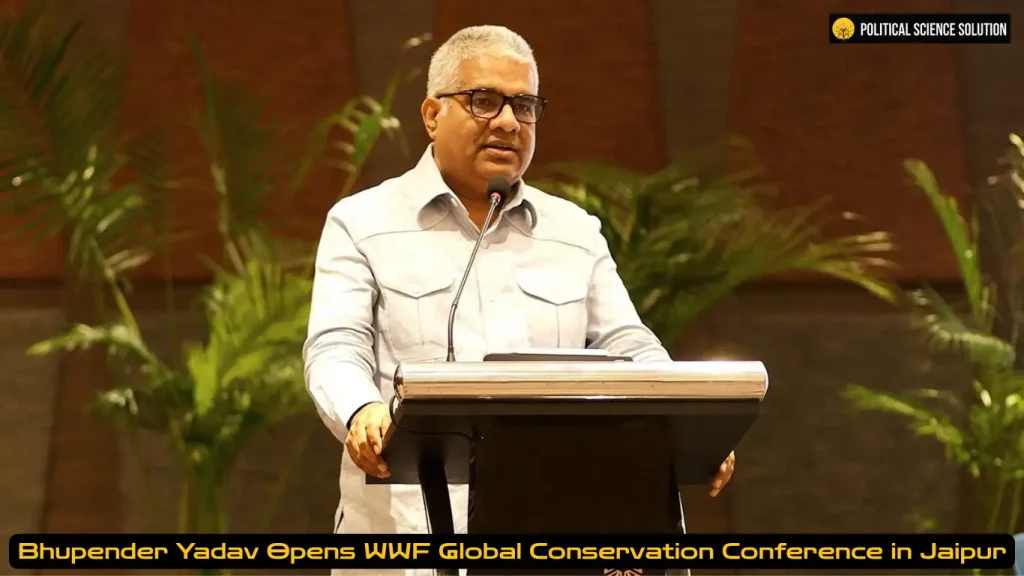
Inauguration Ceremony and Distinguished Attendees
The inauguration ceremony included key officials from the central and state governments as well as WWF leadership. Among those present were Ramesh Pandey, Additional Director General for Wildlife in the Ministry of Environment, Forest and Climate Change; Arijit Banerjee, Head of Forest Force and Principal Chief Conservator of Forests for the Government of Rajasthan; Daudi Samba, Chief Conservation Officer at WWF-International; and Ravi Singh, Chief Executive Officer of WWF-India. The presence of these senior figures underscored the institutional importance attached to the event and the alignment between government agencies and the global conservation organisation.
Call for Collective Action on Conservation and Coexistence
Speaking to the international audience, Yadav stressed the importance of collective action on conservation and coexistence. He encouraged participants to reconnect as a global community dedicated to nature, draw confidence from measurable progress already achieved, and develop a common sense of hope and clear direction for future work. The minister linked these goals to the long-term vision for wildlife protection advanced by Prime Minister Narendra Modi. He framed the conference as an opportunity not merely to review past efforts but to strengthen practical cooperation that involves local communities as active partners rather than passive beneficiaries.
Expansion of Protected Areas, Tiger Reserves, Elephant Reserves and Ramsar Sites
Yadav presented specific figures illustrating the expansion of India’s conservation network over the past decade. Protected areas grew from approximately 750 to more than 1,000. Tiger reserves increased from 47 to 58. Elephant reserves rose from 30 to 33. The number of Ramsar sites, recognised under the international wetlands convention, expanded from 24 to 101. These increases reflect deliberate policy choices sustained across successive years and demonstrate institutional capacity to enlarge formal protection even while other land-use demands continue to grow. He described the reintroduction of cheetahs as a notable achievement carried out under the Prime Minister’s leadership, showing India’s ability to undertake ambitious species recovery projects that restore species previously lost from the national landscape.
Constitutional Foundations, Cultural Ethos and International Commitments
The minister placed these results within a broader framework that combines constitutional obligations, cultural traditions and international commitments. India’s Constitution treats the protection of wildlife as both a directive principle for the state and a fundamental duty of every citizen. This formal structure rests on an older cultural ethos that values living in balance with nature and predates modern protected-area legislation. At the same time, India remains an active party to major global agreements, including the Convention on International Trade in Endangered Species of Wild Fauna and Flora, the Convention on the Conservation of Migratory Species of Wild Animals, the Convention on Biological Diversity, and the Ramsar Convention on Wetlands. Yadav pointed to the recovery of tigers, elephants, rhinoceroses and Asiatic lions as clear evidence of what sustained political commitment, backed by legal and cultural foundations, can deliver over time.
Scientific Research, Population Monitoring and Landscape-Level Planning
Scientific research and systematic monitoring have formed another essential pillar of India’s approach, according to the minister. Nationwide population estimates conducted for tigers, elephants, dolphins, lions and snow leopards have supplied reliable data that guide habitat improvement, the securing of wildlife corridors and landscape-scale planning for large mammals. These pan-India assessments provide insights that allow managers to prioritise interventions, identify critical linkages between habitats and adopt a broader landscape perspective rather than focusing solely on isolated reserves. In Rajasthan, conservation breeding of the Great Indian Bustard has advanced efforts to safeguard this critically endangered species, which also serves as the state bird. Parallel community-led protection of traditional sacred groves known as Orans has contributed to land degradation neutrality by preserving local biodiversity and ecological functions in arid and semi-arid regions.
Emphasis on Grasslands, Wetlands and Grassland-Dependent Megaherbivores
Yadav underscored the need to conserve grasslands with the same seriousness applied to woodlands and wetlands. He outlined India’s programmes aimed at grassland-dependent large herbivores, including ongoing work to protect the greater one-horned rhinoceros and the wild water buffalo. These initiatives reflect a recognition that effective conservation must address the full range of habitats that support India’s diverse wildlife, rather than concentrating exclusively on forest ecosystems. By highlighting grasslands alongside woodlands and wetlands, the minister signalled a more comprehensive habitat strategy that matches the ecological requirements of multiple species of conservation concern.
Closing Appeal for Learning and Practical Implementation
In closing his remarks, the minister invited the assembled conservationists to move beyond reflection. He urged them to examine successful practices, extract practical lessons and convert those lessons into concrete action on the ground. The conference, he indicated, offered an opportunity for practitioners from different regions to share knowledge and strengthen coordinated responses to shared challenges. The emphasis on translating experience into implementation provided a clear standard against which the outcomes of the meeting can later be assessed.
Background on the World Wide Fund for Nature and the Significance of the Jaipur Venue
The World Wide Fund for Nature, founded in 1961 and headquartered in Gland, Switzerland, is widely recognised by its giant panda emblem. Its global conferences provide platforms for exchanging experience on habitat protection, species recovery and the integration of local communities into conservation strategies. The choice of Jaipur as host city placed the discussions in a region with direct experience of both protected-area management and community-based initiatives such as the Oran system. India’s recent expansion of its conservation estate occurs against a backdrop of rapid development pressures and climate-related stresses. The increase in protected areas, tiger and elephant reserves, and Ramsar sites demonstrates institutional capacity to enlarge formal protection. Population monitoring programmes have improved the evidence base for management decisions, allowing authorities to identify priority corridors and adjust habitat interventions with greater precision. The cheetah reintroduction project and the Great Indian Bustard breeding programme illustrate two complementary approaches: re-establishing a species that had disappeared from the country and intensifying captive efforts for a species still present but critically low in numbers.
Community Stewardship and the Role of Traditional Practices
Community involvement remains central to the model Yadav described. Sacred groves maintained by local groups in Rajasthan offer a living example of traditional practices that support modern goals such as land degradation neutrality. By recognising and supporting these community systems, conservation agencies can expand effective protection beyond the boundaries of formally notified reserves. The emphasis on grasslands further acknowledges that many of India’s large herbivores and associated predators depend on open habitats that have historically received less attention than forests. International cooperation forms the third strand of the approach outlined at the conference. Membership in CITES, CMS, CBD and the Ramsar Convention provides frameworks for coordinated action on trade regulation, migratory species, biodiversity targets and wetland management. The recovery stories of several megafauna species show that national political will, when sustained over years and supported by scientific monitoring, can produce measurable gains.
Institutional Alignment and Opportunities for Knowledge Exchange
The presence of senior forest officials from both the central ministry and the Rajasthan government, alongside WWF international and national leadership, signalled institutional alignment behind the conference agenda. Representatives from more than one hundred countries brought comparative experience that can inform India’s programmes and, in turn, allow Indian experience to inform efforts elsewhere. Topics such as landscape-level planning for megafauna, community stewardship of sacred sites and the integration of grassland conservation into broader strategies are relevant across multiple continents. As the conference proceeds, participants will examine detailed case studies and technical approaches. The inauguration address set a clear tone: conservation success requires simultaneous attention to formal protected areas, scientific evidence, cultural traditions, community participation and international partnership.
Looking Ahead: From Reflection to Durable Conservation Gains
Wildlife conservationists attending the event now have the opportunity to examine the Indian data, visit relevant field sites if scheduled, and exchange methods that have produced results in different ecological and social contexts. The emphasis on moving from reflection to implementation provides a practical focus. In an era of accelerating environmental change, the combination of expanded protected areas, rigorous monitoring, community engagement and international cooperation remains one of the most promising routes toward durable conservation gains. India’s decade-long expansion of its conservation network, the recovery of several iconic species, and the continuing work on cheetahs, Great Indian Bustards, one-horned rhinoceroses and wild water buffaloes supply concrete reference points for those discussions. By framing conservation as both a constitutional duty and a cultural inheritance, and by linking national efforts to global conventions, Yadav presented India’s experience as relevant beyond its borders. The call for coexistence through local community involvement offers a practical pathway for reducing conflict and building broader social support for wildlife protection. The conference in Jaipur thus serves as both a recognition of achievements and a working forum for translating those achievements into wider practice.
FAQs
1. When and where was the WWF Global Conservation Conference inaugurated by Union Minister Bhupender Yadav?
The conference was inaugurated on September 21, 2026, in Jaipur, Rajasthan, by Union Minister for Environment, Forest and Climate Change Bhupender Yadav.
2. Who were the key dignitaries present at the inauguration ceremony?
The ceremony was attended by Ramesh Pandey (Additional Director General, Wildlife, MoEFCC), Arijit Banerjee (Head of Forest Force and Principal Chief Conservator of Forests, Rajasthan), Daudi Samba (Chief Conservation Officer, WWF-International), and Ravi Singh (CEO, WWF-India), along with representatives from more than 100 countries.
3. What major conservation achievements in India did Minister Bhupender Yadav highlight during his address?
He noted that protected areas increased from around 750 to over 1,000 in the last decade, tiger reserves rose from 47 to 58, elephant reserves from 30 to 33, and Ramsar sites from 24 to 101. He also highlighted the successful cheetah reintroduction programme and conservation breeding of the Great Indian Bustard in Rajasthan.
4. What role do local communities and traditional practices play according to the minister’s speech?
Yadav emphasised involving local communities in conservation and coexistence. He specifically mentioned community-led protection of sacred groves known as Orans in Rajasthan, which help achieve land degradation neutrality and preserve biodiversity.
5. Which international conventions and scientific approaches did the minister reference as part of India’s conservation framework?
India is a party to CITES, CMS, CBD, and the Ramsar Convention. Yadav also stressed pan-India population estimates of tigers, elephants, dolphins, lions, and snow leopards that support habitat improvement, corridor protection, and landscape-level conservation, along with efforts for grassland megaherbivores such as the one-horned rhinoceros and wild water buffalo.