
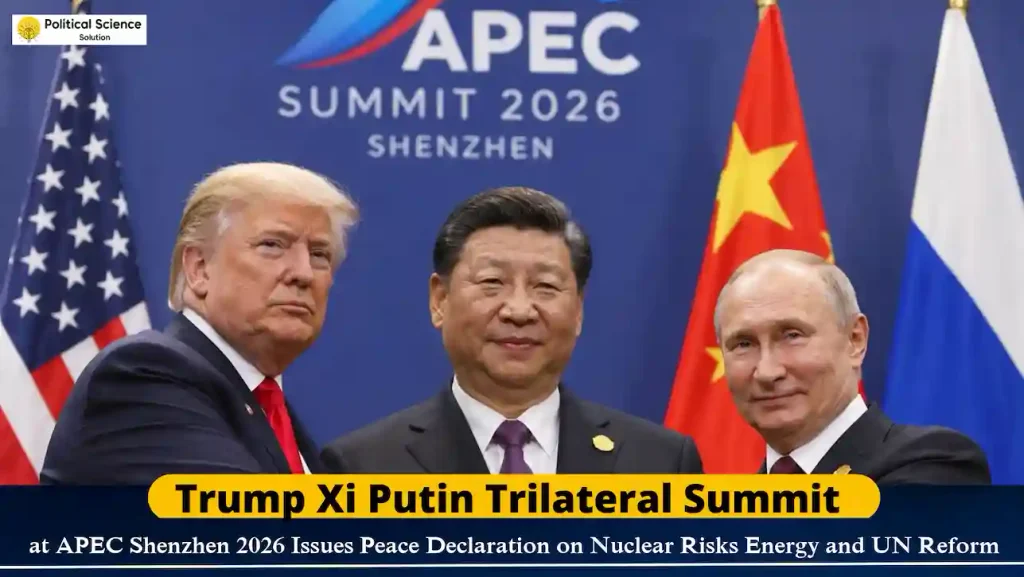
New Delhi: On 19 November 2026 the presidents of the United States, China and Russia held their first ever trilateral meeting on the sidelines of the Asia-Pacific Economic Cooperation summit in Shenzhen. Donald Trump, Xi Jinping and Vladimir Putin sat down at Kylin Villa for more than an hour and later released a four-point statement covering United Nations reform, global petroleum supplies, the jurisdiction of the International Criminal Court and nuclear risk reduction. The encounter took place amid intense strategic competition, the recent expiry of a major arms-control treaty and ongoing conflicts, yet produced no binding agreements or numerical commitments on nuclear arsenals.
The Historic Meeting in Shenzhen
The three leaders arrived in China’s southern technology hub for the APEC leaders’ gathering hosted by Beijing on 18 and 19 November 2026. Trump opened the session by declaring that the three countries were making history and that the United States, Russia and China were uniquely positioned to discuss reducing nuclear stockpiles because they possessed the world’s largest arsenals. Putin emphasised that the three nations shared converging interests in resolving conflicts, including the war in Ukraine, and carried special responsibility for international peace and security. Xi described the meeting as groundbreaking, urged the three powers to abandon Cold War thinking, respect one another’s core interests and avoid crossing sensitive red lines, and stated that every effort must be made to prevent nuclear war while ultimately seeking the comprehensive prohibition and complete destruction of nuclear weapons.
The session lasted over an hour. Officials later characterised the discussion as open and useful. Chinese Foreign Minister Wang Yi called the talks a peace summit that created a new paradigm for interaction among the three countries. Trump told NBC afterwards that he had also discussed artificial intelligence with Xi and that both leaders agreed some form of guardrails would be positive. Putin indicated he would consider attending the December G20 meeting in Miami after receiving an invitation from Trump, though any decision would depend on conditions inside Russia.
Key Points of the Four-Point Peace Declaration
The leaders issued a joint declaration after the meeting. First, they recognised the need to improve the effectiveness of the United Nations in responding to global challenges and highlighted the responsibilities of the three permanent members of the Security Council. The text contained no timetable for Security Council expansion and offered no explicit support for India’s long-standing demand for permanent membership.
Second, the declaration expressed support for increasing the production and supply of refined petroleum products and reaffirmed the importance of stable global energy flows. The statement came against a backdrop of disruptions affecting energy markets and maritime routes, including concerns over the Strait of Hormuz linked to the Iran conflict. No binding production quotas or immediate supply commitments were established.
Third, the leaders stressed the principle of state consent and respect for the immunities of government officials. They argued that the International Criminal Court and similar institutions must not abuse their jurisdiction. The language carried particular weight because of the ICC’s 2023 arrest warrant against Putin. The declaration itself did not alter the court’s legal authority or treaty framework.
Fourth, the three presidents reiterated that a nuclear war cannot be won and must never be fought. They agreed to pursue further dialogue on nuclear risk reduction and non-proliferation. The statement stopped short of any numerical reductions in nuclear arsenals and did not produce a binding trilateral arms-control treaty.
Background: APEC and the Geopolitical Context
APEC is a regional economic forum established in 1989 to promote trade, investment and economic cooperation across the Asia-Pacific. Its secretariat is based in Singapore. The grouping has 21 member economies and reaches decisions by consensus through voluntary, non-binding commitments. China hosted the 2026 summit in Shenzhen, Guangdong province. India is not a member.
Three developments shaped the atmosphere surrounding the trilateral meeting. Growing rivalry between the United States and China continued over trade restrictions, advanced semiconductor technologies, Taiwan and military activities in the Indo-Pacific. Russia’s confrontation with Western countries had intensified since the full-scale invasion of Ukraine in February 2022, increasing Moscow’s strategic dependence on partnerships outside the West, particularly with China. Uncertainty over nuclear arms control had risen after the New START Treaty expired on 5 February 2026, leaving the United States and Russia without a bilateral framework for limiting deployed strategic nuclear weapons and drawing greater attention to possible future arrangements that might involve China.
Nuclear Arms Control After New START
The New START Treaty was signed by the United States and Russia in 2010 and entered into force in 2011. It set limits on deployed strategic nuclear warheads and associated delivery systems. The treaty was extended in 2021 for five years. Its expiration removed the last remaining bilateral constraint on the two largest nuclear arsenals and increased international focus on the absence of verified limits. The Shenzhen declaration created a diplomatic channel for further discussion but represented an agreement to talk rather than an enforceable disarmament instrument.
Positions of the Three Powers
Hosting the meeting allowed China to present itself as a central venue for high-level diplomacy. Xi engaged both Washington and Moscow while showcasing China’s role as APEC host. Diplomatic visibility, however, did not automatically translate into the achievement of every Chinese strategic objective.
For Russia the summit provided an opportunity to demonstrate continued international influence despite sanctions and diplomatic isolation from many Western capitals. Putin was able to engage the US president directly in a multilateral setting. Kremlin officials later described the talks as constructive.
For the United States the engagement offered a chance to explore nuclear risk reduction and address security concerns through direct communication. The absence of enforceable commitments limited the immediate practical results.
The meeting also prompted debate about whether major powers could shape arrangements affecting smaller states without those states’ direct participation. Several other APEC leaders stressed the importance of economic resilience, diversified partnerships and respect for national sovereignty, underscoring the distinction between great-power diplomacy and an inclusive rules-based order.
Implications for Global Energy and the International Criminal Court
Stable energy flows featured prominently because of ongoing disruptions. The declaration’s call for increased production of refined petroleum products reflected shared concern over supply security, yet left concrete measures for later discussion. The ICC language reflected long-standing objections from all three countries. None is a party to the Rome Statute. The United States has objected to investigations involving its personnel and has imposed sanctions on court officials. Russia has rejected the court’s jurisdiction especially after the warrant against Putin. China has grown more critical after warrants issued against other leaders and petitions related to its own internal policies.
Ukraine was discussed in bilateral meetings, particularly between Trump and Putin, but Kremlin spokesman Dmitry Peskov stated it was not the central topic of the trilateral session. Putin later said Russia remained ready for negotiations yet saw no value in territorial discussions conducted under pressure, especially after recent Ukrainian strikes on the Crimean Bridge. He argued that Ukraine and European countries were not yet prepared for the compromises Moscow considered necessary. European leaders meeting concurrently in Berlin under the Coalition of the Willing insisted that any peace process must include Kyiv and European partners. Ukrainian President Volodymyr Zelenskyy maintained that China and the United States together possessed sufficient leverage, including sanctions, to influence the course of the war and that territorial questions could not be decided without Ukrainian representation.
Significance for India
Although India is not an APEC member, the summit carries strategic weight because New Delhi maintains substantial diplomatic, economic and security relationships with all three powers. India imports crude oil, fertilisers, defence equipment and coal from Russia, supporting energy security and defence cooperation. From China it imports electronics, machinery, chemicals and pharmaceutical raw materials that feed manufacturing and industrial supply chains. From the United States it imports energy products, aircraft, aerospace components and machinery that underpin advanced technology, energy and defence ties.
India’s heavy dependence on imported crude oil makes global energy market developments particularly relevant. Improved international supplies could ease pressure on petroleum prices. The diplomatic climate could affect sanctions, shipping and payment arrangements that influence India’s energy trade with Russia. Disruptions in the Strait of Hormuz would raise import costs and affect maritime supply chains. Changes in international energy prices would feed through to domestic inflation, transportation costs and the current account deficit.
Comparison with the Yalta Conference
Observers drew parallels with the 1945 Yalta Conference. That wartime meeting brought together the United States, Britain and the Soviet Union to discuss post-war arrangements and produced consequential political decisions that shaped the emerging international order. The Shenzhen summit occurred amid geopolitical tensions rather than world war, involved the United States, China and Russia rather than the wartime allies, discussed security and global governance rather than post-war settlements, and issued a broad four-point declaration rather than binding decisions. The comparison highlighted both the symbolic weight of three major nuclear powers meeting and the limits of what a single session without enforceable outcomes could achieve.
Looking Ahead
The Shenzhen meeting demonstrated that communication channels among the three largest nuclear powers remain open even during periods of intense rivalry. Future progress will depend on whether the stated commitment to dialogue on nuclear risk reduction produces verifiable confidence-building measures, whether discussions on energy security translate into practical steps that stabilise supplies, and whether any conversation on United Nations reform expands representation while preserving accountability. For smaller states the episode reinforced the value of diversified partnerships and the need to ensure that decisions affecting regional security include the countries directly concerned.
India’s response is likely to continue emphasising strategic autonomy: deepening mutually beneficial relationships with each of the three powers while avoiding exclusive alignment, strengthening Indo-Pacific engagement, diversifying energy sources and advocating more inclusive global governance arrangements. The summit underlines that competition and cooperation among major powers will continue to shape the international environment in which India pursues its interests.
The Trump-Xi-Putin trilateral meeting of 19 November 2026 stands as a significant diplomatic moment that brought three major nuclear powers together to address nuclear security, energy supplies and international institutions. Its symbolic importance should not be mistaken for a fundamental transformation of the international order. Deep strategic differences remain, and the absence of binding commitments on the most difficult issues leaves the practical impact of the Shenzhen declaration still to be tested.
FAQs
1. What was the Trump-Xi-Putin trilateral meeting at the 2026 APEC Summit?
On 19 November 2026, US President Donald Trump, Chinese President Xi Jinping and Russian President Vladimir Putin held their first-ever three-way meeting on the sidelines of the Asia-Pacific Economic Cooperation (APEC) summit in Shenzhen, China. The session lasted more than an hour at Kylin Villa and focused on nuclear risks, energy security, United Nations reform and the role of the International Criminal Court. The leaders issued a four-point peace declaration but reached no binding treaties or concrete settlements on major conflicts such as the war in Ukraine.
2. What were the main points of the four-point peace declaration?
The declaration covered four areas. The leaders called for improving the effectiveness of the United Nations and highlighted their responsibilities as permanent Security Council members, without setting a timetable for expansion or endorsing India’s permanent membership bid. They supported increasing production and supply of refined petroleum products and stressed the need for stable global energy flows. They emphasised state consent and respect for official immunities, stating that the International Criminal Court and similar bodies must not abuse their jurisdiction. Finally, they reaffirmed that a nuclear war cannot be won and must never be fought, and agreed to continue dialogue on nuclear risk reduction and non-proliferation, without agreeing numerical cuts or a new treaty.
3. Why was the meeting significant given the expiry of the New START Treaty?
The New START Treaty, which limited US and Russian deployed strategic nuclear warheads and delivery systems, expired on 5 February 2026. This left the two largest nuclear arsenals without a bilateral verification framework and increased international attention on future arms-control arrangements that could involve China. The Shenzhen meeting created a diplomatic channel for further nuclear risk-reduction talks among the three powers, but it produced only a commitment to dialogue rather than enforceable limits or a new arms-control agreement.
4. How does the summit affect India even though India is not an APEC member?
India maintains substantial economic, energy and security ties with all three countries. It relies on Russia for crude oil, fertilisers and defence equipment; on China for electronics, machinery and pharmaceutical inputs; and on the United States for advanced technology, aircraft and energy products. Developments in global oil markets, sanctions regimes, shipping routes (including the Strait of Hormuz) and great-power diplomacy therefore directly influence India’s energy security, inflation, current-account balance and strategic autonomy. The summit underscored the need for India to manage competition and cooperation among the three powers carefully while diversifying partnerships.
5. Did the leaders make progress on ending the war in Ukraine or other major conflicts?
Ukraine featured in bilateral discussions, particularly between Trump and Putin, but was not the central topic of the trilateral session according to Kremlin officials. Putin stated that Russia remained open to negotiations yet saw no value in territorial talks conducted under pressure, especially after recent strikes on the Crimean Bridge. He argued that Ukraine and European countries were not yet ready for the compromises Moscow sought. No ceasefire, territorial settlement or concrete roadmap emerged from the meeting. The declaration also avoided direct references to the conflicts in Ukraine or Iran, focusing instead on broader principles of nuclear restraint, energy stability and institutional reform.