

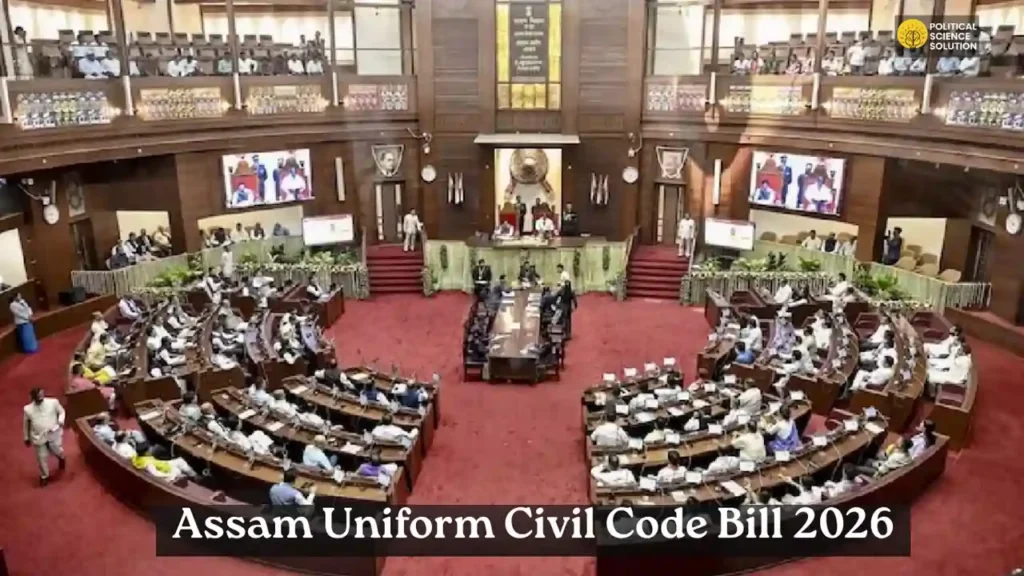
New Delhi: In a landmark development that could reshape personal laws in India’s Northeast, the Assam government has formally introduced the Uniform Civil Code (UCC) Bill 2026 in the state assembly. Tabled on May 25, this progressive legislation aims to establish a common set of rules governing marriage, divorce, succession, inheritance, and live-in relationships for all residents, irrespective of religion. If enacted, Assam would emerge as the third state in the country—after Uttarakhand and Gujarat—to implement a comprehensive Uniform Civil Code, marking a significant step toward realizing the constitutional vision of legal uniformity.
The bill, officially named ‘The Uniform Civil Code, Assam, 2026’, was introduced by Parliamentary Affairs Minister Atul Bora on behalf of Chief Minister Himanta Biswa Sarma. This move fulfills a key promise outlined in the Bharatiya Janata Party’s (BJP) manifesto ahead of the 2026 Assam assembly elections. The state cabinet had already given its nod to the legislation during its first meeting on May 13, underscoring the government’s commitment to gender justice and social reform.
Core Objectives: Promoting Equality, Secularism, and Social Accountability
The Assam UCC Bill 2026 seeks to replace fragmented religion-specific personal laws with a unified framework designed to ensure absolute equality and gender justice. By codifying uniform provisions, the legislation addresses long-standing issues such as discriminatory practices in marriage, inheritance, and family matters. It explicitly upholds the principles enshrined in Article 44 of the Indian Constitution, which directs the state to endeavor toward a Uniform Civil Code for all citizens.
Experts and government officials view this as a bold stride toward secularism in a diverse democracy. Rather than allowing religious practices to dictate legal outcomes, the bill promotes “one nation, one law,” fostering national integration while simplifying complex legal procedures. It also aims to curb exploitation, fraud, and unlawful customs that have disproportionately affected women and vulnerable sections of society.
Chief Minister Himanta Biswa Sarma emphasized that the introduction of the bill opens the door for substantive discussions on its necessity. He described it as a pathway to fulfill the dreams of India’s founding fathers, positioning Assam as a forward-looking and cohesive state that balances modernity with tradition.
Key Provisions: What the Assam UCC Bill Entails
The bill introduces several transformative measures that touch every aspect of personal and family life:
Marriage and Monogamy: The legislation mandates monogamy as the standard, setting the minimum legal age for marriage at 21 years for grooms and 18 years for brides. Bigamy and polygamy are strictly prohibited, with violations attracting imprisonment of up to seven years under Section 82 of the Bharatiya Nyaya Sanhita, 2023. This provision is expected to have far-reaching implications, particularly in communities where polygamous practices have persisted.
To respect cultural diversity, the bill grants full freedom in choosing marriage rituals. Couples can solemnize their union through any traditional or religious ceremony, including Vedic Bibah, Ahom Chaklong, Saptapadi, Ashirvad, Nikah, Holy Union, Anand Karaj, or other established customs.
Compulsory Registration of Marriages and Divorces: In a major transparency initiative, all marriages and divorces must be registered with the Sub-Registrar within 60 days of the event. This requirement is intended to prevent fraud, facilitate legal protections related to maintenance, inheritance, and property rights, and create verifiable records. Failure to register within the stipulated period could result in penalties of up to ₹10,000, along with imprisonment for up to three months.
Divorce and Child Custody: The bill standardizes grounds for divorce, including cruelty, desertion, and mutual consent. Notably, it prioritizes the welfare of young children by granting custody of children under five years to the mother, unless exceptional circumstances dictate otherwise.
Inheritance and Succession Rights: A uniform, gender-neutral order of preference for intestate succession has been defined among Class-1 heirs, which includes the spouse, children, and parents of the deceased. This ensures equitable distribution and eliminates gender-based disparities prevalent in some personal laws. For those making a will (testamentary succession), any adult of sound mind retains the right to execute a written, witnessed document.
Live-In Relationships: Acknowledging contemporary social realities, the bill makes registration of live-in relationships mandatory within one month. This move aims to safeguard the rights of partners and children. Children born out of live-in relationships are declared fully legitimate, and a deserted partner gains explicit legal standing to seek financial maintenance through the courts. Non-registration or providing false information in declarations can lead to imprisonment of up to three months and fines.
Penalties for Violations: The legislation incorporates stringent deterrents against social evils:
- Child marriage or marriage without valid consent: Up to two years imprisonment or fine or both.
- Fraudulent or deceptive marriages involving force, coercion, or concealment: Up to seven years imprisonment plus fine.
- Violation of lawful divorce procedures or illegal dissolution: Up to three years imprisonment and fine.
- Compelling a divorced person to meet unlawful conditions before remarriage: Three years imprisonment and ₹1 lakh penalty.
- Marriage within prohibited degrees (unless protected by custom): Up to six months imprisonment and ₹50,000 fine.
- Submission of forged documents during registration: Up to three months imprisonment or ₹25,000 fine or both.
- Concealment of facts in live-in declarations: Up to three months imprisonment and ₹25,000 fine.
These punitive measures are designed to protect women, promote accountability, and deter exploitative practices.
Exclusions and Safeguards: Importantly, the bill excludes Scheduled Tribes residing in Assam from its purview, respecting the unique cultural and customary practices of indigenous communities. Additionally, it repeals the Assam Compulsory Registration of Muslim Marriages and Divorces Act, 2024, to create a streamlined statutory framework. A crucial savings clause ensures that any polygamous marriages solemnized before the UCC’s enforcement remain legally protected and regularized.
Government’s Vision: Balancing Uniformity with Cultural Sensitivities
In its official statement, the Assam government highlighted how the bill successfully integrates legal uniformity with respect for diverse traditions. By allowing religious ceremonies while enforcing common legal standards, it positions the state as progressive yet inclusive. The focus on compulsory registrations and clear penalties aims to strengthen social accountability and provide legal security to all citizens, especially women and children in vulnerable situations.
Opposition and Concerns: Calls for Wider Consultation
The introduction of the bill was not without contention. MLAs from three opposition parties, including the Congress, voiced strong objections during the assembly session. Congress leader Zakir Hussain Sikdar criticized the move as a “political agenda” of the ruling BJP, accusing the government of “bulldozing” the legislation without adequate preparation.
Opposition members demanded comprehensive consultations with all political parties, non-political organizations, religious bodies, and other stakeholders before proceeding further. On May 23, at least 10 Muslim religious and social organizations gathered in Guwahati to urge the government to engage in broader dialogue prior to passage.
The bill is scheduled for detailed discussion on May 27—the final day of the first session of the 16th Assam Assembly—where these concerns are likely to take center stage.
Additional Developments in the Assam Assembly
Beyond the UCC Bill, the assembly witnessed other significant motions. The government moved a resolution supporting the implementation of 33% reservation for women in Parliament and state legislatures once the delimitation process is completed. This aligns with broader national efforts to enhance women’s political participation.
In his maiden speech as an MLA, Tuliram Ronghang, Chief Executive Member of the Karbi Anglong Autonomous Council, raised the demand for the implementation of Article 244(A) of the Constitution. He called for the creation of Autonomous States within Assam for the three hill districts—Karbi Anglong, West Karbi Anglong, and Dima Hasao—highlighting ongoing aspirations for greater administrative autonomy in tribal areas.
Historical Context and National Significance
Goa has long maintained a form of common civil code inherited from the Portuguese Civil Code of 1867. Uttarakhand and Gujarat have more recently pioneered modern UCC implementations. Assam’s entry into this league makes it the first state in the Northeast to take such a decisive step.
The Supreme Court has repeatedly underscored the importance of a Uniform Civil Code in cases like Sarla Mudgal (1995), emphasizing its role in advancing gender justice and national unity. Proponents argue that differentiated personal laws create inequality and hinder social progress, while critics worry about potential cultural erosion without sufficient consultation.
Implications for Assam and Beyond
If passed, the Assam Uniform Civil Code Bill 2026 could serve as a model for other states grappling with similar reforms. Its emphasis on mandatory registrations, protection of live-in partners, gender-equal inheritance, and strict penalties against polygamy and child marriage addresses modern challenges in family law.
For residents of Assam, the bill promises greater legal clarity, reduced litigation, and enhanced protections, particularly for women. However, its success will depend on effective implementation, public awareness campaigns, and addressing genuine concerns raised by various communities.
As the assembly prepares for final deliberations, the UCC debate in Assam reflects larger national conversations about balancing unity with diversity. The coming days will determine whether this ambitious legislation becomes a beacon of progressive reform or a subject of prolonged political contestation.
FAQs
Q1: What is the Assam Uniform Civil Code Bill 2026?
The Assam UCC Bill 2026 is a proposed law introduced on May 25, 2026, that aims to replace religion-based personal laws with a common code for marriage, divorce, succession, inheritance, and live-in relationships for all residents except Scheduled Tribes.
Q2: Does the Assam UCC Bill ban polygamy?
Yes. The bill prohibits bigamy and polygamy, prescribing imprisonment of up to 7 years. It mandates monogamy and sets the minimum marriage age at 21 years for men and 18 years for women.
Q3: Is registration of live-in relationships compulsory in Assam UCC?
Yes. All live-in relationships must be registered within one month. Children born from such relationships are considered legitimate, and deserted partners can claim maintenance through courts.
Q4: Which groups are excluded from the Assam UCC Bill?
The bill does not apply to any Scheduled Tribes residing in Assam, respecting their customary laws and cultural practices.
Q5: When will the Assam UCC Bill be discussed and what are the main objections?
The bill is scheduled for discussion on May 27, 2026. Opposition parties, including Congress, have objected, demanding wider consultations with all stakeholders before passage.