

New Delhi: In a landmark moment for Indian democracy, Prime Minister Narendra Modi has achieved a historic feat by surpassing the record of India’s first Prime Minister, Jawaharlal Nehru, to become the longest-serving continuously elected Prime Minister. With an unbroken tenure of 4,399 days as of June 10, 2026, this accomplishment underscores Modi’s enduring popularity and the transformative impact of his leadership over the past 12 years.
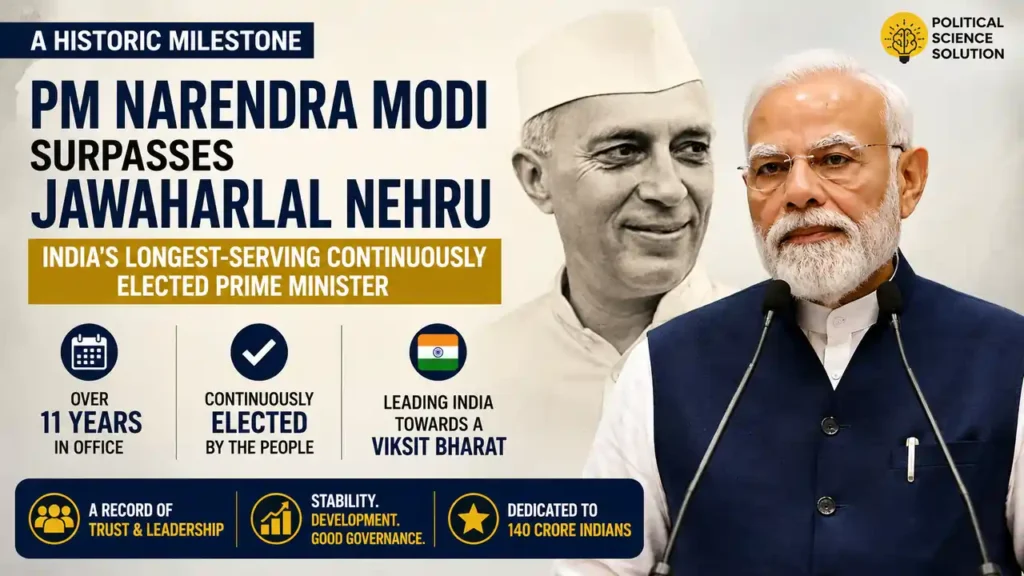
The Record-Breaking Tenure: From 2014 to 2026
Prime Minister Modi first assumed office in 2014 following a decisive electoral victory. He was sworn in for a third consecutive term on June 9, 2024, after another strong performance in the Parliamentary elections. This continuous service has now eclipsed Nehru’s record of 4,398 days, calculated from his election in 1952 until May 27, 1964. Nehru’s earlier period from 1947 to 1952 was as head of an interim government, prior to the institutionalization of general elections.
Unlike fragmented tenures such as Indira Gandhi’s 14 years (1966–1984), which included periods out of power after the 1977 elections following the Emergency, Modi’s record reflects uninterrupted public mandate through democratic processes. BJP leaders and Union Ministers have widely celebrated this as a testament to the people’s trust in his vision of “Nation First.”
Tributes Pour In from Across the Political Spectrum
The achievement has elicited glowing tributes from senior leaders. Defence Minister Rajnath Singh congratulated PM Modi on X, describing him as a “tireless Karmayogi” dedicated to inclusive development and good governance. Singh highlighted India’s progress in development, global leadership, and a “civilisational reawakening” under Modi’s 12-year tenure, positioning the nation confidently toward Viksit Bharat.
Union Commerce Minister Piyush Goyal called it a “historic day,” noting transformative reforms benefiting farmers, entrepreneurs, women, MSMEs, youth, and the middle class. He emphasized Modi’s role in elevating India’s global stature and steering the country toward a developed nation by 2047.
Union Law Minister Arjun Ram Meghwal described the milestone as a landmark in India’s political journey, pointing to expanded schemes, economic growth toward a $5 trillion economy, controlled inflation, increased employment, and enhanced national security through operations like surgical strikes.
A Profound Transformation in Indian Politics
Political observers note that this milestone transcends mere statistics. Ajay Singh, former press secretary to Presidents Kovind and Murmu, remarked that while records are notable, Modi’s legacy lies in reimagining India’s politics. Key resolutions include the construction of the Ram Temple at Ayodhya, the abrogation of Article 370 in Jammu and Kashmir, taming insurgency in the Northeast, and curbing the Naxalite movement.
Political scientist Ashwani Kumar contrasts Modi with historical figures like Nehru (nation-builder), Thatcher (market reformer), Mandela (reconciler), and Lee Kuan Yew (developmental modernizer). He positions Modi as a “civilizational moderniser” and architect of India’s “Second Republic,” whose authority stems from reconfiguring the moral and symbolic foundations of democratic politics into a participatory project of national renewal rooted in identity and civilizational continuity.
Over 12 years, Modi’s government has prioritized Antyodaya – uplifting the poorest – through welfare measures ensuring development benefits reach the grassroots. Initiatives like Jan Dhan Yojana (over 40 crore bank accounts), direct benefit transfers saving the government significant amounts, PMAY housing, and Jal Jeevan Mission extensions exemplify this focus.
Constitutional Role and Responsibilities
The Prime Minister, appointed by the President under Article 75, serves as the de facto executive head of government. Heading the Council of Ministers (Article 74), the PM advises the President, acts as the link between the President and the Council, and chairs key bodies like NITI Aayog, the National Integration Council, and the Interstate Council.
Modi’s tenure has shattered many traditional assumptions of Indian politics, fostering a distinct era marked by decisive governance, economic reforms, and cultural resurgence.
Looking Ahead: Viksit Bharat by 2047
As India marks this milestone, the focus remains on Modi’s vision for a developed India by 2047. His leadership continues to drive progress across sectors, from infrastructure and technology to social empowerment and global diplomacy. The unbroken 4,399 days (and counting) symbolize not just longevity in office but a sustained commitment to national transformation.
This historic achievement reinforces the strength of India’s democratic ethos, where public trust translates into long-term mandates for visionary leadership. As tributes continue and analyses reflect on the past 12 years, PM Modi’s record stands as a watershed in post-independence Indian history.
FAQs
1. When did PM Narendra Modi surpass Jawaharlal Nehru to become India’s longest-serving continuously elected Prime Minister?
Prime Minister Narendra Modi achieved this record on June 10, 2026, completing an unbroken tenure of 4,399 days in office. This surpassed Nehru’s 4,398 days (from his election in 1952 to May 27, 1964). Modi was first sworn in during 2014 and began his third consecutive term on June 9, 2024.
2. How does PM Modi’s tenure differ from previous Prime Ministers like Nehru and Indira Gandhi?
Unlike Nehru’s interim period (1947–1952) before formal elections, Modi’s service has been continuously elected. Indira Gandhi’s total 14 years were fractured, including a loss of power after the 1977 elections post-Emergency. Modi’s 12+ years represent an unbroken democratic mandate, marking the longest continuous elected tenure in independent India.
3. What are the key achievements highlighted during PM Modi’s 12 years in office?
Key highlights include welfare schemes focused on Antyodaya (upliftment of the poorest), major reforms benefiting farmers, women, MSMEs, youth, and the middle class, economic growth toward a $5 trillion economy, controlled inflation, increased employment, and national security operations like surgical strikes. Landmark decisions encompass the Ram Temple construction in Ayodhya, abrogation of Article 370, resolution of Northeast insurgency, and weakening of the Naxalite movement.
4. How have senior BJP leaders and Union Ministers reacted to this milestone?
Defence Minister Rajnath Singh praised Modi as a “tireless Karmayogi” and highlighted India’s development, global leadership, and civilisational reawakening. Commerce Minister Piyush Goyal called it a “historic day” and lauded transformative reforms and India’s rising global stature. Law Minister Arjun Ram Meghwal described it as a landmark moment with expanded schemes, economic strengthening, and enhanced national honour.
5. What broader political and historical significance does this achievement hold?
Experts like Ajay Singh and Prof. Ashwani Kumar view it as more than a statistical record. Modi is seen as a “civilizational moderniser” and architect of India’s “Second Republic,” reconfiguring democratic politics with a focus on national renewal, identity, and participatory governance. The milestone signals a shift from the Nehruvian era and underscores public trust driving India toward Viksit Bharat by 2047.