

New Delhi: In a significant policy shift aimed at addressing the state’s rapidly ageing population, Andhra Pradesh Chief Minister N. Chandrababu Naidu has announced financial incentives of ₹30,000 for the third child and ₹40,000 for the fourth child. This bold initiative forms the cornerstone of the state’s new Population Management Policy, marking a complete reversal from decades of population control measures and sparking nationwide debate on demographic sustainability in India.
The announcement, made at a public event in Narsannapeta in Srikakulam district, underscores Naidu’s concern that young couples in the state are having fewer children, leading to long-term economic and social challenges. With Andhra Pradesh’s Total Fertility Rate (TFR) now at 1.5 — well below the replacement level of 2.1 — the TDP-led NDA government is proactively intervening to boost birth rates and secure the state’s demographic dividend.
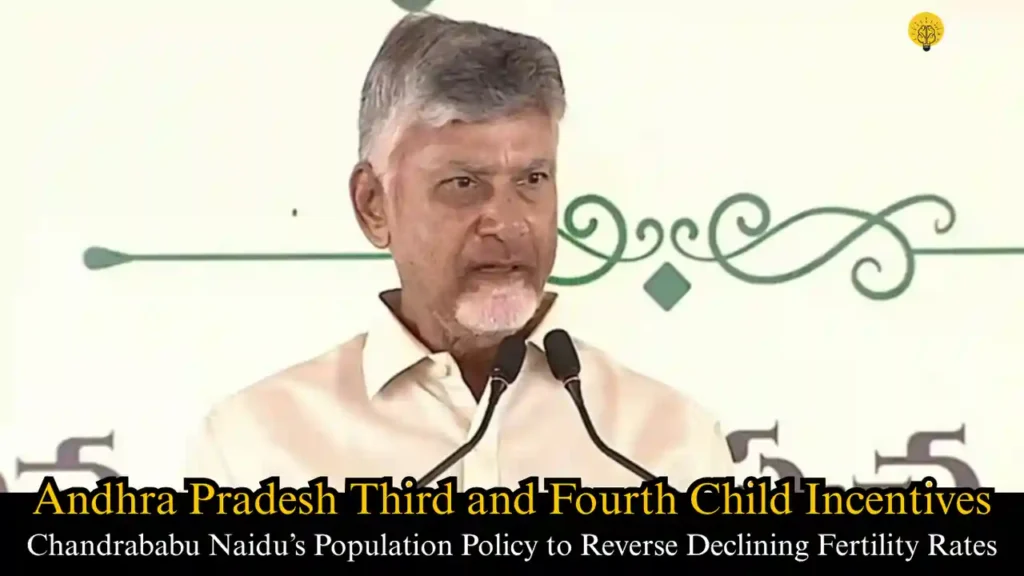
Understanding the New Population Incentives in Andhra Pradesh
Under the newly unveiled incentives, families having a third child will receive a one-time payment of ₹30,000, while those with a fourth child will get ₹40,000. Beyond the cash support, the policy offers comprehensive benefits including ₹1,000 per month in nutrition assistance for the third child for five years, free education up to age 18, and extended parental leave — 12 months of maternity leave along with two months of paternity leave.
This multi-pronged approach also includes support for childless couples facing fertility issues. The government plans to establish a Maternity Centre of Excellence and provide IVF services in government hospitals through public-private partnerships. Additionally, the state aims to set up Fertility Colleges as Centres of Excellence for Reproductive Medicine, the first such public sector initiative focused on training professionals and delivering state-supported infertility treatments.
The policy introduces a five-stage lifecycle support system covering Matrutva (motherhood), Shakti (strength), Kshema (well-being), Naipunyam (skills), and Sanjeevani (longevity). This framework promises government assistance from pregnancy through old age, reflecting a holistic shift from mere population control to comprehensive population care and human resource development.
Health authorities in the state have also outlined targets to reduce caesarean sections and bring down teenage pregnancies from the current 8.8% to below 3%. The Population Management Policy document has been made publicly available online, with local representatives encouraged to conduct month-long community discussions. The government has committed to reviewing and refining the policy based on outcomes after one year.
Andhra Pradesh’s Alarming Demographic Shift
The rationale behind these incentives is firmly rooted in data. According to figures cited by Chief Minister Naidu in the state assembly, Andhra Pradesh’s TFR has dropped dramatically from 3.0 in 1993 to 1.5 based on 2023 data. This places the state among the lowest in India and comparable to many developed European nations facing demographic crises.
India’s national replacement fertility rate stands at 2.1 — the average number of children a woman needs to have to replace herself and her partner in the population, accounting for mortality. While the country’s overall TFR hovers around 2.0 as per the National Family Health Survey (NFHS) 2019-21, southern states consistently record much lower figures. Andhra Pradesh and Karnataka are at approximately 1.7, while Kerala, Tamil Nadu, and Telangana hover between 1.5 and 1.8.
Projections shared by the state government paint a concerning picture. If current trends persist, 23% of Andhra Pradesh’s population could be elderly (above 60 years) by 2047. Currently, the elderly constitute about 10% of the state’s population, and 58% of families have only one child. The state’s median age of 32.5 years already exceeds the national average of 28.4 years, indicating faster ageing compared to the rest of India.
State Health, Medical & Family Welfare Secretary Sourabh Gaur highlighted the urgency: the state faces the same challenges as developed nations — a growing non-working-age population that could strain the economy. Without intervention, the demographic window of opportunity is expected to close by 2040, leading to a heavily skewed dependency ratio favoring the elderly.
Demographic Transition Theory and Its Relevance to India
The situation in Andhra Pradesh and other southern states aligns with the Demographic Transition Theory (DTT), which explains the shift from high birth and death rates to low birth and death rates as societies develop economically. First conceptualized by Warren S. Thompson in 1929 and further developed by Frank W. Notestein in 1945, the theory outlines stages of population transformation driven by improvements in healthcare, education, and economic conditions.
India exhibits sharp inter-state divergences under this framework. Northern states like Bihar (TFR 2.98), Meghalaya (2.91), Uttar Pradesh (2.35), Jharkhand (2.26), and Manipur (2.17) remain above replacement level, while southern states have successfully lowered fertility. This creates differing windows of demographic opportunity, with high-youth-population states like Bihar and Uttar Pradesh enjoying longer dividends.
By 2050, India is projected to have 347 million people aged 60 and above, up from around 149 million currently. This ageing will bring significant fiscal pressures on states with shrinking working-age populations, including reduced tax bases, higher pension and healthcare costs, and increased debt burdens. Politically, it raises questions about future delimitation and parliamentary representation based on population.
The Delimitation Debate and Political Context
Naidu’s announcement comes weeks after intense national debate over delimitation. In April 2026, the Constitution (131st Amendment) Bill, 2026 — proposing expansion of Lok Sabha seats to 816-850 and adjustments to women’s reservation — was defeated in Parliament. The bill fell short of the required two-thirds majority, marking the first such setback for the NDA government under Prime Minister Narendra Modi.
The core issue revolves around the current freeze on parliamentary constituencies based on the 1971 Census. Southern states argue that using latest population figures for delimitation would penalize them for successful family planning, reducing their representation. An MP from Kerala currently represents about 1.75 million people, compared to 3.35 million in Bihar. TDP, Naidu’s party, supported the government bill, distinguishing itself from other southern parties like DMK, while relying on verbal assurances from Union Home Minister Amit Shah regarding proportional seat increases.
Naidu has publicly warned that failure to address the freeze after the upcoming census could diminish southern representation. This political dimension adds complexity to the population policy, as critics point to timing and broader federal dynamics.
From Two-Child Norm to Population Care
Until recently, Andhra Pradesh enforced a three-decade-old two-child norm that disqualified candidates with more than two children from local elections. This was repealed, paving the way for the current pro-natalist stance. Naidu, who once championed family planning during his earlier tenure as Chief Minister of undivided Andhra Pradesh (1995-2004), now views children as “wealth” rather than a burden.
The policy marks a transition from “family planning” to “population care.” It contrasts with the national “Hum do, Hamare do” campaign of past decades. While northern leaders like those from the Samajwadi Party continue to emphasize population control, southern leaders increasingly advocate for higher birth rates.
Challenges and Global Lessons on Fertility Incentives
Experts remain cautious about the effectiveness of financial incentives. Similar policies in countries like South Korea, Denmark, France, Hungary, and China have shown limited success in reversing fertility declines. A 2025 Lancet study on Japan indicated only a 12% probability of meaningful reversal by 2030 through cash benefits.
The UN State of World Population 2025 report notes that many Indian women who desire more children face barriers related to healthcare access, economic pressures, and social norms, while others face unwanted pregnancies due to son preference. Policies must enhance women’s agency rather than impose targets, researchers argue.
Analysts like Rukmini S, referencing the book After the Spike by Dean Spears and Michael Geruso, suggest that rising opportunity costs of child-rearing in developed economies — driven by education, career aspirations, and lifestyle changes — explain declining fertility more than policy alone. Southern Indian states may simply be further along this global trajectory.
Vision for Swarna Andhra 2047
This Population Management and Human Resource Development initiative is the third “sutra” in the state’s “Padi Sutralu” (10 points) under the Swarna Andhra Vision 2047. The government aims not only to raise TFR to 2.1 but also to build a sustainable demographic balance supporting long-term economic growth.
Chief Minister Naidu has emphasized the need for collective societal effort, urging public representatives to engage communities. While data supports concerns about ageing, the policy’s ultimate impact will depend on implementation, cultural shifts, and addressing underlying economic factors influencing family decisions.
As Andhra Pradesh takes this pioneering step — the first state in India with such a comprehensive Population Management Policy — it sets the stage for broader national conversations on balancing regional demographic realities with India’s federal democratic framework. The coming years will reveal whether incentives and support systems can successfully encourage families to have more children while ensuring the well-being of future generations.
FAQs
1. What are the financial incentives announced by Chandrababu Naidu for the third and fourth child in Andhra Pradesh?
Andhra Pradesh Chief Minister N. Chandrababu Naidu has announced ₹30,000 cash incentive for families having a third child and ₹40,000 for a fourth child under the state’s new Population Management Policy. Additionally, families get ₹1,000 per month as nutrition support for the third child for five years, free education till age 18, and 12 months of parental leave (including 2 months of paternity leave). The policy also includes IVF support through government hospitals under PPP mode and the establishment of Fertility Colleges as Centres of Excellence.
2. Why did Andhra Pradesh introduce incentives for having more children?
Andhra Pradesh’s Total Fertility Rate (TFR) has declined sharply to 1.5, which is well below the replacement level of 2.1. The state government fears rapid population ageing — with 23% of the population projected to be above 60 years by 2047. Currently, 58% of families have only one child and the elderly population stands at 10%. With a median age of 32.5 years (higher than the national average), the state wants to prevent a shrinking workforce, rising dependency ratio, and economic slowdown similar to Japan, South Korea, and Italy.
3. How does Andhra Pradesh’s Population Management Policy differ from India’s earlier two-child policy?
The new policy marks a complete reversal from the decades-old “Hum do, Hamare do” approach and the previous two-child norm that disqualified people with more than two children from contesting local elections (repealed recently). Instead of population control, the focus has shifted to “population care” and sustainability. It introduces a five-stage lifecycle support system — Matrutva, Shakti, Kshema, Naipunyam, and Sanjeevani — and aims to raise the TFR back to 2.1 through incentives, healthcare support, and community engagement.
4. What is the connection between Andhra Pradesh’s population policy and the delimitation debate?
The timing of the announcement comes shortly after the defeat of the Constitution (131st Amendment) Bill, 2026 in Parliament regarding delimitation and Lok Sabha seat expansion. Southern states like Andhra Pradesh fear losing political representation if seats are redistributed purely on current population. Northern states with higher fertility would gain more seats. TDP supported the bill with assurances from the Centre, while Naidu has warned that the post-2026 census could reduce southern states’ parliamentary voice if the current fertility trends continue.
5. Will the cash incentives for third and fourth child be effective in increasing Andhra Pradesh’s birth rate?
While the policy is one of the most comprehensive in India, global evidence shows mixed results. Countries like South Korea, Japan, France, and Hungary have offered similar incentives with limited success. Experts note that rising opportunity costs of child-rearing, women’s career aspirations, and changing social norms play a bigger role than cash alone. The Andhra Pradesh government will review the policy after one year based on outcomes. It also addresses supply-side issues through better fertility treatment access and reduction in teenage pregnancies and caesarean sections.