
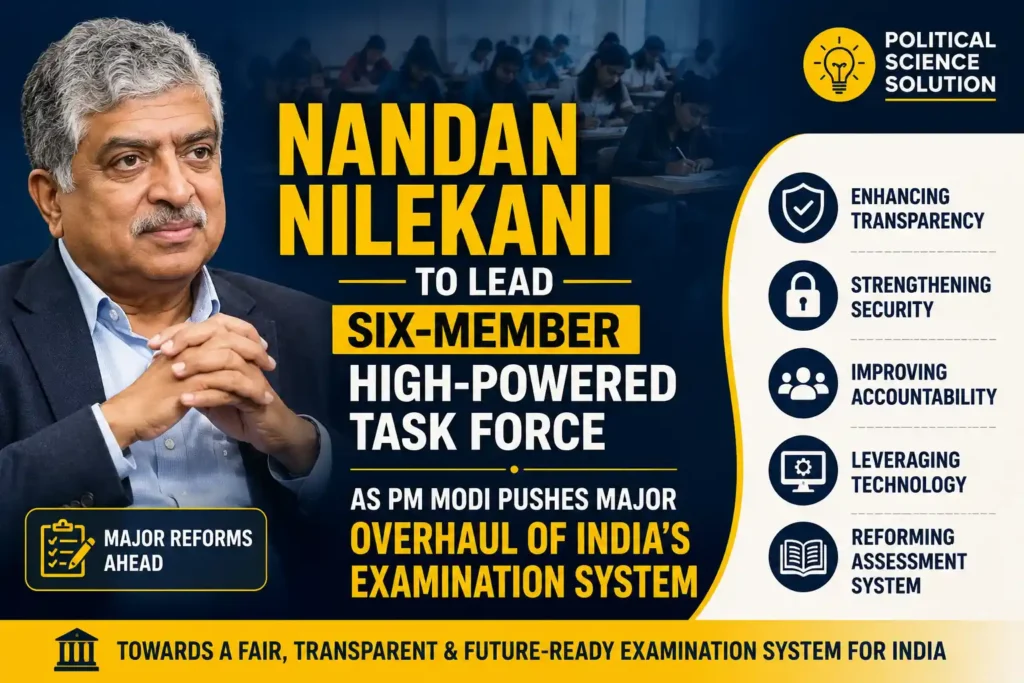
New Delhi: Prime Minister Narendra Modi has announced the creation of a high-powered six-member task force that will recommend sweeping reforms to strengthen the integrity of India’s public examination system. Headed by technology expert and Infosys co-founder Nandan Nilekani, the panel has been asked to focus on making examinations more secure, transparent and technology-driven so that the credibility of future tests is firmly established.
Announcement and Core Objectives
In a video message released earlier this week, the Prime Minister said the task force will examine the existing examination framework and submit recommendations at the earliest. Once those recommendations are received, the government will take the necessary steps to ensure the reliability of upcoming examinations. Mr Modi underlined three essential requirements: the system must remain trustworthy, it must function with complete transparency, and it must make maximum use of available technology.
He also revealed that a new law containing stringent provisions against examination-related irregularities will be introduced in Parliament the following day. The Prime Minister reaffirmed the government’s commitment to protecting the integrity of competitive examinations and safeguarding the future of the millions of students who appear for them every year.
Union Home Minister’s Endorsement
Union Home Minister Amit Shah welcomed the formation of the panel. He said that under the leadership of Prime Minister Narendra Modi the government follows a principle of continuous reform aimed at securing the prospects of the next generation. Referring to the Nilekani-led task force, Mr Shah stated that it would ensure no one is able to breach the sanctity of the country’s examination system. He added that the government would impose exemplary punishment on those involved in paper leaks so that such offences are deterred in the future.
Composition of the High-Powered Task Force
The six-member panel brings together expertise from technology, national security, space science, artificial intelligence, education administration and logistics. Besides chairperson Nandan Nilekani, the members are former Intelligence Bureau Director Tapan Deka, former ISRO Chairman S Somanath, IIT Madras Director V Kamakoti, former Education Secretary Anita Karwal, and logistics expert Amrit Lal Meena.
Nandan Nilekani – Chairperson and Technology Visionary
Nandan Nilekani is co-founder and chairman of Infosys. He served as the founding Chairperson of the Unique Identification Authority of India from 2009 to 2014 and oversaw the large-scale rollout of Aadhaar. He also chaired the Technology Advisory Group for Unique Projects, which recommended technology-based reforms for major government programmes, including systems linked to the Goods and Services Tax. In 2023 he was appointed co-chair of the G20 Task Force on Digital Public Infrastructure for Economic Transformation, Financial Inclusion and Development. An IIT Bombay graduate, Nilekani has co-founded the eGov Foundation, which develops citizen-centric digital platforms for urban local bodies, and the EkStep Foundation, which works to improve basic literacy and numeracy through digital means. He has been honoured with the Padma Bhushan and the Joseph Schumpeter Prize.
Amrit Lal Meena – Logistics Specialist
Amrit Lal Meena is a retired 1989-batch Bihar-cadre IAS officer. He served as Chief Secretary of Bihar from August 2024 until his retirement in August 2025. Earlier he held the positions of Secretary in the Ministry of Coal and Special Secretary for Logistics in the Department for Promotion of Industry and Internal Trade. Holding a BTech degree in Electrical Engineering, he brings more than three decades of administrative experience at both state and central levels.
Anita Karwal – Education Expert
Anita Karwal is a retired 1988-batch Gujarat-cadre IAS officer. She served as India’s Education Secretary from 2020 until her retirement in 2022. Before that she was Chairperson of the Central Board of Secondary Education from 2017 to 2020. After retirement she was appointed Chairperson of the Gujarat Real Estate Regulatory Authority. She was closely involved in the development and implementation of the National Education Policy 2020 and studied Economics at Lady Shri Ram College, University of Delhi.
S Somanath – Science and Technology Expert
S Somanath served as Chairman of the Indian Space Research Organisation from 2022 to 2025. During his tenure India successfully landed Chandrayaan-3 near the Moon’s south pole and launched the Aditya-L1 solar mission. He also oversaw the operationalisation of the Small Satellite Launch Vehicle and the continued development of the LVM3 launch vehicle. Before becoming Chairman he headed the Vikram Sarabhai Space Centre and the Liquid Propulsion Systems Centre. A propulsion engineer by training, he joined ISRO in 1985.
Dr V Kamakoti – Artificial Intelligence and Computing Expert
Dr V Kamakoti is the Director of IIT Madras. A computer scientist, he is known for leading the Shakti project that developed India’s indigenous microprocessor. His work focuses on computer architecture, cybersecurity, artificial intelligence and high-performance computing. He serves on the National Security Advisory Board and has contributed to several government initiatives related to technology and digital infrastructure.
Tapan Deka – Security Expert
Tapan Deka is the former Director of the Intelligence Bureau. A 1988-batch IPS officer, he headed the IB from 2022 to 2026. Across a career spanning nearly four decades he worked extensively on counter-terrorism, intelligence operations and internal security. Before becoming Director he spent more than a decade in the agency’s Operations branch, handling counter-terrorism investigations and intelligence coordination.
Mandate and Areas of Focus
The government has stated that the task force will recommend reforms to make India’s examination system more transparent, reliable and technology-driven. The panel is expected to examine technology-led reforms for public examinations, measures to prevent paper leaks and other forms of malpractice, cybersecurity and digital safeguards, administrative and logistical improvements, and structural reforms that can strengthen examination systems overall. The government has indicated that the panel’s recommendations will be considered while implementing broader reforms across the examination ecosystem.
Background and Context of the Decision
The announcement follows a period of heightened public concern over examination malpractice and paper leaks. It came a day after protests led by the satirical political group Cockroach Janta Party ended following the resignation of Union Education Minister Dharmendra Pradhan. The government has already taken steps to prosecute those accused of compromising examinations, set up fast-track courts, and is now moving forward with new legislation containing strict legal provisions.
Looking Ahead
By combining expertise in large-scale digital systems, national security, space technology, indigenous computing, education policy and logistics, the task force is expected to deliver practical recommendations that address both technological and structural gaps. Prime Minister Modi has made clear that the report of the Nilekani-led panel will guide immediate efforts to secure the reliability of future examinations. Home Minister Shah has reiterated that the government will not allow the sanctity of the examination process to be compromised and will pursue the strongest possible action against those who attempt paper leaks.
The constitution of this high-powered task force marks a determined effort to restore confidence among students and parents, embed technology at the core of examination processes, and create a framework capable of withstanding future attempts at malpractice. Once the recommendations are submitted, the government has committed to rapid action so that the integrity of competitive examinations is protected for the benefit of millions of young Indians.
FAQs
1. What is the high-powered task force announced by PM Modi and who is leading it?
Prime Minister Narendra Modi has constituted a six-member high-powered task force to recommend reforms that will strengthen India’s examination system. The panel is headed by renowned technology expert and Infosys co-founder Nandan Nilekani. Its primary goal is to make public examinations more trustworthy, transparent and technology-driven so that the credibility of future tests is firmly protected.
2. Who are the six members of the task force and what expertise do they bring?
Besides chairperson Nandan Nilekani, the members are:
- Tapan Deka, former Director of the Intelligence Bureau (security and counter-terrorism expertise)
- S Somanath, former Chairman of ISRO (science, technology and large-scale project management)
- Dr V Kamakoti, Director of IIT Madras (artificial intelligence, cybersecurity and indigenous computing)
- Anita Karwal, former Education Secretary and former CBSE Chairperson (education policy and administration)
- Amrit Lal Meena, retired IAS officer and logistics specialist (administrative and logistical experience)
Together they cover technology, national security, space science, computing, education and logistics.
3. What specific areas will the task force examine?
The panel has been asked to recommend reforms that make the examination system more transparent, reliable and technology-driven. Key focus areas include technology-led reforms for public examinations, measures to prevent paper leaks and other forms of malpractice, cybersecurity and digital safeguards, administrative and logistical improvements, and structural reforms that strengthen the overall examination architecture.
4. Why was this task force formed and what other steps is the government taking?
The announcement comes amid growing concerns over examination malpractice and paper leaks. It followed the end of protests organised by the Cockroach Janta Party after the resignation of Union Education Minister Dharmendra Pradhan. In addition to the task force, the government is introducing a new law in Parliament with stringent provisions to deal with examination-related irregularities. Fast-track courts have already been set up, and those found guilty of compromising examinations are facing legal action. Union Home Minister Amit Shah has stated that the government will impose exemplary punishment on paper-leak culprits to deter future offences.
5. What has Prime Minister Modi said about the task force and the future of examinations?
In his video message, PM Modi said the task force will focus on strengthening the examination system. Based on its recommendations, necessary steps will be taken at the earliest to ensure the credibility of future examinations. He stressed that the country’s examination system must be trustworthy, transparent and must leverage technology to the maximum extent. He also reaffirmed the government’s commitment to protecting the integrity of competitive examinations and safeguarding the future of millions of students.