

New Delhi: The Union Cabinet, chaired by Prime Minister Narendra Modi, approved a Constitution Amendment Bill on Friday that mandates a proportionate 50 percent increase in parliamentary and assembly seats across every state. The expanded seat ratio will stay locked for 25 years and will only change after the Census following 2051. The Women’s Reservation Bill will come into force at the same time as this expansion. The decision sets the stage for a special Parliament session starting November 30, 2026, after an earlier version of the proposal was rejected by the Lok Sabha in April.
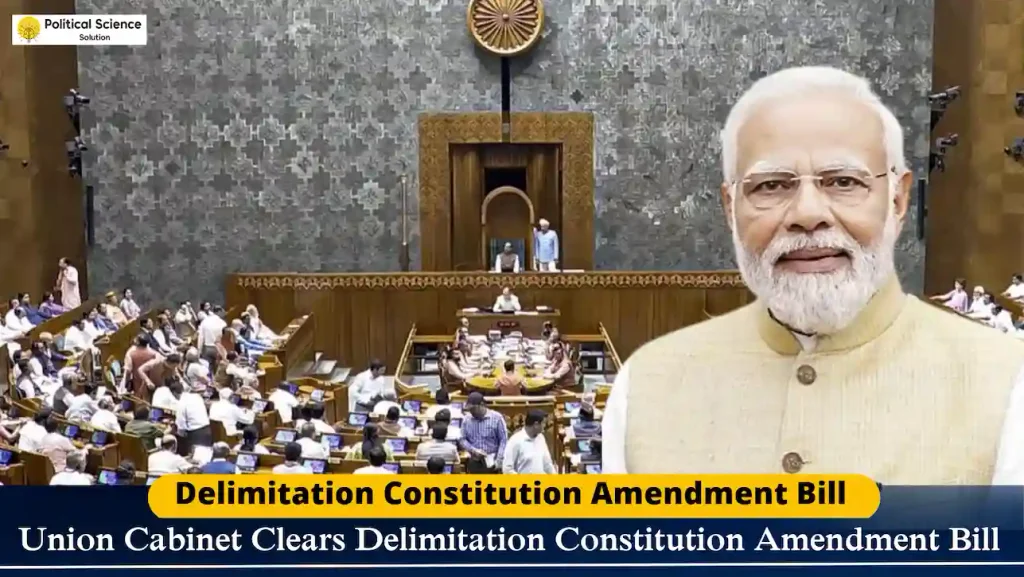
Cabinet Meeting and Core Decision at Sewa Teerth
The Cabinet met at 1 pm at Sewa Teerth under the chairmanship of the Prime Minister. Sources confirmed that the approved bill provides for a uniform 50 percent rise in seats for all states while freezing the existing inter-state proportion of Lok Sabha seats—originally fixed on the basis of the 1971 population—until 2051. The fresh measure uses 2011 Census data to redraw the increased constituencies. Officials stressed that the amendments guarantee no state will lose its relative share of representation after delimitation. A two-thirds majority in both Houses remains mandatory for the Constitutional amendment to pass, and government sources expressed confidence that the required numbers are available.
Special Parliament Session Schedule and Procedural Background
Union Parliamentary Affairs Minister Kiren Rijiju announced on Thursday, November 26—the 104th day since the Monsoon Session was adjourned sine die on August 13—that both Houses would reconvene for essential government business. The special sitting is an extension of the Monsoon Session, which was never prorogued. The Lok Sabha will meet on November 30 and December 1; the Rajya Sabha will sit on December 2 and 3. The session is expected to conclude on December 3, subject to government business needs. No Question Hour or Zero Hour will be held. The government has requested the presiding officers to facilitate the proceedings focused primarily on the delimitation package and the linked women’s reservation implementation.
Key Differences from the April Attempt
A similar Constitution Amendment Bill was introduced during a special session in April 2026 but failed to secure the necessary two-thirds majority in the Lok Sabha. That earlier draft did not contain the provision for a 50 percent across-the-board increase in seats for every state. The current version incorporates this expansion specifically to address concerns about relative representation and to enable the simultaneous rollout of 33 percent reservation for women in the Lok Sabha and state legislatures.
Detailed Provisions of the Delimitation Bill
The bill proposes that the allocation of seats and the division of territorial constituencies, once readjusted, will continue until 2051. Every state will receive a 50 percent increase in its existing seats, preserving the current proportionate share among states and Union territories.
A new delimitation commission will be constituted once the bill becomes law. The panel will be headed by a former or sitting Supreme Court judge. It will include either the Chief Election Commissioner or an Election Commissioner nominated by the Chief Election Commissioner, along with the state election commissioner of the concerned state serving in an ex-officio capacity.
Each state will nominate ten associate members to assist the commission—five Lok Sabha MPs from that state and five members of the state legislative assembly. If a state has five or fewer Lok Sabha MPs, all its MPs will serve as associate members and the total will be reduced accordingly. These associate members will have no voting rights and will not be authorized to sign the commission’s decisions. The commission’s mandate covers readjusting the allocation of Lok Sabha seats among states and Union territories and determining the strength of state and Union territory assemblies.
Congress Flags Non-Sharing of Draft Bills and Holds Strategy Meetings
Congress general secretary in-charge of communications Jairam Ramesh posted on X that it was extraordinary and totally unacceptable for the Lok Sabha to be scheduled to debate the Constitution Amendment Bill and other related bills on Monday, November 30, when the drafts had still not been shared with MPs by 1800 hours on Friday, November 27. He stated that games continue to be played by the PM-HM jodi.
Throughout Friday, Congress leaders convened multiple strategy meetings. Rahul Gandhi and Priyanka Gandhi arrived at Congress president Mallikarjun Kharge’s residence. Later, senior leaders gathered at 10 Janpath, the residence of Congress Parliamentary Party chairperson Sonia Gandhi. Congress MP Gaurav Gogoi confirmed that the meeting included Sonia Gandhi, Mallikarjun Kharge, Rahul Gandhi, K.C. Venugopal, Priyanka Gandhi and senior MPs from both Houses. A joint meeting with leaders of other opposition parties was scheduled for Saturday under Kharge’s leadership.
Congress has set out three demands: retain the existing strength of the Lok Sabha, implement 33 percent women’s reservation within the current strength of 543 seats, and maintain the existing proportion of Lok Sabha seats among states for the next 25 years. Congress leader Supriya Shrinate reiterated that the party stands firm on these points and noted that no draft had been circulated. Congress MP Shashi Tharoor called the insistence that women’s reservation can only be implemented through delimitation a complete travesty, arguing the two issues are unrelated. He also expressed disappointment at the DMK’s reported readiness to support the bill if proportionate shares are protected, describing it as an abdication of responsibility.
DMK, Southern Parties and Conditions for Support
DMK president and Tamil Nadu Chief Minister M.K. Stalin stated that under no circumstances should Tamil Nadu’s existing 7.18 percent share of Lok Sabha seats be reduced. He insisted that the proportion determined on the basis of the 1971 Census must remain frozen for another 25 years. DMK sources indicated the party, which opposed the earlier version, is likely to extend support if these conditions are fully met. DMK MP P. Wilson confirmed that Stalin had called a meeting of party MPs at the Chennai headquarters and that the leader would decide on whether to demand an all-party meeting.
Andhra Pradesh Chief Minister N. Chandrababu Naidu urged all parties not to stand on the wrong side of history. He detailed projected outcomes under the 50 percent enhancement: Andhra Pradesh seats rising from 25 to 38 while retaining 4.6 percent; Tamil Nadu from 39 to 59 at 7.18 percent; Karnataka from 28 to 42 at 5.16 percent; Telangana from 17 to 26 at 3.13 percent; and Kerala from 20 to 30 at 3.68 percent. Southern states collectively would move from 129 to 195 seats while preserving their 23.76 percent share. Naidu questioned the opposition’s alternative path and noted that the women’s reservation demand had been pending for three decades. YSRCP conveyed support because the framework protects Andhra Pradesh’s representation. BJD MPs indicated possible backing if Odisha’s share is safeguarded.
Positions of Other Parties, Whips and Criticisms
NCP (Sharad Pawar) leader Jitendra Awhad initially announced support for delimitation as a constitutional requirement, but party MP Supriya Sule later clarified that no decision would be taken without studying the draft and that the party’s stand would be declared on the floor of the Lok Sabha on Monday. Sule confirmed the party would attend the INDIA bloc meeting. NCP(SP) also issued a whip to its MPs. Shiv Sena issued a whip directing members to be present. Shiv Sena (UBT) MP Arvind Sawant asked why women’s reservation could not be implemented on the existing Lok Sabha strength and described the exercise as political rather than purely about social justice.
TMC sought the termination of the suspension of MP Kalyan Banerjee, which began on July 22. Abhishek Banerjee wrote to Speaker Om Birla citing Rule 374(2) and noting that the suspension continues because the session was never prorogued. Reports suggested around 20 rebel TMC MPs were likely to support the bill.
Raijor Dal chief Akhil Gogoi supported women’s reservation in principle but criticized the method, arguing that a 50 percent increase on the current approximately 540 seats would add about 270 seats and that 33 percent reservation on the new total would still leave the existing seats untouched by women. BJP MP Rekha Sharma accused Congress of creating obstacles to women’s reservation. Congress MP Christopher Tilak claimed the BJP was mobilizing numbers through deals with various parties and raised questions about the Chief Election Commissioner’s role. Samajwadi Party leader Akhilesh Yadav termed the delimitation bill the BJP’s biggest mistake; Congress and SP leaders echoed similar language.
Road Ahead for the Special Sitting
The four-day special sitting beginning November 30 will test whether the government can secure the constitutionally required two-thirds majority. The bill’s combination of a uniform 50 percent seat expansion, a 25-year freeze on inter-state proportions, a newly structured delimitation commission with non-voting associate members, and the simultaneous activation of women’s reservation has reshaped the political calculations of parties across the spectrum. While several regional parties have signaled conditional openness, the Congress-led opposition continues to press for implementation of reservation on the existing strength of the House and has criticized the non-circulation of drafts. The coming days in Parliament will determine whether the Cabinet’s clearance translates into law.
FAQs
1. What exactly did the Union Cabinet approve regarding the delimitation and women’s reservation?
The Union Cabinet, chaired by Prime Minister Narendra Modi, approved a Constitution Amendment Bill that provides for a proportionate 50 percent increase in seats across all states. This expanded ratio will remain frozen for 25 years until it is revised according to the population figures from the Census after 2051. The Women’s Reservation Bill will come into effect at the same time as the seat increase. The bill seeks to use 2011 Census data to redraw the new constituencies while locking the existing inter-state seat proportions (based on the 1971 population) until 2051, ensuring no state loses its relative share of representation.
2. When is the special Parliament sitting scheduled and what is its nature?
The government has called a special sitting of Parliament beginning Monday, November 30, 2026. The Lok Sabha will meet on November 30 and December 1, while the Rajya Sabha will meet on December 2 and 3. The session is an extension of the Monsoon Session that was adjourned sine die on August 13 but was never prorogued. Union Parliamentary Affairs Minister Kiren Rijiju announced the schedule on November 26, the 104th day after that adjournment. The sitting is expected to conclude on December 3 (subject to government business) and will have no Question Hour or Zero Hour.
3. How does the new bill differ from the one that failed in April 2026?
A similar Constitution Amendment Bill was introduced during a special session in April 2026 but failed to secure the required two-thirds majority in the Lok Sabha. That earlier version did not contain the provision for a uniform 50 percent increase in seats for every state. The current bill includes this across-the-board expansion, freezes the existing inter-state proportions until 2051, and links the expansion directly to the implementation of 33 percent women’s reservation in the Lok Sabha and state legislatures.
4. What will be the structure and powers of the proposed delimitation commission?
Once the bill becomes law, a new delimitation commission will be formed. It will be headed by a former or sitting Supreme Court judge and will include either the Chief Election Commissioner or an Election Commissioner nominated by him, along with the state election commissioner of the concerned state as an ex-officio member. Each state will have ten associate members (five Lok Sabha MPs and five members of the state legislative assembly; fewer if a state has five or fewer MPs). These associate members will assist the panel but will have no voting rights and cannot sign its decisions. The commission will readjust the allocation of Lok Sabha seats among states and Union territories and determine the strength of state and Union territory assemblies. The readjusted allocation will remain in force until 2051.
5. What are the main political reactions and conditions raised by major parties?
Congress has demanded that the existing strength of the Lok Sabha be retained, that 33 percent women’s reservation be implemented within the current 543 seats, and that the existing inter-state seat proportions be maintained for the next 25 years. Jairam Ramesh criticized the government for not sharing the draft bills with MPs by 1800 hours on November 27 even though debate is scheduled for November 30. DMK leader M.K. Stalin has insisted that Tamil Nadu’s existing 7.18 percent share of Lok Sabha seats must not be reduced and that the 1971-based proportions must stay frozen for another 25 years; the party is expected to support the bill if these conditions are met. Andhra Pradesh Chief Minister N. Chandrababu Naidu has urged parties not to be on the wrong side of history and presented projected seat numbers showing southern states retaining their overall percentage. Several other parties, including YSRCP and potentially BJD and NCP (SP), have indicated conditional support provided state shares are protected, while the government has expressed confidence of securing the required two-thirds majority in both Houses.