

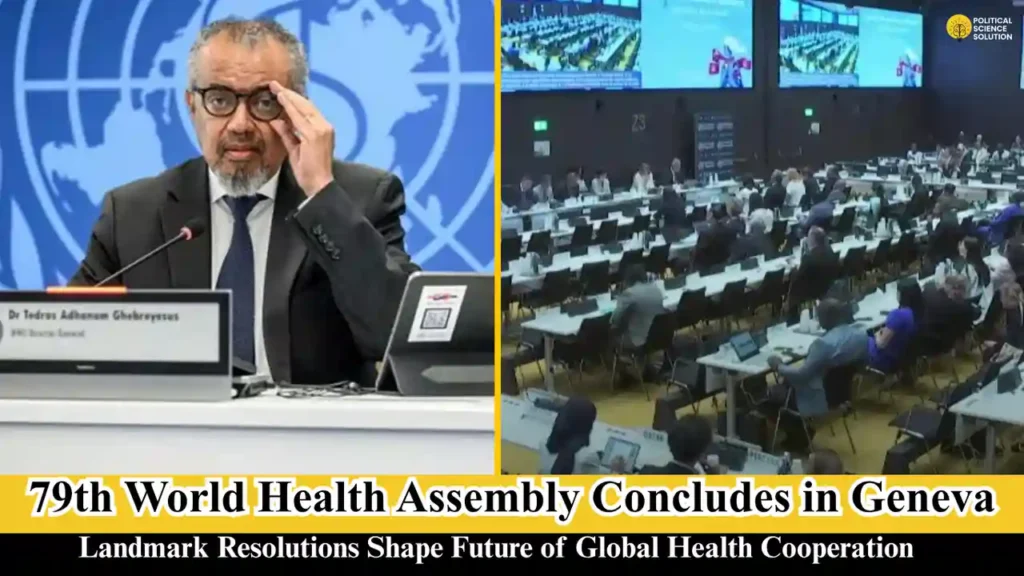
New Delhi: The 79th World Health Assembly (WHA) wrapped up its sessions yesterday after six days of intensive deliberations, marking a significant milestone in international health governance. Held under the compelling theme “Reshaping global health: a shared responsibility,” the assembly brought together member states to tackle pressing health challenges through collaborative action, resulting in the adoption of more than 20 decisions and 13 resolutions covering a wide spectrum of critical issues.
This year’s gathering emphasized the urgent need for unified global efforts to address health threats that transcend national borders. From combating antimicrobial resistance (AMR) to advancing radiation protection and integrating health into economic policies, the outcomes reflect a renewed commitment to multilateralism in safeguarding human well-being worldwide.
Global Action Plan on Antimicrobial Resistance Takes Center Stage
One of the standout achievements of the 79th WHA was the adoption of the second edition of the Global Action Plan on Antimicrobial Resistance (GAP-AMR) for the period 2026–2036. This updated framework builds directly upon a decade of experience gained from the implementation of the first GAP-AMR, which was originally adopted in 2015.
The new plan sets ambitious yet achievable targets aligned with the 2024 UN General Assembly goals. Specifically, it aims for a 10% reduction in bacterial AMR-associated deaths among humans by 2030. Additionally, it focuses on substantially reducing the use of antimicrobials in agrifood systems and minimizing environmental pollution caused by resistant microbes. These objectives recognize the interconnected nature of human, animal, and environmental health—a concept often referred to as the One Health approach.
Technical support and coordination for the GAP-AMR will be provided by the World Health Organization (WHO) in collaboration with its Quadripartite partners. These include the Food and Agriculture Organization (FAO), the United Nations Environment Programme (UNEP), and the World Organisation for Animal Health (WOAH). This multi-agency partnership underscores the comprehensive strategy required to tackle AMR effectively across sectors.
Understanding Antimicrobial Resistance and Its Growing Threat
Antimicrobial resistance occurs when bacteria, viruses, fungi, and parasites evolve over time and no longer respond to antimicrobial agents such as antibiotics, antivirals, antifungals, and other medicines. This phenomenon renders standard treatments ineffective, leading to infections that are harder to treat and increasing the risk of disease spread, severe illness, and death.
The global burden of AMR is staggering. Projections indicate that antimicrobial resistance could be responsible for up to 39 million deaths by 2050 if current trends continue unchecked. This alarming figure highlights why the 79th World Health Assembly prioritized robust action on this front.
Several key initiatives were highlighted during discussions. At the national level, India has made notable strides with its National Action Plan on AMR (NAP-AMR) and the innovative Red Line Awareness Campaign, which educates the public on the responsible use of antibiotics. Globally, the WHO’s Global Antimicrobial Resistance and Use Surveillance System (GLASS) continues to play a vital role in monitoring resistance patterns and informing evidence-based responses.
The renewed Global Action Plan seeks to accelerate progress by strengthening surveillance, promoting stewardship of antimicrobials, enhancing infection prevention measures, and fostering research and innovation in new treatments. By addressing AMR through a shared responsibility lens, the assembly reinforced that no single country can solve this crisis in isolation.
Historic Resolution on Radiation and Health
In another pioneering move, the 79th World Health Assembly adopted the first-ever resolution dedicated to radiation and health. This comprehensive document covers both ionizing and non-ionizing radiation, aiming to strengthen national systems for radiation protection.
The resolution acknowledges the dual role of radiation in modern society—beneficial in medical diagnostics and cancer treatment, yet potentially harmful if not properly managed. By focusing on capacity building, regulatory frameworks, and public awareness, member states aim to minimize risks while maximizing the safe application of radiation technologies in healthcare and other fields.
This marks a significant step forward in global health policy, providing a dedicated platform for countries to collaborate on radiation safety standards and emergency preparedness.
Strategy on the Economics of Health for All
Recognizing that health cannot be viewed in isolation from broader economic systems, the assembly endorsed the Strategy on the Economics of Health for All (2026–2030). This forward-looking document outlines concrete actions to ensure health considerations are systematically integrated into economic, fiscal, and industrial policies at national and international levels.
The strategy emphasizes the need for sustainable financing, innovative investment models, and policy coherence that values health as a fundamental driver of economic productivity and social stability. It calls on governments to move beyond traditional health budgets and embed health impacts into decisions across all sectors, from trade and agriculture to infrastructure and technology.
Broader Agenda: Resolutions on Multiple Health Priorities
Beyond AMR, radiation, and economic strategies, the 79th World Health Assembly addressed a diverse range of health topics through its adopted resolutions and decisions. These included:
- Stroke prevention and management
- Tuberculosis control efforts
- Emergency care systems strengthening
- Support for individuals with haemophilia
- Advancements in precision medicine
- Additional measures on radiation protection
The breadth of these topics demonstrates the assembly’s holistic approach to global health challenges. Discussions highlighted the importance of equitable access to care, particularly in low- and middle-income countries, and the need for resilient health systems capable of responding to both routine needs and emergencies.
Reforming Global Health Architecture
In addition to technical and clinical resolutions, member states engaged with important political and administrative matters. A key outcome was the agreement to reform the global health architecture through a member state-led joint process hosted by the World Health Organization. This initiative aims to enhance coordination, efficiency, and responsiveness within the international health framework, ensuring it better meets 21st-century demands.
Such reforms are expected to improve resource allocation, strengthen pandemic preparedness, and foster greater inclusivity in decision-making processes that affect billions of people.
WHO Director-General’s Call to Action
In his closing remarks, WHO Director-General Dr. Tedros Adhanom Ghebreyesus delivered a powerful message to delegates. He urged member states to move swiftly from resolution to implementation, emphasizing that meaningful progress depends on sustained political commitment, adequate financing, and ongoing cooperation among governments, partners, and communities.
“Reshaping global health requires not just words on paper, but concrete actions that deliver results for people everywhere,” Dr. Tedros stressed. His remarks encapsulated the spirit of the assembly—optimistic yet pragmatic about the challenges ahead.
Implications for Global Health Equity
The outcomes of the 79th World Health Assembly carry profound implications for health equity worldwide. By prioritizing issues like antimicrobial resistance and radiation safety, the assembly has laid groundwork for protecting vulnerable populations who often bear the brunt of these threats.
Developing nations, in particular, stand to benefit from enhanced international support and knowledge sharing. The integration of health into economic policies could lead to more sustainable development models that prioritize well-being alongside growth.
Furthermore, the emphasis on shared responsibility reinforces the principle that global health security is a collective endeavor. Whether through the Quadripartite collaboration on AMR or broader architectural reforms, the assembly highlighted the power of partnerships in addressing complex problems.
Looking Ahead: From Geneva to National Implementation
As the 79th World Health Assembly concludes, the real work begins at the country level. Member states are now tasked with adapting these global commitments to their unique contexts, allocating necessary resources, and monitoring progress toward established targets.
The second edition of the GAP-AMR, for instance, will require countries to update national action plans, strengthen surveillance systems like GLASS, and engage diverse stakeholders from healthcare providers to agricultural communities. Similarly, the radiation and health resolution calls for investment in training, equipment, and regulatory oversight.
Success will hinge on several factors: consistent political will, transparent reporting mechanisms, innovative financing solutions, and active civil society participation. The Red Line Awareness Campaign in India serves as a practical example of how targeted public education can complement policy measures.
Why These Developments Matter Now
In an era defined by emerging health threats, climate change impacts, and technological disruptions, the decisions made at the 79th WHA provide a timely roadmap. Antimicrobial resistance alone poses a risk comparable to major global crises, with potential economic losses running into trillions of dollars alongside the human cost.
The assembly’s focus on precision medicine and emergency care reflects an understanding that health systems must evolve with scientific advances. Meanwhile, addressing the economics of health ensures that future policies are both ambitious and feasible.
As nations work to operationalize these resolutions, the spirit of “shared responsibility” articulated in Geneva will serve as a guiding principle. Collaborative platforms, data sharing, and mutual accountability will be essential to translate international consensus into tangible improvements in health outcomes.
The 79th World Health Assembly has set a clear direction for the coming decade. Its emphasis on antimicrobial resistance through the new GAP-AMR, groundbreaking attention to radiation protection, and integration of health into economic thinking represent meaningful progress toward a healthier, more resilient world.
With strong leadership from the WHO and active engagement from all member states, there is cautious optimism that these resolutions will drive real change. The coming years will test the global community’s ability to follow through on the promises made in Geneva, but the foundation laid during this assembly offers a solid starting point for transformative action.
FAQs
1. What is the 79th World Health Assembly (WHA) and why is it important?
The 79th World Health Assembly was a six-day global health summit held in Geneva that concluded on May 25, 2026. Organized by the World Health Organization (WHO), it brought together member states under the theme “Reshaping global health: a shared responsibility.” The assembly adopted over 20 decisions and 13 resolutions addressing critical issues including antimicrobial resistance, radiation protection, tuberculosis, stroke, emergency care, haemophilia, and precision medicine. It is considered important because it sets the global health agenda for the coming years and promotes coordinated international action on pressing health challenges.
2. What is the new Global Action Plan on Antimicrobial Resistance (GAP-AMR) 2026–2036?
The second edition of the Global Action Plan on Antimicrobial Resistance (GAP-AMR) for 2026–2036 is a major outcome of the 79th WHA. It builds upon the first plan adopted in 2015 and provides a renewed roadmap to combat antimicrobial resistance. The plan is coordinated by WHO along with Quadripartite partners — FAO, UNEP, and WOAH — and follows the One Health approach, recognizing the link between human, animal, and environmental health.
3. What are the main targets of the GAP-AMR 2026–2036?
The new GAP-AMR aims to achieve the 2024 UN General Assembly targets by 2030, specifically:
- A 10% reduction in bacterial AMR-associated deaths in humans
- Significant reduction in antimicrobial use in agrifood systems
- Minimizing environmental pollution from resistant microbes
It also seeks to strengthen surveillance, infection prevention, antimicrobial stewardship, and innovation in new treatments to prevent AMR from causing up to 39 million deaths by 2050.
4. What other key resolutions were adopted at the 79th World Health Assembly?
Apart from AMR, the assembly passed several important resolutions including:
An agreement to reform the global health architecture through a member state-led process.
The first-ever Resolution on Radiation and Health, covering both ionizing and non-ionizing radiation to strengthen national protection systems.
The Strategy on the Economics of Health for All (2026–2030), which aims to integrate health into economic, fiscal, and industrial policies.
Resolutions on stroke, tuberculosis, emergency care, haemophilia, and precision medicine.
5. What did WHO Director-General Tedros Adhanom Ghebreyesus say at the closing of the 79th WHA?
In his closing remarks, WHO Director-General Dr. Tedros Adhanom Ghebreyesus urged all member states to translate the adopted resolutions into immediate action. He emphasized that achieving global health goals will require strong political commitment, sustained financing, and continued cooperation between governments, partners, and communities. He stressed that “reshaping global health” demands moving beyond words into concrete, results-oriented implementation.