

New Delhi: As geopolitical tensions reshape global trade routes in June 2026, the India-Middle East-Europe Economic Corridor (IMEC) stands at a critical crossroads. The ongoing escalation of conflict involving Iran has created a paradoxical situation: while the instability underscores the urgent need for diversified connectivity projects like IMEC, it simultaneously introduces formidable barriers to its successful implementation. This ambitious multi-modal infrastructure initiative, envisioned as a game-changer for international commerce, now faces tests that could define its viability in the coming years.
Understanding the Vision Behind IMEC
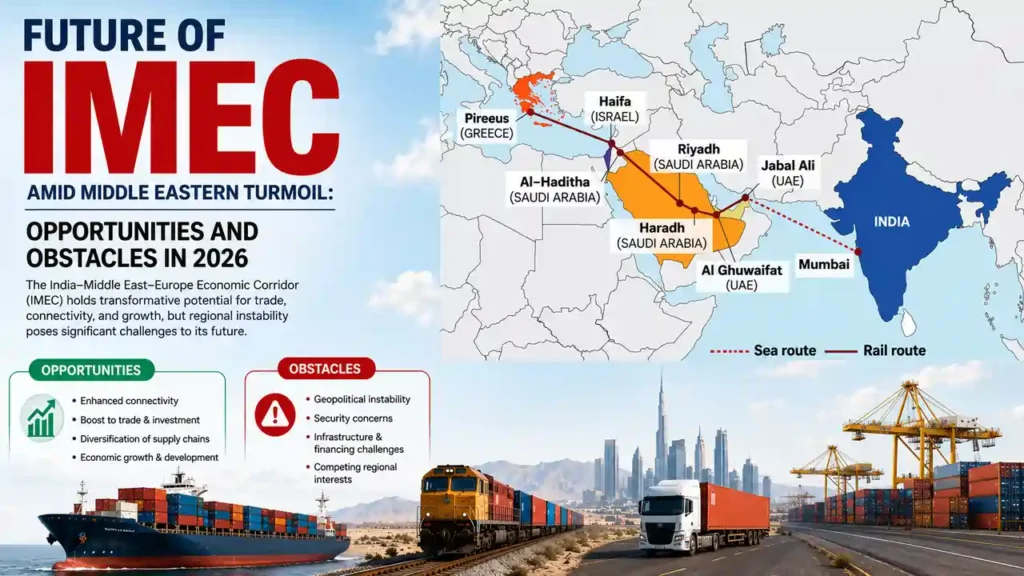
The India-Middle East-Europe Economic Corridor represents a bold collaborative effort to forge new pathways for economic integration across continents. At its core, IMEC is designed as a comprehensive multi-modal connectivity network that integrates ports, railways, roads, sea lanes, and pipelines. This infrastructure framework aims to significantly boost trade flows between India, the Arabian Peninsula, the broader Mediterranean region, and European markets.
The project first gained international prominence during the G20 Summit held in 2023 under India’s presidency. This high-profile launch reflected a shared commitment among major global players to build resilient supply chains less vulnerable to traditional chokepoints. The signatories include India, the United States, Saudi Arabia, the United Arab Emirates, France, Germany, Italy, and the European Union as a collective entity. This diverse coalition brings together economic powerhouses from Asia, the Middle East, North America, and Europe, signaling strong political backing for the corridor’s development.
IMEC is structured around two primary corridors that work in tandem to create seamless connectivity. The Eastern Corridor focuses on linking India directly with the Arabian Gulf region, effectively bridging South Asia and the Middle East. This segment emphasizes maritime and initial land connections that facilitate the movement of goods from Indian ports to key Gulf hubs. Complementing this is the Northern Corridor, which extends from the Gulf states northward toward European markets. Together, these corridors form an integrated network capable of handling diverse cargo types through a combination of sea, rail, and road transport options.
For India, the potential advantages of IMEC are particularly compelling. Analysts project that the corridor could slash transportation times by approximately 40% compared to existing routes while reducing overall logistics costs by around 30%. Such efficiencies would provide a much-needed alternative to heavily congested traditional pathways, most notably the Suez Canal. By bypassing certain vulnerable maritime stretches, IMEC promises to enhance supply chain reliability for Indian exporters and importers, potentially transforming the country’s role in global value chains. Sectors ranging from manufacturing and agriculture to energy and technology stand to benefit from faster, more cost-effective access to European consumers and Middle Eastern markets.
The Geopolitical Context: How Conflict Shapes IMEC’s Trajectory
The current regional instability, particularly the intensification of hostilities between Iran and Israel that have expanded into a wider Middle Eastern conflict, has brought renewed attention to IMEC. On one hand, this turbulence strengthens the strategic rationale for the project. Traditional shipping lanes have become increasingly precarious, highlighting the risks of over-reliance on narrow maritime passages. Disruptions in these areas have already led to volatility in global energy markets and supply chain uncertainties, making alternative routes like IMEC appear more attractive than ever before.
However, the same conflicts that make IMEC desirable are also creating substantial hurdles for its realization. The escalation has introduced multiple layers of complexity that stakeholders must navigate carefully.
One of the most pressing vulnerabilities lies in trade route disruptions. Strategic maritime chokepoints, especially the Strait of Hormuz, have experienced heightened risks due to the regional war. This has triggered sharp increases in oil prices and elevated shipping insurance costs, directly impacting the economic calculations that underpin IMEC’s feasibility. Investors and participating nations are now forced to reassess projected returns in light of these unpredictable security dynamics.
Furthermore, the conflict has strained diplomatic relationships across the region. Ties between Israel and several Arab nations, which had shown promising signs of normalization in recent years, face significant pressure. This breakdown in regional cooperation poses a direct threat to the coordinated infrastructure development required for IMEC’s success. Without harmonious collaboration among key players along the route, critical elements such as cross-border rail links and joint port operations could face prolonged delays.
Execution challenges compound these issues. Differences in priorities and approaches among participating countries add another dimension of complexity. For instance, varying stakeholder interests between the United Arab Emirates and Saudi Arabia have created friction points around funding mechanisms and project timelines. These divergences reflect broader economic and strategic considerations unique to each nation, making consensus-building an essential yet difficult task.
Despite these obstacles, the core promise of IMEC remains intact. The project continues to offer a vision of enhanced connectivity that could foster economic resilience across participating regions. By reducing dependence on vulnerable sea routes and creating integrated land-sea transport options, IMEC has the potential to reshape trade patterns in ways that benefit not just India but also Gulf economies and European industries seeking diversified partnerships.
Navigating Vulnerabilities: A Closer Look at Current Risks
The Iran-Israel conflict’s transformation into a broader regional confrontation has exposed several specific vulnerabilities within the IMEC framework. Security concerns along proposed transport corridors represent perhaps the most immediate challenge. Infrastructure projects spanning volatile regions require stable operating environments, and current tensions make long-term planning particularly difficult.
Economic ripple effects from the conflict further complicate matters. Spikes in oil prices affect not only operational costs but also broader investment sentiments. Shipping companies operating in the region face higher risks, leading to potential delays and increased expenses that could erode the projected 30% reduction in logistics costs. For Indian businesses, this translates to uncertainty in planning export schedules and managing inventory across international supply chains.
The diplomatic dimension cannot be overstated. Successful implementation of IMEC depends heavily on sustained cooperation between Israel and Arab partner nations. Any erosion in these relationships risks stalling progress on joint ventures essential for the corridor’s functionality. Additionally, internal dynamics within the Gulf cooperation framework, particularly between major players like the UAE and Saudi Arabia, require careful management to ensure aligned objectives regarding resource allocation and project prioritization.
These challenges arrive at a time when global trade architecture is already under stress from multiple factors, including post-pandemic recovery dynamics and shifting geopolitical alliances. In this context, IMEC’s progress serves as a litmus test for multilateral economic initiatives in turbulent times.
Strategic Pathways Forward: Building Resilience and Momentum
Looking ahead, several key strategies emerge as essential for advancing the India-Middle East-Europe Economic Corridor despite current headwinds. The first priority involves strengthening diplomatic engagement across West Asia. Proactive promotion of regional dialogue and confidence-building measures can help create the stable environment necessary for large-scale infrastructure projects. This diplomatic push should involve all signatories working in concert to address security concerns while emphasizing shared economic benefits.
A phased approach to development offers another practical solution. Rather than attempting simultaneous implementation across all segments, stakeholders could prioritize high-impact infrastructure components that demonstrate early successes. This strategy would help build momentum, attract additional investment, and provide tangible proof of concept that could sustain political and financial support through challenging periods. Initial focus areas might include key port enhancements or critical rail connections that deliver immediate connectivity improvements.
Deepening existing partnerships represents a third crucial element of the way forward. Strengthening economic and trade ties with the European Union and Gulf nations will be vital for maintaining enthusiasm and resource commitment to the project. This could involve supplementary agreements on technology sharing, capacity building, and joint financing mechanisms that address the diverse interests of participating countries.
Furthermore, incorporating risk mitigation frameworks into IMEC’s planning process could enhance its resilience. This might include contingency planning for security scenarios, diversified funding sources, and flexible implementation timelines that can adapt to changing regional conditions.
The Broader Implications for Global Trade Architecture
The evolution of IMEC carries significance that extends far beyond the immediate interests of its signatories. In an era marked by increasing protectionism and supply chain disruptions, projects like this corridor demonstrate the enduring value of collaborative infrastructure development. For India, successful realization of IMEC would mark a significant milestone in its ambition to become a central hub in global trade networks.
The project’s multi-modal design also aligns with broader sustainability goals by potentially offering more efficient transport options that could reduce carbon footprints compared to longer sea voyages. As European partners increasingly emphasize green transitions, IMEC’s integration of rail and road components could position it favorably within evolving environmental standards.
However, the ultimate success of IMEC will depend on the ability of all involved parties to navigate the complex interplay between geopolitical realities and economic aspirations. The coming months and years will test the commitment levels of signatory nations as they balance immediate security concerns with long-term strategic objectives.
Conclusion: A Corridor of Promise in Uncertain Times
The India-Middle East-Europe Economic Corridor continues to represent a forward-looking vision for interconnected prosperity even as Middle Eastern conflicts create substantial implementation challenges. From its announcement at the 2023 G20 Summit to its current status amid regional tensions, IMEC embodies both the opportunities and difficulties inherent in large-scale multinational projects.
By addressing vulnerabilities through strengthened diplomacy, phased implementation, and deepened partnerships, stakeholders can work toward realizing the corridor’s full potential. The projected reductions in transportation time and costs offer compelling incentives for perseverance, particularly as traditional routes face ongoing disruptions.
As the situation in the Middle East evolves, the international community will be watching closely to see how IMEC adapts and progresses. For India and its partners, the corridor represents more than just infrastructure—it symbolizes a commitment to building resilient, inclusive economic frameworks capable of withstanding geopolitical pressures. The path forward may be complex, but the potential rewards for successful navigation make IMEC one of the most significant economic initiatives of this decade.