

New Delhi: The Supreme Court of India has taken a significant step toward regulating artificial intelligence in the country’s legal system. On June 3, 2026, the apex court published the ‘Draft Regulations for Use of Artificial Intelligence (AI) in Courts, 2026’, prepared by a dedicated Supreme Court AI Committee. This detailed framework aims to harness the potential of AI while establishing strict boundaries to protect judicial integrity, fairness, and constitutional values.
This development comes at a crucial time when courts across India are increasingly exploring technology to address longstanding challenges like case backlogs and accessibility. The draft regulations provide clear guidelines for responsible AI adoption across all levels of the judiciary, marking a proactive approach to emerging technology in one of the world’s largest legal systems.
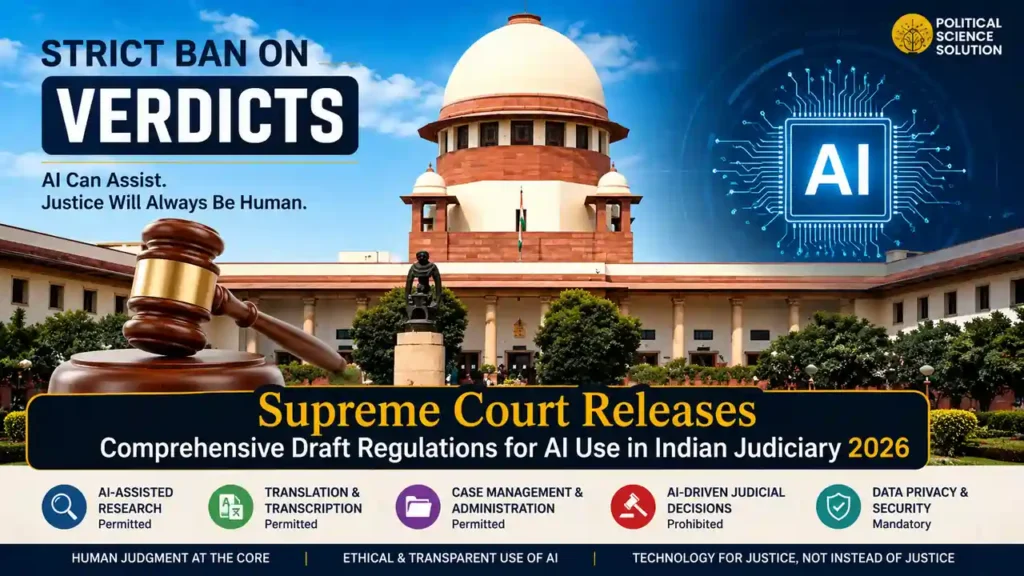
Scope and Objectives of the AI Regulations in Judiciary
The draft regulations apply comprehensively to all judicial, adjudicatory, and administrative functions. This includes the Supreme Court, High Courts, subordinate courts, tribunals, and any statutory commissions performing adjudicatory roles in India.
The primary objectives focus on three key areas: demonstrably improving access to justice, reducing delays in case disposal, and enhancing overall administrative efficiency. By positioning AI as a supportive tool rather than a replacement for human judgment, the regulations seek to modernize judicial processes without compromising the core principles of the Indian legal system.
Guiding principles underscore human primacy in all decision-making. AI deployment must adhere to fairness, transparency, accountability, and strict compliance with the Digital Personal Data Protection Act, 2023, as well as the fundamental rights enshrined in the Indian Constitution. Judicial officers remain entirely accountable for every decision, regardless of any AI assistance used in preparatory stages.
Key Highlights: Permitted Uses and Strict Prohibitions
The draft clearly distinguishes between assistive applications of AI and areas where its use is strictly prohibited, ensuring technology serves justice rather than supplants it.
Permitted Assistive Uses Include:
- Administrative tasks such as case management, preparation of cause lists, and scheduling of hearings.
- Legal research assistance through tools that analyze documents and extract relevant precedents.
- Translation of judgments and proceedings into multiple languages.
- Transcription of court proceedings using Automatic Speech Recognition (ASR) systems for near real-time accuracy.
- Accessibility services for persons with disabilities or language barriers.
- Filing and registry operations, including defect detection in e-filings via Machine Learning and Optical Character Recognition.
- Voice-to-text dictation for judges drafting orders and judgments.
All permitted uses require mandatory human verification. AI outputs are treated as advisory, with final authority resting exclusively with judicial officers.
Absolute Prohibitions:
The regulations impose firm bans on several high-risk applications. AI cannot be used to decide verdicts, determine judicial outcomes, or perform adjudication or sentencing functions. There is a complete prohibition on AI-assisted risk scoring, including assessments of flight risk, prediction of recidivism, evaluation of bail eligibility, or determination of witness or party credibility.
Additional bans cover predicting human behavior, profiling parties or witnesses, and any form of surveillance or continuous monitoring of judges, lawyers, litigants, or other stakeholders—except where specifically authorized by law. The draft explicitly bars “opaque” or “unexplainable” AI systems in any court process that could materially affect rights or personal liberty.
These prohibitions address recent concerns, including instances where trial courts relied on AI-generated non-existent judgments, which the Supreme Court has previously described as judicial misconduct.
Existing AI Initiatives in the Indian Judiciary
The draft builds upon several ongoing AI implementations, demonstrating a practical foundation for regulated expansion:
- Courtroom Transcription: AI-enabled ASR systems provide near real-time transcription of proceedings, improving record accuracy and efficiency.
- Multilingual Access: The SUVAS platform translates Supreme Court judgments into 18 Indian languages, promoting linguistic inclusivity.
- Filing and Registry: Machine Learning and OCR tools automatically detect defects in electronic filings, streamlining administrative processes.
- Legal Research Tools: LegRAA (Legal Research Analysis Assistant) helps analyze documents and extract legal references. SUPACE (Supreme Court Portal for Assistance in Court Efficiency) identifies precedents and clarifies case facts.
- Dictation Systems: ASR-SHRUTI converts judicial speech into text, aiding in the preparation of orders and judgments.
These tools illustrate how AI is already contributing to efficiency while operating under human supervision.
Governance Structure: Apex Body and Institutional Framework
A cornerstone of the draft is the establishment of robust governance mechanisms. The regulations propose a permanent national Apex Body at the Supreme Court to regulate, promote innovation, integrate, govern, oversee, set standards, and develop policies for AI in the judiciary.
Composition of the Apex Body:
- Two Supreme Court judges nominated by the Chief Justice of India (CJI), with one serving as ex-officio chairperson.
- Two High Court Chief Justices and two High Court judges nominated by the CJI.
- One member from a national institution of importance or repute.
- A Joint Secretary-level officer from the Ministry of Electronics and Information Technology.
- Finance and cybersecurity experts.
- Advocates with expertise in technology law, data privacy, and related fields.
- The professor heading Artificial Intelligence at the National Judicial Academy, Bhopal.
Additional experts can be co-opted with CJI approval. This high-level body will ensure coordinated and standardized AI adoption nationwide.
The draft also recommends dedicated AI Committees at every High Court to oversee implementation within their jurisdictions, aligned with minimum standards set by the Apex Body. A research center, referred to as CoRE-AI, is envisioned to support ongoing innovation and capacity building.
Compliance, Oversight, and Safeguards
Stringent compliance measures form an integral part of the framework. AI tools require pre-deployment impact assessments and annual internal audits. Processing of personal data must comply fully with the Digital Personal Data Protection Act, 2023.
Lawyers and litigants must explicitly disclose any use of AI in preparing court documents or submissions. This transparency requirement aims to maintain trust in the judicial process.
The regulations emphasize bias prevention. AI systems must not perpetuate, amplify, or introduce discrimination based on race, religion, caste, sex, gender, disability, language, economic status, or any other constitutionally prohibited ground. Special protections are mandated for vulnerable groups, including women, children, persons with disabilities, and marginalized communities.
Data used for training and operating AI must be accurate, representative, lawfully obtained, and free from discriminatory bias to the extent feasible. Applications involving higher risks to personal liberty or judicial outcomes require heightened safeguards, including mandatory human-in-the-loop oversight and independent review.
Addressing Digital Divides and Ensuring Inclusivity
A notable aspect of the draft is its focus on digital inclusion. AI tools must be designed to be accessible and should not widen existing digital divides. This includes considerations for rural areas, economically disadvantaged communities, and linguistically diverse populations. The framework stresses that technological advancement in the judiciary must benefit all stakeholders equally, aligning with constitutional goals of equality and justice.
Public Consultation and Next Steps
The Supreme Court AI Committee, chaired by Justice P.S. Narasimha and including Justices Sanjeev Sachdeva, Raja Vijayaraghavan V., Anoop Chitkara, and Suraj Govindaraj, has invited comments and suggestions from all stakeholders and the general public. The deadline for submitting responses is June 20, 2026. This consultative approach reflects a commitment to inclusive policy-making.
Stakeholders are encouraged to provide input on various aspects, from technical standards to practical implementation challenges, ensuring the final regulations are robust and widely accepted.
Implications for the Future of Justice in India
The draft regulations represent a thoughtful balance between innovation and caution. By embracing AI for administrative efficiency and accessibility while drawing firm red lines around core judicial functions, the Supreme Court is setting a precedent for responsible technology integration in the legal domain.
Experts view this as a forward-looking response to global trends in judicial technology, tailored to India’s unique constitutional framework and diverse societal needs. Successful implementation could significantly reduce case pendency, improve access for underserved populations, and enhance transparency—provided the human-centric principles are upheld.
As the deadline for public feedback approaches, the legal community and technology experts are expected to engage actively. The final version of these regulations could shape how justice is delivered in India for decades to come, potentially serving as a model for other jurisdictions navigating similar challenges.
This comprehensive draft underscores the judiciary’s commitment to evolving with technology while safeguarding the timeless values of fairness, accountability, and independence that define the Indian legal system. The coming weeks of consultation will be critical in refining this framework to meet both current needs and future aspirations for a more efficient and equitable justice delivery mechanism.
FAQs
1. What is the main purpose of the Supreme Court’s Draft AI Regulations 2026?
The primary objective is to create a responsible framework for AI adoption in the Indian judiciary that improves access to justice, reduces delays, and boosts administrative efficiency while strictly maintaining human primacy. The regulations ensure AI serves only as an assistive tool and remains fully subservient to human judicial authority. They emphasize fairness, transparency, accountability, data privacy under the Digital Personal Data Protection Act 2023, and constitutional values. Judicial officers stay completely accountable for all decisions.
2. Can AI be used to deliver judgments, decide bail applications, or determine verdicts under the new draft rules?
No. The draft imposes an absolute ban on using AI for deciding judicial outcomes, adjudication, sentencing, risk scoring (including flight risk, recidivism prediction, or bail eligibility), profiling witnesses/parties, or determining credibility. AI is prohibited from any function that could materially affect personal liberty or judicial integrity without mandatory human oversight. Only advisory use is allowed, with final authority resting exclusively with judicial officers.
3. What AI tools and applications are currently permitted or already in use in Indian courts?
Permitted uses include administrative tasks (case management, cause lists, scheduling), legal research (LegRAA and SUPACE), transcription (ASR systems), translation (SUVAS for 18 Indian languages), voice-to-text dictation (ASR-SHRUTI), defect detection in e-filings using ML and OCR, and accessibility services. All outputs require human verification. The draft also supports conversational AI chatbots for litigants and anonymisation of records.
4. What new governance structures does the draft propose for AI oversight in the judiciary?
The regulations recommend establishing a permanent full-time Apex Body at the Supreme Court comprising senior judges, High Court representatives, technical experts, cybersecurity and finance specialists, and AI academics. It will handle standard-setting, policy development, and nationwide oversight. Additionally, dedicated AI Committees will be set up at every High Court, and a research centre (CoRE-AI) is proposed to drive innovation. Pre-deployment impact assessments and annual audits are mandatory.
5. How does the draft address concerns about bias, privacy, and digital inclusion?
The regulations strictly prohibit AI systems that perpetuate or introduce bias based on caste, religion, gender, disability, economic status, or any other constitutionally protected ground. Personal data processing must comply with the Digital Personal Data Protection Act, 2023. Lawyers and litigants must disclose AI use in court documents. Special emphasis is placed on accessibility so AI tools do not widen digital divides for rural, economically weaker, or linguistically diverse communities. Higher-risk applications require enhanced human-in-the-loop safeguards.