

New Delhi: A fresh United Nations Development Programme (UNDP) assessment has delivered a stark warning for India amid escalating military tensions in West Asia. The report, titled Military Escalation In The Middle East: Human Development Impacts Across Asia And The Pacific, highlights that South Asia will bear the largest absolute and relative economic losses from the conflict. For India, the consequences could push nearly 2.5 million people into poverty, stall human development progress, and expose deep structural dependencies in energy, agriculture, trade, and labour sectors.
Released on April 14, 2026, the preliminary assessment estimates that the West Asia crisis could cost the Asia-Pacific region up to $299 billion while placing 8.8 million people globally at risk of falling into poverty. In India, the impact is particularly severe due to the country’s heavy reliance on the Gulf region for energy, fertilizers, exports, and remittances.
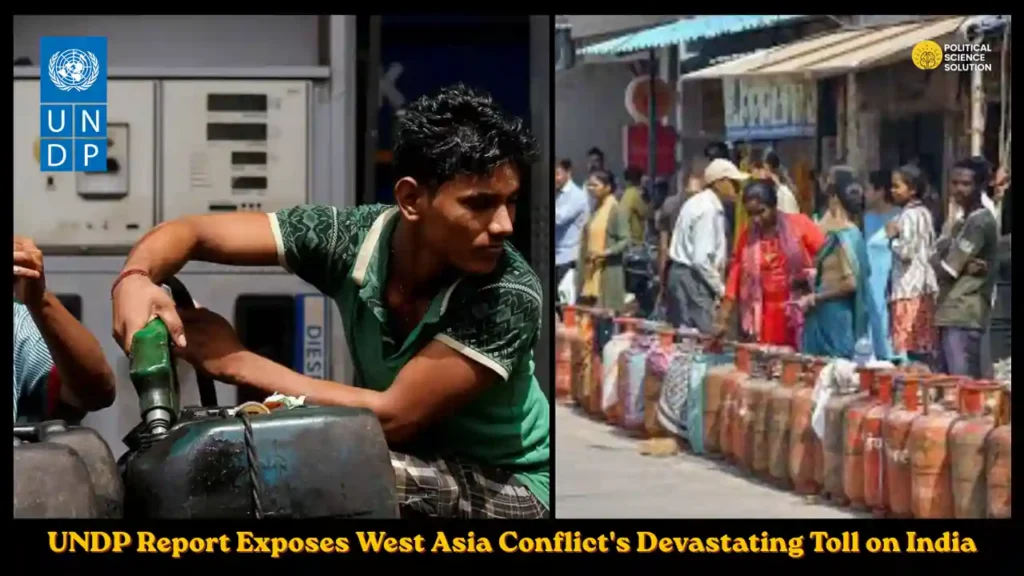
Poverty and Human Development Impact in India
The UNDP report projects that the ongoing conflict could increase India’s poverty rate from a pre-crisis level of 23.9% to 24.2% in the worst-case scenario. This translates to roughly 24.6 lakh (2.46 million) additional people falling into poverty, raising the total number of people living in poverty from 35.15 crore to 35.40 crore.
Beyond poverty numbers, the crisis threatens to reverse hard-earned gains in human development. India could experience a regression in its Human Development Index (HDI) progress by 0.03 to 0.12 years, effectively erasing months of advancement in health, education, and income indicators. The report warns that higher fuel prices, freight costs, and input expenses are diminishing household purchasing power, raising food insecurity, straining public budgets, and weakening livelihoods across the country.
Energy Crisis and Financial Strain on India
India’s energy security faces one of the most immediate threats. The country sources over 40% of its crude oil imports and a staggering 90% of all LPG imports from West Asia. Disruptions in the region, particularly around the Strait of Hormuz, have already driven up gas prices, weakened the Indian Rupee, and forced a costly shift toward greater reliance on coal-based power generation.
This pivot to coal has elevated pollution levels and increased associated health risks for millions of citizens. The report notes that India imports over 90% of its total oil needs, making it highly vulnerable to any escalation that affects supply routes, freight charges, or war-risk insurance premiums. These factors are feeding directly into domestic fuel inflation and broader economic instability.
Trade Disruptions Threatening $48 Billion in Exports
West Asia accounts for approximately 14% of India’s total exports and 21% of its imports. The UNDP report flags serious risks to nearly $48 billion worth of non-oil exports due to conflict-related disruptions, including stranded air cargo, route diversions, and higher shipping costs.
Key sectors at high risk include basmati rice, gems and jewellery, tea, and apparel. Export-oriented MSMEs in these areas are already experiencing delayed shipments, elevated freight surcharges, and softening demand. The report emphasizes that these trade shocks are compounding pressures on supply chains and threatening jobs in labour-intensive industries.
Agriculture and Food Security at Risk Ahead of Kharif Season
Fertilizer supply chains represent another critical vulnerability. West Asia supplies over 45% of India’s fertilizer imports, while 85% of domestic urea production depends on imported liquefied natural gas (LNG). The report specifically warns that prolonged disruptions could jeopardize the upcoming Kharif (monsoon) planting season, which begins in June.
Although current urea stocks stand at 6.114 million tonnes and provide a short-term buffer, any extended crisis could lead to input shortages, higher costs for farmers, and increased food inflation. This linkage between global conflict and domestic agriculture threatens rural livelihoods and overall food security across the country.
Labour Disruptions and Remittance Risks for 9.37 Million Indians
The human dimension of the crisis is equally concerning. Approximately 9.37 million Indian nationals live and work in Gulf Cooperation Council (GCC) countries. These workers generate 38 to 40% of India’s total inward remittances, making the corridor vital for household incomes in states like Kerala, Uttar Pradesh, Bihar, Rajasthan, and Tamil Nadu.
Any slowdown in Gulf economic activity — whether in construction, hospitality, or other sectors — could disrupt employment and reduce remittance flows. The report highlights that migrant workers and their families back home are among the most vulnerable to these shocks, which directly affect food security and daily household expenses for low-income groups.
Broader Sectoral Impacts: Healthcare, MSMEs, and Informal Economy
The UNDP assessment extends beyond core areas to reveal wider ripple effects. In the healthcare and pharmaceuticals sector, raw material costs for medical devices could rise by approximately 50% due to Strait of Hormuz disruptions. Wholesale medicine prices have already increased by 10–15%, raising serious concerns about healthcare affordability.
With nearly 90% of India’s workforce in informal employment, MSME-intensive sectors such as hospitality, food processing, construction materials, steel manufacturing, and gems and diamonds face a multi-sided squeeze. Rising input costs, broken supply chains, and falling export demand are likely to result in reduced working hours, job losses, and business closures.
India’s Structural Vulnerabilities Exposed by the Conflict
The report provides a clear snapshot of India’s exposure to West Asia:
- Crude oil imports from West Asia: Over 40%
- LPG imports from West Asia: Approximately 90%
- Fertiliser imports from West Asia: Over 45%
- Domestic urea production dependent on imported LNG: Around 85%
- Indian nationals in GCC countries: 9.37 million
- Share of remittances from GCC: 38–40%
- Exports to West Asia: Roughly 14% of total
- Imports from West Asia: Approximately 21% of total
These dependencies illustrate why the conflict represents a live stress test for India’s economy. The combination of imported inflation, current account pressures, rupee depreciation risks, and potential fiscal strain from fuel subsidies creates a challenging macroeconomic environment.
Policy Priorities for Building Long-Term Resilience
The UNDP report does not stop at highlighting problems — it also outlines actionable policy recommendations to strengthen resilience:
- Strengthen Shock-Responsive Social Protection: Move from blanket subsidies to targeted cash transfers that effectively reach informal workers, migrants, and women.
- Protect Livelihoods and MSME Resilience: Introduce concessional credit, guarantee mechanisms, and business continuity support for small firms.
- Reduce Structural Exposure: Accelerate investments in renewable energy, diversify input sources for energy and fertilizers, and strengthen domestic food systems.
- Deepen Regional Cooperation: Establish joint approaches to energy and food security through diversified supply chains and coordinated stock management.
Additional measures suggested include expanding Strategic Petroleum Reserve capacity, investing in domestic urea production and green ammonia alternatives, enhancing labour diplomacy to protect migrant workers, and creating emergency credit buffers for affected MSMEs. Extending schemes like PM-KISAN and PMGKAY to better absorb external price shocks is also recommended.
Economic, Social, and Strategic Implications for India
Economically, the crisis brings risks of imported inflation, weakened currency, and higher fiscal burdens. Socially, the poverty increase is expected to hit informal workers, MSME employees, and remittance-dependent households hardest, potentially reversing recent poverty reduction gains.
Strategically, the conflict exposes India’s concentrated energy import profile and limited diversification in supplier geography and energy mix. From a development perspective, the projected HDI regression underscores how external shocks can rapidly erode years of investment in human capital.
Turning Crisis into Opportunity for Sustainable Development
The West Asia conflict is far more than a distant geopolitical event for India. Through its deep integration with the Gulf economy via energy imports, diaspora labour, remittances, and trade, external military escalations quickly translate into domestic challenges around poverty, food insecurity, and employment.
The UNDP report, which simulates scenarios including a 28-day escalation with an eight-month economic adjustment period, reinforces the urgent need for structural reforms. By treating this moment as a strategic inflection point, India can accelerate progress in energy security, agricultural resilience, and social protection systems.
Diversified international partnerships, stronger regional value chains, and proactive diplomacy will be essential. As the Kharif season approaches and global uncertainties persist, timely implementation of resilience-building measures could determine how effectively India weathers this storm and emerges stronger.
Frequently Asked Questions (FAQs)
1. How many Indians could fall into poverty due to the West Asia conflict according to the UNDP report?
The UNDP report estimates that nearly 2.5 million (24.6 lakh) Indians could be pushed into poverty. India’s poverty rate may rise from 23.9% to 24.2%, increasing the total number of people in poverty from 35.15 crore to 35.40 crore.
2. Which sectors in India are most affected by the West Asia military escalation?
The most affected sectors include energy (oil & LPG), agriculture (fertilizers & urea), trade & exports ($48 billion non-oil exports), remittances, MSMEs, healthcare/pharmaceuticals, and informal employment. Key risks involve rising fuel prices, fertilizer shortages ahead of Kharif season, and disrupted labour flows from the Gulf.
3. Why is India so vulnerable to conflicts in West Asia?
India depends heavily on the region: over 40% of crude oil, 90% of LPG, and 45% of fertilizer imports come from West Asia. Additionally, 9.37 million Indians work in GCC countries, sending back 38–40% of total remittances. West Asia also accounts for 14% of India’s exports and 21% of imports.
4. What policy measures does the UNDP recommend for India to build resilience?
Key recommendations include shifting to targeted cash transfers, providing concessional credit to MSMEs, accelerating renewable energy adoption, diversifying import sources, strengthening strategic reserves, investing in domestic urea and green ammonia production, and enhancing regional cooperation on energy and food security.
5. What is the overall economic cost to the Asia-Pacific region and global poverty impact?
The conflict could cost the Asia-Pacific region up to $299 billion. Globally, 8.8 million people are at risk of falling into poverty, with South Asia — and India in particular — facing the largest absolute and relative losses.